
How many pills does your parent take each day? If you have to count on two hands, you're not alone. Taking many medicines, called polypharmacy, is common after 65, and some medicines carry extra risks with age. The Beers Criteria helps doctors and pharmacists spot them.

This guide is based on the 2023 American Geriatrics Society (AGS) Beers Criteria, the AGS 2025 alternatives announcement, and a National Institute on Aging (NIA) article on polypharmacy and deprescribing. It explains in detail what the list is and how to use it. Never stop or change a medicine without talking to your doctor or pharmacist.
What the Beers Criteria is
The AGS Beers Criteria is a list of potentially inappropriate medications that are usually best avoided by adults 65 and older, either in most cases or in certain conditions. It covers all settings except hospice and end-of-life care. AGS stresses that it should support, not replace, shared decision-making.
The list has five parts: medicines to generally avoid; medicines to avoid with certain diseases; medicines to use with caution; risky drug interactions; and medicines needing dose changes for kidney function.
Is there a 2026 Beers list? No. The current edition is the 2023 update. In July 2025, AGS published a companion Alternative Treatments list suggesting safer options. Learn more at the AGS sources below.

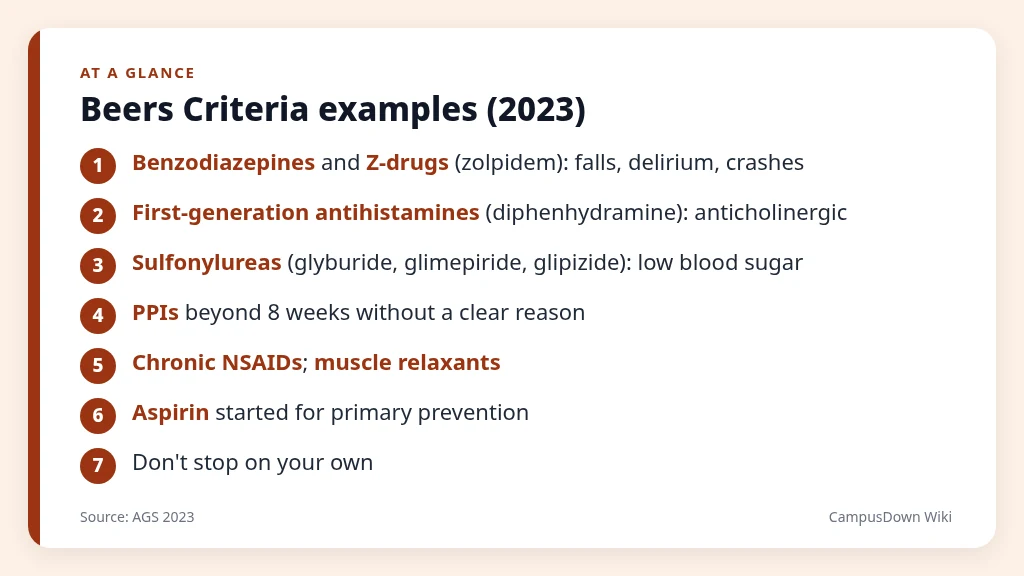
Examples flagged in the 2023 criteria
| Medicine or class | Why it's flagged (AGS) |
|---|---|
| Benzodiazepines (alprazolam, lorazepam, diazepam) | Higher risk of cognitive impairment, delirium, falls, fractures, crashes; dependence |
| Z-drugs (zolpidem, eszopiclone, zaleplon) | Similar risks: delirium, falls, fractures, ER visits |
| First-generation antihistamines (diphenhydramine, doxylamine, hydroxyzine) | Highly anticholinergic; confusion, dry mouth, constipation |
| Sulfonylureas (glyburide, glimepiride, glipizide) | Low blood sugar, cardiovascular risk; if used, prefer short-acting glipizide |
| PPIs (omeprazole, pantoprazole) beyond 8 weeks | C. diff, bone loss, fractures, unless a clear reason |
| Oral NSAIDs, chronic use (ibuprofen, naproxen) | GI bleeding, kidney injury |
| Muscle relaxants (cyclobenzaprine, methocarbamol) | Anticholinergic effects, sedation, fractures |
| Aspirin for primary prevention | Bleeding risk rises with age; still used for established heart disease |
| Warfarin as a first choice for AFib or clots | More major bleeding than DOACs |
| Sliding-scale insulin alone | Low blood sugar without better control |
This isn't the full list, so take a closer look with your pharmacist. See anticholinergic drugs and memory, alprazolam and omeprazole.
Get help now if
Some of these medicines can't be stopped suddenly. Benzodiazepines, for example, may cause withdrawal and need a gradual taper supervised by a clinician. Talk to your doctor or pharmacist before making any change.
Polypharmacy: why it matters
NIA cites a CDC report that 83% of U.S. adults in their 60s and 70s used at least one prescription drug in the past 30 days, and about one-third used five or more. More medicines mean more chances for side effects, interactions, falls and confusion. Check it for yourself: list every prescription, over-the-counter medicine and supplement, then share it with one pharmacist.
Deprescribing: reducing medicines safely
Deprescribing means planned, supervised reduction or stopping of medicines that may no longer help or may cause harm. NIA funds a research network on how to do it well. Ways to start:
- Bring every pill bottle to a visit; see brown bag medication review.
- Ask: "Is this still needed? Is there a safer alternative? What happens if we taper it?"
- For sleep, ask about non-drug options such as CBT-I.
- Change one medicine at a time and watch for symptoms.
Example scenario: twelve bottles in a shoebox
- Who
- Wendell, 79, a retired postal carrier in Dayton, Ohio, saw four doctors and kept 12 medicines in a shoebox. His daughter, Fenella, 50, noticed he'd become unsteady and fell twice in one winter.
- What happened
- The box included a nightly sleep aid with diphenhydramine, a long-acting sulfonylurea, an old muscle relaxant from a back strain, and omeprazole he'd taken for six years without knowing why.
- How it felt
- Fenella was scared he'd break a hip, and Wendell was annoyed, insisting each doctor knew what they were doing.
- What they did
- She booked a medication review with his pharmacist and primary care doctor, bringing the whole shoebox. They used the Beers Criteria as a starting point and made a plan to change one medicine at a time.
- How it turned out
- Over three months, the sleep aid and muscle relaxant were stopped, his diabetes medicine was switched, and the omeprazole was tapered with a check-in. He hasn't fallen since, and he jokes that the shoebox now holds his fishing lures.
This is an illustrative example, not a real patient or a review.
Wendell's story is an illustrative example. Every medicine change should be decided with your clinicians.
Most-asked questions about the Beers Criteria
What is on the Beers Criteria list?
Examples include benzodiazepines, Z-drug sleep medicines, first-generation antihistamines, sulfonylureas, long-term PPIs, chronic NSAIDs, muscle relaxants and aspirin started for primary prevention.
Why people ask: "beers criteria list" is #2 for "beers criteria" (US autocomplete, November 2026).
Where can I find the Beers Criteria medication list?
The full 2023 criteria are published by the American Geriatrics Society in the Journal of the American Geriatrics Society. Ask your pharmacist to review your list against it.
Why people ask: "beers criteria medication list" is #3 for "beers criteria" (US, November 2026).
Is there a 2026 Beers Criteria?
No. The current edition is the 2023 update. AGS added a companion alternatives list in 2025.
Why people ask: "beers criteria 2026" is #4 for "beers criteria" (US, November 2026).
What age does the Beers Criteria apply to?
Adults 65 and older, in all care settings except hospice and end-of-life care.
Why people ask: "beers criteria age" is #10 for "beers criteria" (US, November 2026).
What is polypharmacy in elderly patients?
Taking many medicines at once, often five or more. NIA notes about one-third of adults in their 60s and 70s take five or more prescription drugs.
Why people ask: "polypharmacy in elderly patients" is #2 for "polypharmacy in elderly" (US, November 2026).
Related on CampusDown
To take a closer look at bringing all your medicines to an appointment, read brown bag medication review.
Frequently asked questions
- Does being on the Beers list mean a drug is banned?
- No. It means the drug is potentially inappropriate for many older adults and deserves a careful look. Some people still need it.
- Can I stop a Beers list medicine myself?
- No. Some need tapering. Talk to your doctor or pharmacist first.
- Are over-the-counter medicines on the list?
- Yes. Examples include diphenhydramine and doxylamine sleep aids and NSAIDs like ibuprofen and naproxen.
The Beers Criteria is a tool for better conversations, not a list of forbidden drugs. Bring all your medicines, ask what each one is for, and work with your doctor and pharmacist to adjust safely.
Browse more guides like this in the Senior Health and Medicare hub.
This article is for general education and does not replace advice from your own doctor, nurse or pharmacist.