
Do you take a "PM" pain reliever or an allergy pill every night to sleep? Millions of older adults do. Many of these products contain diphenhydramine or doxylamine, medicines with strong anticholinergic effects that geriatric experts recommend older adults avoid. Here's what the research shows, and what to do about it safely.

This guide uses the 2023 American Geriatrics Society (AGS) Beers Criteria and two large studies in JAMA Internal Medicine. It explains in detail what they found. Talk to your doctor or pharmacist before changing any medicine.
What "anticholinergic" means
Anticholinergic drugs block acetylcholine, a chemical messenger the brain uses for memory and attention and the body uses for functions like bladder control, digestion and saliva. That's why these drugs can cause confusion, dry mouth, constipation, blurred vision and trouble urinating.

Common examples
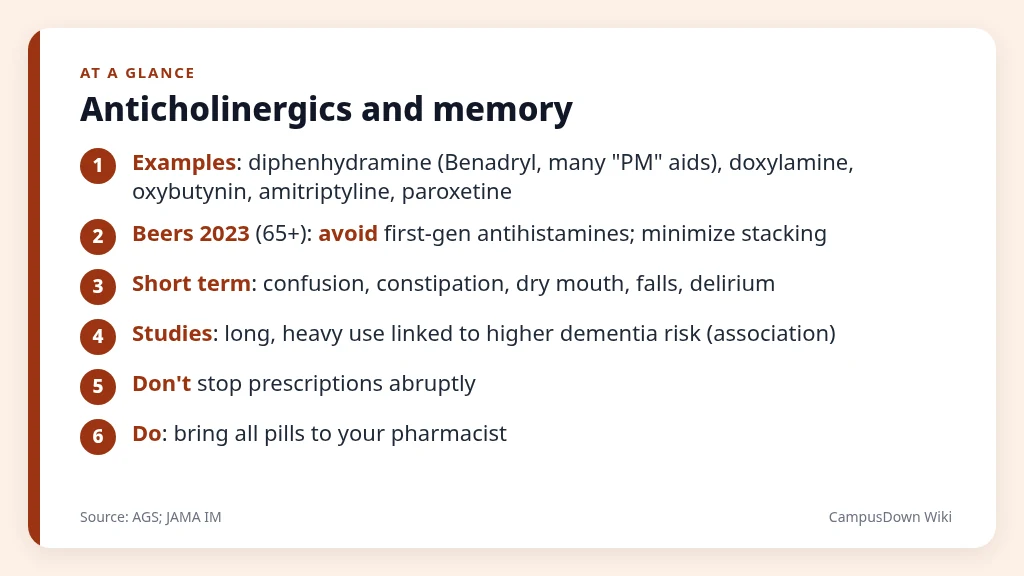
The Beers Criteria list drugs with strong anticholinergic properties, including:
- First-generation antihistamines: diphenhydramine (the ingredient in Benadryl and in many "PM" or nighttime products), doxylamine, chlorpheniramine, hydroxyzine, meclizine, promethazine
- Bladder antimuscarinics for overactive bladder: oxybutynin, tolterodine, darifenacin, fesoterodine, solifenacin, trospium
- Certain antidepressants: amitriptyline, nortriptyline, imipramine, doxepin above 6 mg a day, paroxetine
- Certain anti-nausea drugs: prochlorperazine, promethazine
AGS notes this isn't a complete list, so check it for yourself on every label's "active ingredients," since the same drug may appear in sleep, cold and allergy products.
What the 2023 Beers Criteria say
For adults 65 and older, AGS recommends avoiding first-generation antihistamines (strong recommendation). The reasons: they're highly anticholinergic, the body clears them more slowly with age, tolerance develops when they're used for sleep, and they risk confusion, dry mouth and constipation. AGS adds that cumulative anticholinergic exposure is associated with falls, delirium and dementia. Diphenhydramine may still be appropriate for acute treatment of a severe allergic reaction.
AGS also advises avoiding taking more than one anticholinergic drug, since combining them raises the risk of cognitive decline, delirium, falls and fractures. Learn more in polypharmacy and the Beers Criteria.
What the dementia studies found
Gray and colleagues (2015) followed 3,434 adults 65+ without dementia in Seattle for an average of 7.3 years. The most common anticholinergics were tricyclic antidepressants, first-generation antihistamines and bladder antimuscarinics. Risk rose with cumulative dose; the highest use group, roughly equal to more than three years of daily use, had a 54% higher risk of dementia than nonusers.
Coupland and colleagues (2019) compared 58,769 people with dementia with 225,574 matched controls aged 55+ in England. The highest cumulative exposure was linked to 49% higher odds of dementia. Significant links were found for antidepressants, bladder antimuscarinics, antipsychotics, antiparkinson drugs and antiepileptics.
Both are observational studies: they show associations, not proof that the drugs cause dementia. Still, both research teams urged reducing anticholinergic exposure in middle-aged and older people.
Get help now if
Don't stop prescription medicines abruptly, especially antidepressants, antipsychotics, antiparkinson drugs or seizure medicines. Some can cause withdrawal or relapse. Make changes only with your prescriber. For a severe allergic reaction, follow your emergency plan and call 911.
Safer steps
- Do a brown bag review: bring every pill, including OTC and supplements, to your pharmacist. See brown bag medication reviews.
- For sleep, ask about non-drug approaches such as CBT-I.
- For allergies, ask whether a less sedating antihistamine is right for you.
- For bladder symptoms, ask about alternatives; see nighttime overactive bladder.
- Ask: "What's my total anticholinergic burden?" Clinicians use scoring tools to add up exposure across medicines.
Example scenario: the nightly PM pill
- Who
- Tamsin, 66, a retired insurance adjuster in Tulsa, took a "PM" pain reliever every night for ten years, plus oxybutynin for her bladder.
- What happened
- Lately she'd been losing her train of thought, misplacing her keys and feeling foggy until noon. She'd also started getting constipated.
- How it felt
- She was frightened she was getting Alzheimer's like her mother and was too embarrassed to mention the sleep pills, which felt like "nothing."
- What they did
- At a brown bag review, her pharmacist flagged both medicines as strongly anticholinergic and explained the Beers Criteria. With her doctor, she tapered off the nightly PM product and started CBT-I, and her doctor reviewed bladder treatment options.
- How it turned out
- A few months later, Tamsin said her mornings felt clearer, though sleep took work. Her doctor still planned a memory check to be thorough. She said she wished someone had asked her about OTC pills years earlier.
This is an illustrative example, not a real patient or a review.
Tamsin is an illustrative example. Talk to your doctor or pharmacist about your own medicines.
Most-asked questions about anticholinergic drugs
Do anticholinergic drugs increase dementia risk?
Large studies link heavy, long-term use with higher dementia risk, but they show associations, not proof of cause.
Why people ask: "anticholinergic drugs dementia risk" is #2 for "anticholinergic drugs dementia" (US autocomplete, November 2026).
Which anticholinergic drugs are on the list?
Beers Criteria examples include diphenhydramine, doxylamine, hydroxyzine, oxybutynin, tolterodine, amitriptyline and paroxetine. The list isn't complete.
Why people ask: "anticholinergic drugs dementia list" is #3 for "anticholinergic drugs dementia" (US, November 2026).
Do anticholinergic drugs cause dementia?
It's not proven. Observational studies show links that grow with cumulative dose, so experts recommend minimizing use, especially in older adults.
Why people ask: "do anticholinergic drugs cause dementia" is #9 for "anticholinergic drugs dementia" (US, November 2026).
Does Benadryl raise dementia risk?
Diphenhydramine is a strong anticholinergic. The Beers Criteria advise adults 65+ to avoid it except for situations like acute severe allergic reactions, citing confusion and links to dementia.
Why people ask: "benadryl dementia risk" is #2 for "benadryl dementia" (US, November 2026).
What is an anticholinergic burden scale?
A scoring tool clinicians use to add up the anticholinergic effects of all your medicines. Ask your pharmacist to review yours.
Why people ask: "anticholinergic burden scale" is #2 for "anticholinergic burden" (US, November 2026).
Related on CampusDown
To take a closer look at memory, read dementia.
Frequently asked questions
- Is Tylenol PM safe for older adults?
- Many "PM" pain relievers contain diphenhydramine, which the Beers Criteria advise adults 65+ to avoid. Ask your pharmacist about alternatives.
- Will memory improve if I stop an anticholinergic?
- Short-term confusion from these drugs may improve, but whether stopping lowers long-term dementia risk isn't proven. Change medicines only with your doctor.
- Is melatonin anticholinergic?
- Melatonin isn't on the Beers anticholinergic list. Ask your doctor whether any sleep aid is right for you.
Anticholinergic medicines are common, often hidden in OTC sleep and allergy products, and best minimized in older adults. Read labels, bring all your pills to a pharmacist, and talk to your doctor before stopping anything.
Browse more guides like this in the Senior Health and Medicare hub.
This article is for general education and does not replace advice from your own doctor, nurse or pharmacist.
References
- American Geriatrics Society 2023 updated AGS Beers Criteria for potentially inappropriate medication use in older adults, PMC
- Gray SL, et al. Cumulative use of strong anticholinergics and incident dementia. JAMA Intern Med. 2015 (PubMed)
- Coupland CAC, et al. Anticholinergic drug exposure and the risk of dementia. JAMA Intern Med. 2019 (PubMed)