
Have you tried every tea, app and pillow, and still lie awake at 3 a.m. doing math about how many hours are left until the alarm? If that has gone on for months, you may have chronic insomnia. The treatment doctors recommend first is not a pill. It is a short, structured program called CBT-I.

This guide uses the American College of Physicians (ACP) guideline, the National Heart, Lung, and Blood Institute (NHLBI), the National Institute on Aging (NIA), the U.S. Department of Veterans Affairs (VA) and the FDA, checked in November 2026. It is general information, not a treatment plan.
When trouble sleeping becomes insomnia
The NIA describes insomnia as trouble falling asleep or staying asleep at least three nights a week. Short-term insomnia often follows stress or a change in routine. Chronic insomnia lasts more than three months and is not fully explained by another medical cause. The NIA calls insomnia the most common sleep problem in adults 60 and older; see sleep changes with age.

Why CBT-I comes first
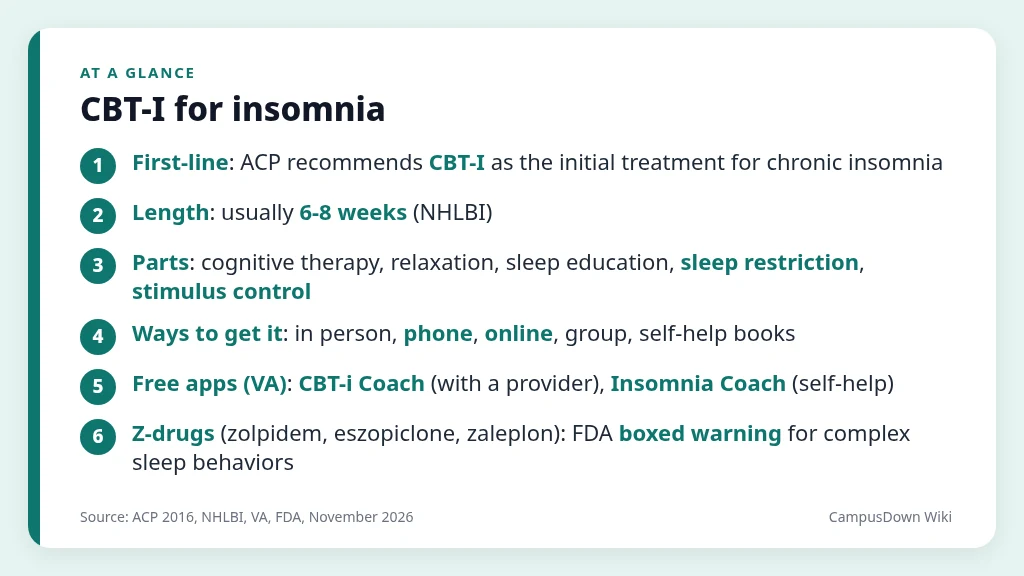
In 2016, the American College of Physicians recommended that CBT-I be the initial treatment for all adults with chronic insomnia disorder. ACP said CBT-I can start in primary care, and that while there was not enough evidence to compare it directly with drugs, CBT-I is likely to have fewer harms. If CBT-I alone is not enough, ACP advises doctors and patients to decide together whether to add medication, weighing benefits, harms and costs.
NHLBI says CBT-I is "usually recommended as the first treatment option for long-term insomnia and can be very effective."
What CBT-I actually involves
NHLBI describes CBT-I as a 6- to 8-week plan with five parts:
- Cognitive therapy: working on the worry and beliefs that keep you awake ("If I don't sleep eight hours, tomorrow is ruined").
2. Relaxation or meditation: techniques to calm your body and mind before bed. 3. Sleep education: learning habits that support sleep. 4. Sleep restriction: setting a specific amount of time in bed, even if you cannot sleep during all of it. As sleep improves, time in bed is increased. 5. Stimulus control: going to bed only when sleepy, getting out of bed if you cannot sleep, and using the bed only for sleep and sex, so your brain links bed with sleep again.
Most programs start with a sleep diary. The NIA suggests tracking for a couple of weeks when you go to bed, when you wake in the night, when you get up, and whether you had caffeine, alcohol or exercise.
Key point
Sleep restriction can make you sleepier during the first weeks. Do it with guidance, and be careful with driving or machinery if you feel drowsy. If you have a health condition that sleep loss can worsen, ask your clinician before starting.
How to get CBT-I
NHLBI says CBT-I can be done by a doctor, nurse or therapist, in person, by telephone or online. ACP adds group sessions and self-help books. Practical routes:
- Ask your primary care doctor for a referral to a behavioral sleep medicine provider or a psychologist trained in CBT-I.
- Ask whether your insurer covers telehealth CBT-I.
- Look at the VA's free apps:
- CBT-i Coach: designed to be used with a provider as part of CBT-I. The VA says it is not meant for self-care alone. - Insomnia Coach: a separate VA app for people managing sleep problems on their own.
Compare the options in detail with your doctor; a trained clinician can adjust the plan if you get stuck.
Example scenario: the 3 a.m. spreadsheet
- Who
- Yolanda, 47, a hospital scheduling manager in Houston, had slept badly since a stressful year of night calls. Two years later she was still lying awake most nights.
- What happened
- She had tried melatonin, a white-noise machine and an over-the-counter sleep aid that left her groggy. She spent nights checking the clock and mornings dreading the day. Her doctor suggested CBT-I, and her first thought was, "I don't need therapy, I need sleep."
- How it felt
- She felt exhausted, irritable with her kids, and a little ashamed that she could not do something "everyone does." The idea of spending less time in bed sounded backwards and frightening.
- What they did
- She started a telehealth CBT-I program with a psychologist and used a paper sleep diary. They set a fixed wake time, a shorter time in bed to begin, and a rule to get up and read in dim light when she could not sleep. She worked on her "tomorrow is ruined" thoughts.
- How it turned out
- The first two weeks were rough, and she leaned on afternoon walks instead of naps. By week six she was falling asleep faster and waking less, and her time in bed was being stretched back out. She still has bad nights, but she says they no longer scare her.
This is an illustrative example, not a real patient or a review.
Yolanda is an illustrative example, not a real patient. CBT-I should be guided by a trained clinician.
What about sleeping pills?
NHLBI says some prescription insomnia medicines are meant for short-term use and others for longer-term use, and that you should talk with your doctor about benefits and side effects. The NIA says sleep medicines may help in the short term but carry risks and should not be used long term.
The FDA singles out the "Z-drugs": eszopiclone (Lunesta), zaleplon (Sonata) and zolpidem (Ambien, Ambien CR, Edluar, Zolpimist). In 2019, it required a boxed warning about complex sleep behaviors, such as sleepwalking, sleep driving and sleep cooking, which have led to serious injuries and deaths. These can happen after the first dose and at lower doses. If one happens, the FDA says to stop the drug and contact your health care professional right away.
Doctors sometimes prescribe medicines approved for other conditions, such as trazodone, for sleep; NHLBI notes these are not FDA-approved for insomnia. Over-the-counter "PM" products often contain diphenhydramine, which deserves extra caution in older adults. Ask a pharmacist before combining any sleep aid with other medicines, and see our melatonin page if you are considering a supplement.
Get help now if
If you snore loudly, stop breathing in your sleep, or feel very sleepy during the day despite enough time in bed, ask about sleep apnea. Insomnia and sleep apnea can occur together, and CPAP problems like dry mouth can also break up sleep. Seek help right away if insomnia comes with thoughts of self-harm.
Most-asked questions about insomnia treatment
What are the main insomnia treatment options?
CBT-I is the recommended first treatment for chronic insomnia. Better sleep habits help, and medicines may be added short term after discussing benefits and risks with your doctor.
Why people ask: "insomnia treatment options" is #2 for "insomnia treatment" (US autocomplete, November 2026).
Is there a free CBT-I app?
The VA offers two free apps: CBT-i Coach, designed for use with a provider, and Insomnia Coach, for self-help.
Why people ask: "cbt-i coach app" is #7 and "cbt-i app" is #5 for "cbt-i" (US, November 2026).
Can I do CBT for insomnia online for free?
CBT-I can be delivered online or by phone, according to NHLBI. Free options include the VA's apps; ask your doctor or insurer about covered online programs.
Why people ask: "cbt for insomnia online free" is the #2 Google suggestion for "cbt for insomnia" (US, November 2026).
What is the best insomnia treatment for older adults?
CBT-I is recommended for adults of all ages, and the NIA notes sleep medicines carry risks for older adults and should not be used long term. Talk with your doctor about medicines that may be disturbing sleep.
Why people ask: "insomnia treatment for elderly" is #6 for "insomnia treatment" (US, November 2026).
If you want to learn more about your own sleep pattern, start a two-week sleep diary before your next appointment.
Related on CampusDown
Read our overview of insomnia, see how sleep shifts with age in sleep changes with age, and learn about trazodone if it has been suggested to you.
Frequently asked questions
- How long does CBT-I take?
- NHLBI describes it as a 6- to 8-week plan.
- Does CBT-I work if I have had insomnia for years?
- It is recommended for chronic insomnia, including long-standing cases. Results vary; a trained clinician can tailor it.
- Can I keep taking my sleeping pill during CBT-I?
- Do not stop or change a prescription on your own. Ask your prescriber whether and how to adjust it.
- Is sleep restriction safe?
- It is a standard part of CBT-I but can cause daytime sleepiness at first. Do it with guidance, especially if you drive.
CBT-I takes a few weeks of effort, but it targets the habits and worries that keep insomnia going. Talk to your doctor about a referral, and take a closer look at your sleep diary together.
Browse more guides like this in the U.S. Health Topics hub.
This article is for general education and does not replace advice from your own doctor, nurse or pharmacist.