
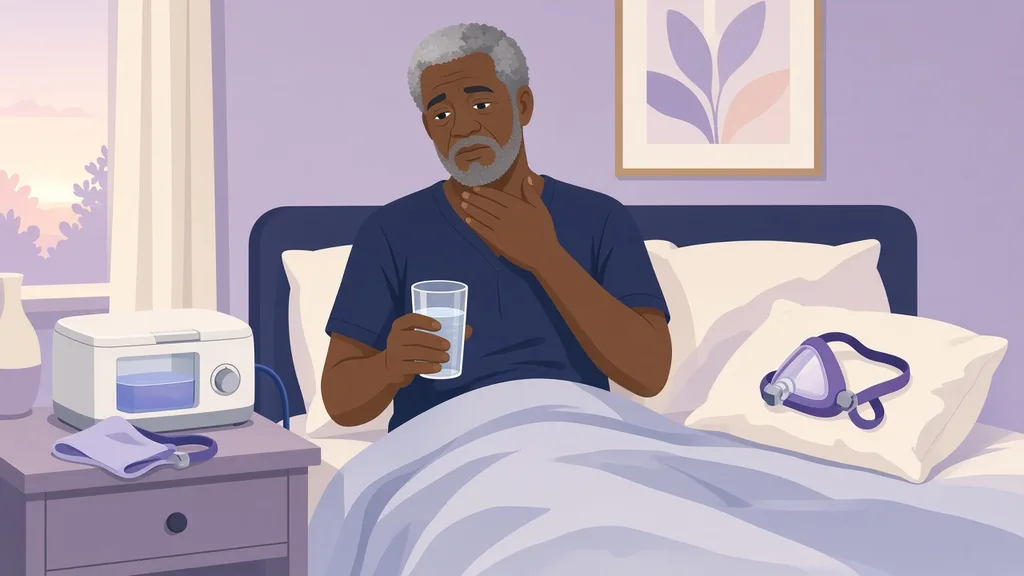
Do you wake up at 3 a.m. with your tongue stuck to the roof of your mouth, reach for water, and wonder whether CPAP is worth it? Dry mouth is one of the most common CPAP complaints. It is also one of the most fixable, once you know which of two problems you have.
This guide uses ResMed's AirSense 11 user guide and website, the National Institute of Dental and Craniofacial Research (NIDCR) and Medicare's PAP policy, checked in November 2026. It is general information; your sleep doctor and equipment supplier should guide changes.
Two reasons CPAP dries your mouth
1. Air escaping through your mouth. If you use a nasal or nasal pillows mask and your mouth falls open during sleep, pressurized air flows in through your nose and out through your mouth. That stream dries the mouth fast, and it also means your therapy is leaking.
2. Air that is too dry. Even with a closed mouth, room air (especially in winter or in dry climates) can dry the nose and throat. ResMed lists drying of the nose, mouth or throat among the known side effects of its PAP machines.
Many people have both. The fixes below start with the simplest.

Step 1: adjust humidity
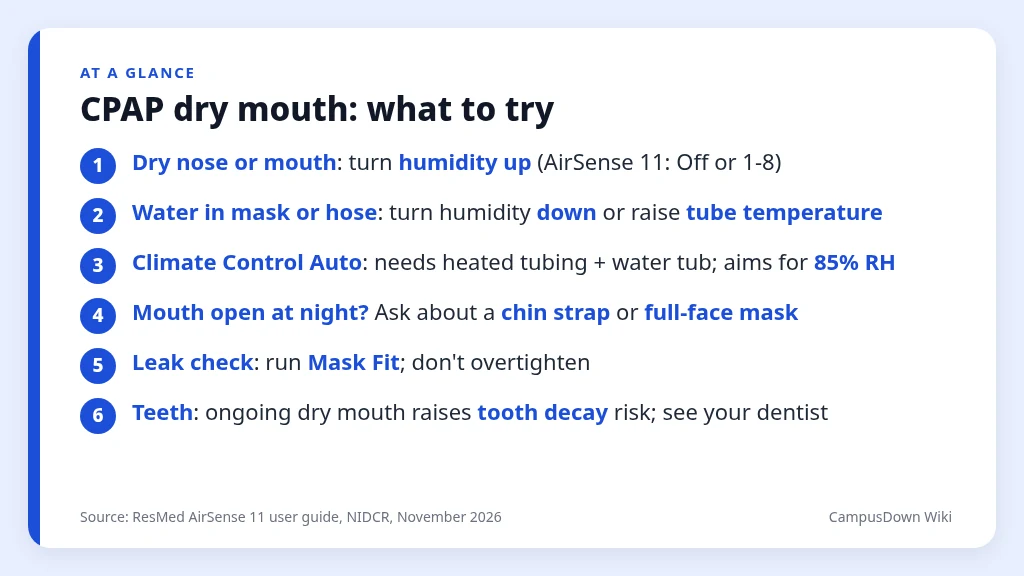
On a ResMed AirSense 11, go to MY OPTIONS > Humidity Level. You can choose Off or 1 to 8, where 1 is the lowest. ResMed's rule:
- Dry nose or mouth? Turn the humidity up.
- Moisture in the mask? Turn the humidity down.
Change one step at a time and give each setting a few nights. Other brands have similar controls; check your manual.
Step 2: heated tubing and Climate Control
Warm, humid air cools as it travels through a plain hose, and water can condense inside (called rainout). Heated tubing helps.
On the AirSense 11, ClimateLineAir 11 heated tubing plus the HumidAir 11 tub turns on Climate Control. In Auto, ResMed says it aims for a steady 85% relative humidity and sets the tube temperature to 80°F (27°C). If you still get rainout, ResMed says first try raising the tube temperature; if the air feels too warm, then lower the humidity.
If you keep waking dry even with a humidifier, ask your supplier whether you have heated tubing and whether Climate Control is on Auto.
Step 3: find and fix the leak
- Check your seal. Run the Mask Fit test on your machine, and look at the mask seal score in your app.
- Do not overtighten. A cushion squeezed too hard can fold and leak.
- Try a different size cushion before a different style.
- Consider a full-face mask. ResMed points mouth breathers and people with stuffy noses toward full-face masks such as the AirFit F20, F30i or F40. Our CPAP mask types guide compares them in detail.
- Ask about a chin strap. A soft strap that supports the jaw can help some nasal-mask users keep their mouth closed. Medicare's PAP policy covers a chin strap (A7036) as an accessory, usually up to 1 every 6 months, when the device itself is covered.
Key point
Mouth tape is popular online, but it is not part of ResMed's instructions or Medicare's covered accessories. Ask your sleep doctor before taping your mouth, especially if your nose is often blocked.
Example scenario: the sandpaper mornings
- Who
- Desmond, 64, a retired postal carrier in Baltimore, started CPAP with a nasal mask after a sleep study showed severe sleep apnea. He felt more alert within weeks.
- What happened
- But nearly every night he woke around 3 a.m. with a painfully dry mouth and sore throat. He started keeping a full water glass by the bed, then getting up to use the bathroom, and some nights he just pulled the mask off.
- How it felt
- He felt torn. He liked having energy again, but the dry mouth made him dread bedtime, and he worried his wife was right that he was "giving up on it." His dentist also mentioned a new cavity at his checkup.
- What they did
- He brought a week of app data to his supplier. It showed high leak. They raised his humidity two steps, added heated tubing, and fitted him with a chin strap; when that was not enough, his sleep doctor approved a switch to a full-face mask. He also asked his doctor whether any of his medicines dry the mouth.
- How it turned out
- The 3 a.m. water glass disappeared within two weeks. His dentist suggested a fluoride toothpaste and closer checkups, and his doctor adjusted one blood pressure pill. He says he wishes he had called after the first week instead of the fourth.
This is an illustrative example, not a real patient or a review.
Desmond is an illustrative example, not a real patient. Changes to masks or medicines should come from your care team.
Step 4: look beyond the machine
NIDCR says dry mouth is not a normal part of aging, and hundreds of medicines can reduce saliva, including some for high blood pressure, depression and bladder control. Conditions such as Sjögren's disease and diabetes can also cause it. If your mouth is dry during the day too, CPAP may not be the only cause. Bring your medicine list to your doctor or pharmacist, and see dry mouth from medications and anticholinergic medicines.
Do not stop or change a prescription on your own to fix dry mouth.
Protect your teeth
Saliva washes away food and contains minerals that help keep teeth strong. NIDCR warns that ongoing dry mouth increases the risk of tooth decay and fungal infections. Its self-care tips include sipping water, chewing sugarless gum or sucking sugarless candy, limiting caffeine, and avoiding tobacco and alcohol. Tell your dentist you use CPAP and wake with a dry mouth.
Get help now if
See your doctor if you have nosebleeds, sinus pain, sores in your mouth, trouble swallowing, or dry mouth that lasts all day. These can have causes unrelated to CPAP.
Most-asked questions about CPAP dry mouth
What is the best fix for CPAP dry mouth?
Start by raising humidity and checking for mouth leaks. If air escapes through your mouth on a nasal mask, ask about a chin strap or a full-face mask. Heated tubing helps keep humid air from cooling in the hose.
Why people ask: "cpap dry mouth solutions" is the #2 Google suggestion for "cpap dry mouth" (US autocomplete, November 2026).
What humidity level should I use for dry mouth?
There is no single right number. ResMed's AirSense 11 offers Off or 1 to 8; turn it up one step at a time if you are dry, and down if water collects in the mask.
Why people ask: "cpap dry mouth humidity level" is #5 for "cpap dry mouth," and "cpap humidity level" is #1 for "cpap humidity" (US, November 2026).
Why do I still get dry mouth with a humidifier?
Usually because air is escaping through your mouth, which humidity alone cannot fix. Mask fit, a chin strap or a full-face mask may help. Medicines can also be a cause.
Why people ask: "cpap dry mouth even with humidifier" is #8 for "cpap dry mouth" (US, November 2026).
Can CPAP dry mouth cause tooth decay?
Ongoing dry mouth from any cause raises the risk of tooth decay, according to NIDCR. Tell your dentist, and work with your care team to fix the dryness.
Why people ask: "cpap dry mouth tooth decay" is #3 for "cpap dry mouth" (US, November 2026).
To learn more about what your machine sees, take a closer look at the leak and usage numbers in your app for a full week before your next appointment.
Related on CampusDown
Keep humid parts clean with our CPAP cleaning guide, learn the comfort menu on the ResMed AirSense 11, and review the basics of obstructive sleep apnea.
Frequently asked questions
- Should I turn the humidifier all the way up?
- Not right away. Raise it one step at a time; too much humidity can cause water in the hose and mask.
- Does a full-face mask stop dry mouth?
- It can stop leak through the mouth, which is a common cause. Some people still need more humidity.
- Is a chin strap covered?
- Medicare's PAP policy covers a chin strap as an accessory when the device is covered, usually 1 every 6 months.
- Is it normal to have a dry nose too?
- ResMed lists dryness of the nose, mouth or throat as possible side effects. Humidity changes often help; tell your doctor if it persists.
CPAP dry mouth is usually a leak problem, a humidity problem or both, and each has fixes. Talk to your doctor or supplier early, and do not let a dry mouth quietly end your therapy.
Browse more guides like this in the Home Medical Devices hub.
This article is for general education and does not replace advice from your own doctor, nurse or pharmacist.