
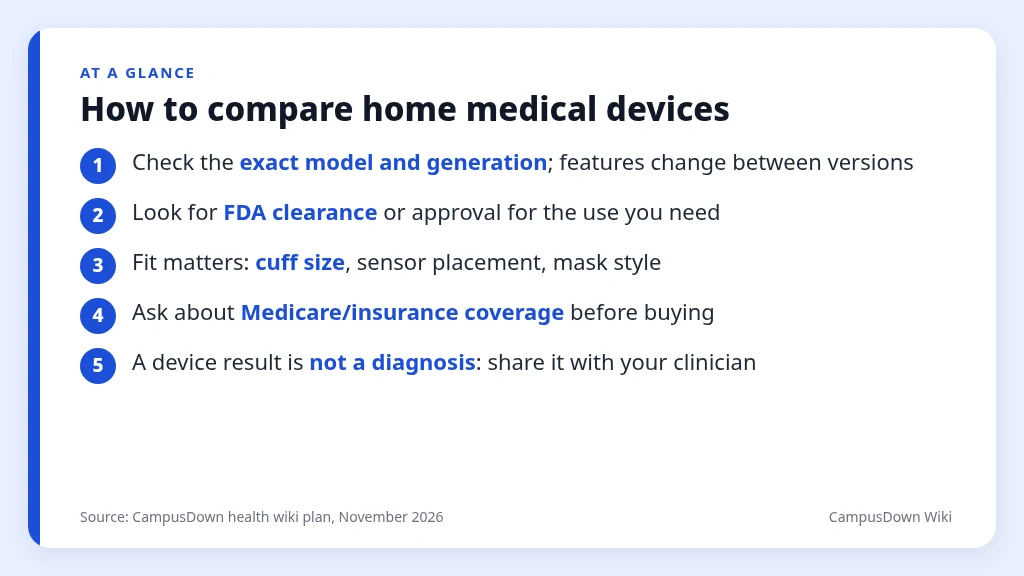
Standing in a pharmacy aisle looking at six blood pressure monitors that all claim to be "clinically validated"? You are not alone. Home medical devices have become more powerful and more confusing at the same time, and the model number often decides what a device can actually do. This hub collects CampusDown's 100 device guides, grouped by type. Each guide names exact models and generations, quotes what the manufacturer and FDA say, and notes Medicare coverage where it applies. If you are about to buy, take a closer look at the "how to compare" card below.
How to use this hub
- Find the device type, then the model or comparison closest to what you own or are considering.
- Guides list what each device detects, what it cannot do, and how to get a reliable reading.
- Prices and coverage change; each guide says when it was checked, so check it for yourself before buying.
- Titles shown as plain text are coming soon and switch on automatically.

Blood sugar and diabetes
- Contour Next One Glucose Meter: Accuracy, Strips and App
- Dexcom G7 CGM: How the Sensor Works, Alerts and Wear Time
- Dexcom Stelo: The Over-the-Counter CGM for Adults Not on Insulin
- FreeStyle Libre 3 Plus: 15-Day Sensor, Readings and Insurance Basics
- Abbott Lingo: An Over-the-Counter Glucose Biosensor for Wellness
- Accu-Chek Guide Me Glucose Meter: Features and Test Strip Tips
- Beta Bionics iLet Bionic Pancreas: Weight-Based Insulin Dosing System
- CGM Coverage Under Medicare: Who Qualifies
- CGM Sensor Fell Off or Is Inaccurate: Overpatches, Warm-Up and Replacement
- Dexcom G7 vs FreeStyle Libre 3 Plus: Comparing Two Prescription CGMs
- Dexcom Stelo vs Abbott Lingo: Two OTC Glucose Sensors Compared
- Eversense 365: The Implantable CGM That Lasts a Year
- Fingerstick Meter vs CGM: When Each Is Used
- FreeStyle Libre 2 Plus: Sensor Wear, Alarms and Reader Options
- How to Check Blood Sugar With a Fingerstick Meter Step by Step
- InPen Smart Insulin Pen: Dose Logging and Reminders
- Insulin Pump vs Multiple Daily Injections: Questions to Discuss
- Medtronic MiniMed 780G: Automated Insulin Delivery Explained
- Omnipod 5 Automated Insulin Delivery System: How the Tubeless Pod Works
- OneTouch Verio Reflect: Color Range Indicator Glucose Meter
- ReliOn Premier Glucose Meters: Low-Cost Strips at Walmart
- Tandem Mobi: A Small Tubed Pump Controlled From a Phone
- Tandem t:slim X2 With Control-IQ: Tubed Insulin Pump Basics
Lungs and breathing
- AeroChamber Plus Flow-Vu Spacer: How to Use an Inhaler Spacer
- Home Oxygen Fire Safety: Smoking, Candles and Distance Rules
- Inogen One G5 Portable Oxygen Concentrator: Battery, Settings and Travel
- Inogen Rove 6 Portable Oxygen Concentrator: Features and Use
- Masimo MightySat Fingertip Pulse Oximeter: Features and Limits
- Nebulizer vs Inhaler With Spacer: Which Delivery Works When
- Nonin Onyx Vantage 9590 Pulse Oximeter: A Clinical-Grade Fingertip Model
- Oxygen Concentrator vs Oxygen Tank: Pulse Dose, Continuous Flow and Safety
- PARI Trek S Portable Compressor Nebulizer
- Peak Flow Meter: Personal Best and the Asthma Zone Plan
- Philips InnoSpire Essence Compressor Nebulizer: Setup and Cleaning
- Pulse Oximeter Accuracy and Skin Pigmentation: What the FDA Has Said
- Pulse Oximeter Readings: Normal SpO2 and When a Number Needs a Call
- Pulse Oximeters for Children: Probe Fit and Reading Limits
Example scenario: the monitor that did not fit
- Who
- Wes, 74, a retired union electrician in Wisconsin, bought the cheapest wrist blood pressure monitor on the shelf after his doctor asked for home readings.
- What happened
- His readings jumped all over the place, and his doctor could not use them. Wes felt he had wasted money and was "bad at technology."
- How it felt
- He was frustrated and a bit embarrassed to bring the log back a second time.
- What they did
- His granddaughter used the device guides to compare upper-arm monitors and cuff sizes, measured his arm, and they picked a validated upper-arm model with the right cuff.
- How it turned out
- His next two weeks of readings were steady enough for his doctor to adjust his medicine. Wes now keeps the cuff by his reading chair and says the fit made all the difference.
This is an illustrative example, not a real patient or a review.
Wes is an illustrative example, not a real person or a product review. Ask your clinician which device fits your needs.
Blood pressure
- Blood Pressure Cuff Size: Measuring Your Arm So Readings Are Accurate
- How to Take Blood Pressure at Home: 7 Steps Doctors Ask You to Follow
- Omron Platinum BP5450 Upper Arm Blood Pressure Monitor: Features and Correct Use
- Blood Pressure Monitor Error Messages: Movement, Cuff Fit and Irregular Heartbeat Symbols
- Omron Complete BP7900: Blood Pressure Monitor With EKG
- Omron Gold Wrist Monitor BP4350: When a Wrist Cuff Makes Sense
- Omron MicroAir U100: Portable Mesh Nebulizer
- Omron Pocket Pain Pro TENS Unit: Modes and Safe Pad Placement
- Omron Silver BP5250: A Basic Upper Arm Monitor for Daily Readings
- Validated Blood Pressure Monitors: Using the US ValidateBP List Before You Buy
- Withings BPM Connect: Wi-Fi Blood Pressure Monitor and App Tracking
- iHealth Track Blood Pressure Monitor: Setup and App Pairing
Falls and mobility
- Apple Watch Fall Detection: How It Calls for Help
- Cane Height and How to Use a Cane on the Correct Side
- Drive Medical Nitro Rollator: Fit, Brakes and Folding
- Grab Bars: Placement Heights and Why Suction Bars Are Risky
- Knee Scooter vs Crutches After Foot or Ankle Surgery
- Lift Chair Recliners: Who They Help and Medicare's Motor Coverage
- Medical Alert Systems: In-Home vs Mobile and Monitoring Costs
- Shower Chair vs Tub Transfer Bench: Bathroom Safety Choices
- Stair Lifts: Straight vs Curved Rails and Safety Features
- Walker vs Rollator: Which Mobility Aid Fits Which Need
Sleep and CPAP
- CPAP Dry Mouth and Mask Leaks: Humidity, Chin Straps and Fit
- CPAP Mask Types: Nasal Pillows, Nasal and Full Face (ResMed AirFit Examples)
- CPAP vs BiPAP: Pressure Settings and Who Needs Which
- How to Clean a CPAP Machine, Tubing and Mask Safely
- Inspire Upper Airway Stimulation: Sleep Apnea Implant for CPAP-Intolerant Patients
- Philips DreamStation Recall: What CPAP Users Needed to Know
- ResMed AirMini: Travel CPAP Size, Masks and Airplane Use
- ResMed AirSense 11 CPAP: Setup, AutoRamp and the myAir App
Hearing
- AirPods Pro 2 Hearing Aid Feature: Hearing Test and Setup
- Eargo In-Canal OTC Hearing Aids: Who They Fit
- Hearing Aid Batteries vs Rechargeable Models: Daily Practicalities
- Jabra Enhance Select: Remote Care OTC Hearing Aids
- Lexie B2 Plus Powered by Bose: OTC Hearing Aid Features
- OTC vs Prescription Hearing Aids: Who Qualifies Under the FDA Rule
- Sony CRE-E10 OTC Hearing Aid: Self-Fitting Earbud Style
Heart, rhythm and blood thinners
- Apple Watch ECG and Irregular Rhythm Notifications: What They Can Detect
- KardiaMobile 6L: Personal EKG and AFib Detection
- Home AEDs: Philips HeartStart OnSite and When a Defibrillator Is Used
- Samsung Galaxy Watch ECG and Irregular Heart Rhythm Notification
- Withings ScanWatch 2: ECG, SpO2 and Hybrid Watch Features
Pain, joints and bones
- Electric Heating Pads: Auto Shut-Off and Burn Prevention
- Ostomy Pouching Systems: One-Piece vs Two-Piece Basics
- Percussion Massage Guns: Where Not to Use Them
- TENS Unit Pad Placement: Where Not to Put Electrodes
- TENS vs EMS Devices: Pain Relief vs Muscle Stimulation
Home safety
- Braun ThermoScan 7 Ear Thermometer: Age Precision and Technique
- Compression Socks: 15-20 vs 20-30 mmHg and Who Should Avoid Them
- Exergen Temporal Artery Thermometer: How to Scan Correctly
- Thermometer Types: Oral, Ear, Forehead and Rectal Accuracy by Age
More topics
- Epinephrine Auto-Injectors and Neffy Nasal Spray: Carrying and Using Them
- NeilMed Sinus Rinse: Using Distilled Water Safely for Nasal Irrigation
- Hero Automatic Pill Dispenser: Reminders and Caregiver Alerts
- Weekly Pill Organizers: Setting Up AM/PM Boxes Without Mistakes
- Red Light Therapy Devices: FDA Clearance and What Evidence Supports
- Smart Scales and Body Fat Readings: Bioimpedance Limits
- Medela Pump in Style With MaxFlow: Features and Use
- Spectra S1 Breast Pump: Insurance Coverage and Flange Fit
- Upper Arm vs Wrist Blood Pressure Monitors: Accuracy and Who Each Suits
- Home Hospital Beds: Semi-Electric vs Full-Electric and Medicare Coverage
- How to Check an FDA Medical Device Recall or Safety Communication
- Home Urinary Catheter Care: Foley Bag Position and Infection Signs
Other CampusDown health hubs
Get help now if
A home device is not an emergency tool. Call 911 for chest pain, severe shortness of breath, fainting or stroke signs, whatever your device says.
How these guides are written
We use manufacturer instructions, FDA databases and Medicare.gov, and we never fake product photos. Each device guide explains limits as clearly as features, so you can learn more about what a number means before you act on it.
Frequently asked questions
- Do you sell these devices?
- No. CampusDown does not sell devices; guides explain features and limits from public sources.
- Does Medicare cover home devices?
- Some, as durable medical equipment with a prescription; each guide notes coverage where it applies.
- Are watch and phone health features medical devices?
- Some features are FDA-cleared for specific uses; guides explain which and their limits.
- Why do you list model generations?
- Features, accuracy claims and coverage often change between versions.
Pick the device that fits your diagnosis, your body and your routine, and bring its readings to your clinician. You can learn more in detail from the guides above, and ask your doctor or pharmacist before relying on any device.
This article is for general education and does not replace advice from your own doctor, nurse or pharmacist.