
Have you ever been halfway through a conversation when your hearing aid started beeping, and realized the spare batteries were in another purse? Or plugged in your rechargeable aids at night, only to find in the morning that one was still dead? Both kinds of hearing aid power have their own daily habits.
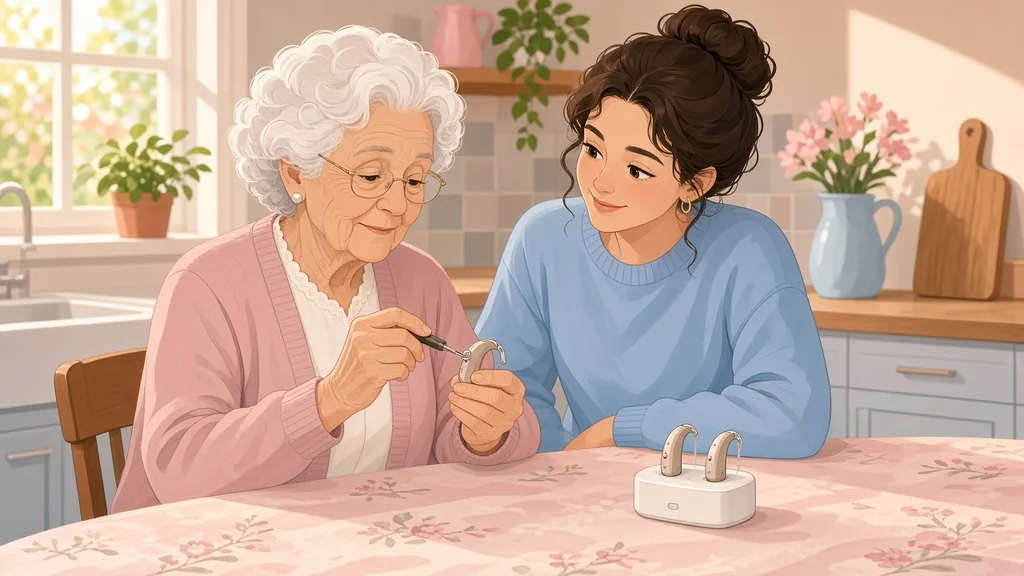
This guide compares disposable zinc-air batteries with rechargeable hearing aids. It uses battery guides from hearing aid makers Widex and Beltone, user information from Sony, Lexie and Jabra Enhance, and safety guidance from the FDA and Poison Control, all checked in November 2026. It focuses on daily life: what fits your hands, your schedule and your home.
Disposable batteries: sizes and colors
Most non-rechargeable hearing aids use zinc-air button batteries. Widex and Beltone describe a color and number code that is standard across brands:
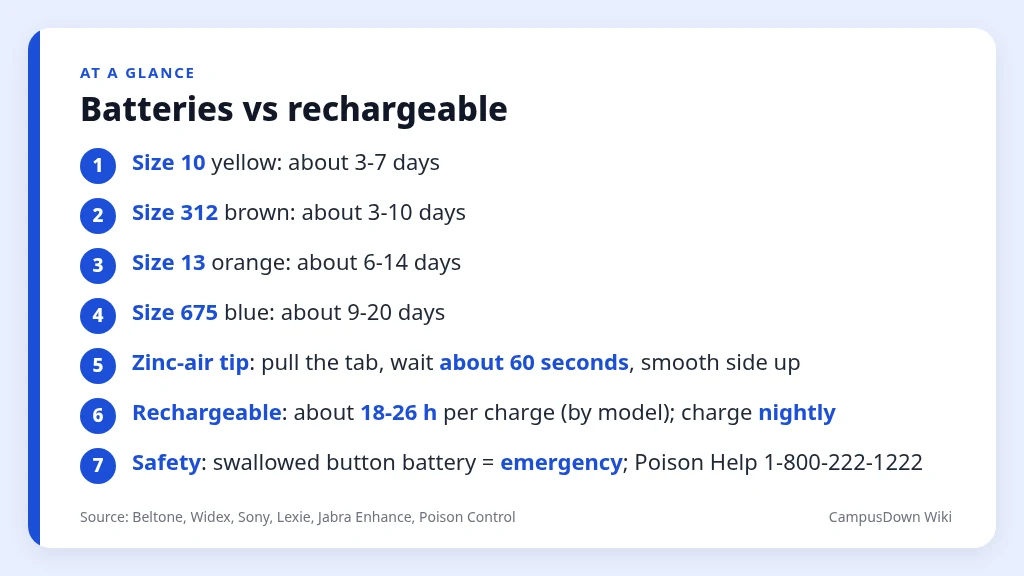
| Size | Tab color | Typical life (Beltone) |
|---|---|---|
| 10 | Yellow | About 3 to 7 days |
| 312 | Brown | About 3 to 10 days |
| 13 | Orange | About 6 to 14 days |
| 675 | Blue | About 9 to 20 days |
Beltone also lists size 5 for some very small aids, at about 3 to 5 days. Smaller batteries run out sooner. Life also depends on hours of use, how much amplification you need and how much you stream. Check your user guide for the right size; the FDA's OTC rule requires the box to state battery type and number.

How to change a zinc-air battery
Zinc-air cells use oxygen from the air. It helps to take a closer look at these steps from Beltone and Widex:
- Leave the sticker tab on until you are ready. Once it comes off, the battery is activated and can't be resealed.
2. Peel the tab and let the battery "breathe" for about a minute. 3. Remove the old battery and throw it away; zinc-air cells are not rechargeable. 4. Insert the new one smooth (positive) side up. If the door doesn't close easily, check the direction. 5. Work over a soft surface, such as a towel or tablecloth, so a dropped battery doesn't bounce away.
Widex notes that once the tab is off, a battery runs down in about four weeks even if unused. Beltone says unopened batteries have an average shelf life of about three years. To make them last, turn aids off when not in use, open the battery door at night, and take the battery out if you won't wear the aids for a while.
Rechargeable hearing aids
Rechargeable aids have a built-in lithium-ion cell you can't remove. Here is what some makers list:
| Model | Per charge | Charge time | Case |
|---|---|---|---|
| Sony CRE-E10 | Up to 26 h (23 h with 2 h streaming) | About 4 h | 3 full charges |
| Lexie B2 Plus | Up to 18 h | About 3 h | 1 extra charge |
| Jabra Enhance Select M series | About 24 h | About 3 h | 3 full charges |
Sony's guide says its aids are meant to be charged daily, even if not empty. Lexie's manual asks owners to fully charge aids and case at least every three months in storage, or the battery can over-discharge. Lithium-ion aids can go in carry-on luggage, according to Lexie.
Sony also notes that battery capacity drops with age, and lists an expected service life of five years for its aids. A rechargeable aid that ran all day in year one may need a midday top-up later. Because the cell is sealed, a worn battery usually means a service visit or a new device.
Which fits your life?
Disposable batteries may suit you if you:
- Travel or camp where charging is hard
- Want to swap power in seconds
- Use a model that only takes batteries, such as some larger prescription aids
Rechargeable may suit you if you:
- Have arthritis, tremor or low vision that makes tiny batteries hard to handle
- Can keep a steady nightly charging habit
- Have young grandchildren or pets visiting, and want fewer loose button cells around
Learn more about how the first weeks with new aids go in our adjustment guide. Device-specific details are in our guides to the Sony CRE-E10, Lexie B2 Plus and Jabra Enhance Select.
Example scenario: the dropped battery
- Who
- Mabel, 81, a retired school librarian in Omaha, had worn size 312 battery aids for a decade. Her arthritis had crept into her fingers.
- What happened
- Changing batteries had become a twice-a-week struggle. One evening she dropped a fresh battery on the kitchen floor and couldn't find it. The next morning her granddaughter Priscilla's toddler was crawling in that kitchen.
- How it felt
- She was shaken. She pictured the baby finding it first, and felt ashamed that something so small was beating her. She also dreaded admitting to her audiologist that she couldn't manage anymore.
- What they did
- Priscilla searched the floor with a flashlight and found the battery under the stove. Mabel then asked her audiologist about rechargeable options. They tried a rechargeable model in the clinic, practiced seating it in the charger, and put a sticky note by the nightstand: "Ears in the charger."
- How it turned out
- After two weeks, she stopped thinking about batteries at all. She kept one spare pack of 312s for her old aids, sealed and locked in a high cabinet, as a backup for power outages.
This is an illustrative example, not a real patient or a review.
Mabel is an illustrative example, not a real patient. Your audiologist can tell you which power options your hearing loss allows.
Get help now if
Button batteries are dangerous if swallowed. Poison Control says more than 3,500 people in the U.S. swallow button batteries each year, and hearing aid batteries are among them. A battery stuck in the esophagus can cause severe damage in about two hours. Get emergency care right away and call Poison Help at 1-800-222-1222. Batteries placed in the ear or nose can also cause injury; young children and older adults are most often involved. Don't use ear or nose drops until a doctor has checked.
Battery and charging problems
- Short battery life: check the size, turn aids off when not in use, and reduce streaming. Beltone suggests seeing a professional if life is clearly shorter than typical.
- Rechargeable not holding a charge: clean the charging contacts, make sure the aids are seated correctly, and confirm the case itself is charged. If it keeps happening, contact the maker or your audiologist; a sealed battery may be wearing out.
- Weak or crackling sound: before blaming the battery, check the wax guard. Our earwax guide explains in detail why wax matters.
- Heat or swelling: stop using the device. The FDA lists burns from an overheated battery among hearing aid problems to report through MedWatch or 1-800-FDA-1088.
Most-asked questions about hearing aid batteries
Rechargeable hearing aids vs battery: which is better?
Neither is better for everyone. Rechargeable aids suit people with dexterity problems who can charge nightly; disposable batteries suit travelers and some higher-power models.
Why people ask: "rechargeable hearing aids vs battery" is #5 for "rechargeable hearing aids" (US autocomplete, November 2026).
What are the hearing aid battery sizes?
The common sizes are 10 (yellow), 312 (brown), 13 (orange) and 675 (blue). Beltone also lists size 5 for some very small aids.
Why people ask: "hearing aid battery sizes" is #4 for "hearing aid battery" (US, November 2026).
How long do size 312 hearing aid batteries last?
Beltone lists about 3 to 10 days, depending on the aid, hours of use and streaming.
Why people ask: "hearing aid batteries 312" is #2 for "hearing aid batteries" (US, November 2026).
How long do size 13 batteries last?
Beltone lists about 6 to 14 days.
Why people ask: "hearing aid batteries 13" is #3 for "hearing aid batteries" (US, November 2026).
Why are my rechargeable hearing aids not holding a charge?
Common causes are dirty contacts, aids not seated properly, a drained case, or an aging sealed battery. Contact the maker if cleaning doesn't help.
Why people ask: "rechargeable hearing aids not holding charge" is #7 for "rechargeable hearing aids" (US, November 2026).
Related on CampusDown
To check it for yourself before buying any device, read OTC vs prescription hearing aids. For context on hearing in later life, see age-related hearing loss.
Frequently asked questions
- Should I wait a minute after pulling the battery tab?
- Yes. Beltone and Widex both recommend about a minute so the battery can take in oxygen.
- Can I recharge zinc-air hearing aid batteries?
- No. Beltone says zinc-air batteries are not rechargeable and must be thrown away after use.
- Should I store hearing aid batteries in the refrigerator?
- Widex recommends a cool, dry place away from children and pets. Follow your battery maker's instructions.
- Can I fly with rechargeable hearing aids?
- Lexie says its lithium-ion aids and case can go in carry-on luggage. Check your airline and device maker.
The best power option is the one you will manage every day without stress: a battery you can handle, or a charger you will remember. Talk to your audiologist or pharmacist about options that fit your hands and home, and keep every button battery, new or used, out of reach of children and pets.
Browse more guides like this in the Home Medical Devices hub.
This article is for general education and does not replace advice from your own doctor, nurse or pharmacist.