
Have you ever pulled out a cotton swab, seen a little wax on the tip, and felt sure you had done something useful? Ear specialists say that small win is usually an illusion. Most of the wax you can't see just got pushed deeper.
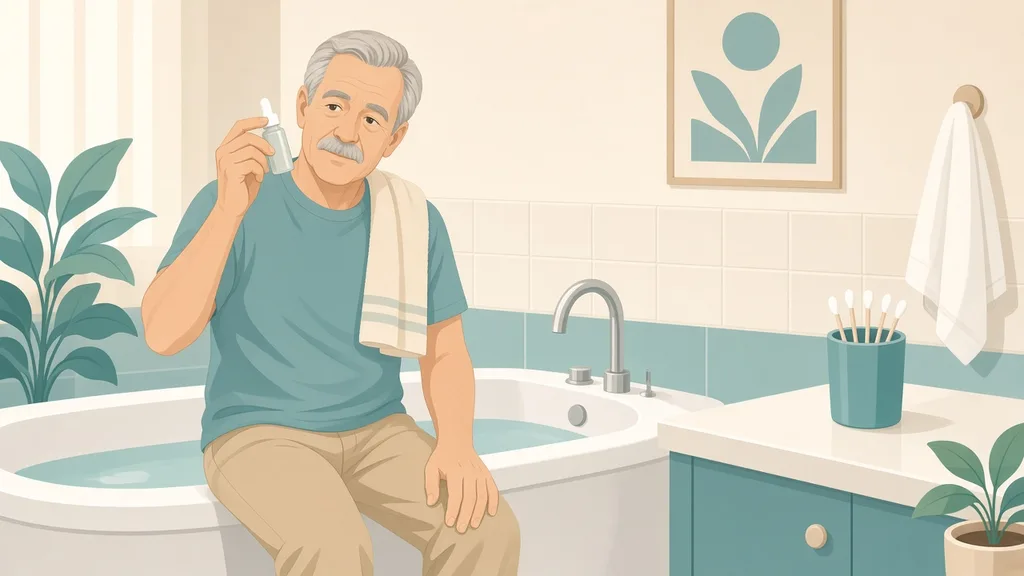
This guide is built on the American Academy of Otolaryngology-Head and Neck Surgery (AAO-HNS) clinical practice guideline on earwax, updated in 2017, plus the U.S. drug label for carbamide peroxide drops and the FDA's import alert on ear candles. It explains what earwax does, when buildup becomes a problem, and which home steps are reasonable. It also covers when to stop and see a clinician.
Earwax is supposed to be there
Earwax, or cerumen, is made by glands in the outer part of the ear canal. The AAO-HNS describes it as a self-cleaning substance. It traps dust, keeps the canal skin oiled and helps protect it. Chewing, jaw movement and the slow outward growth of canal skin carry old wax toward the opening, where it dries and falls out or washes away in the shower.
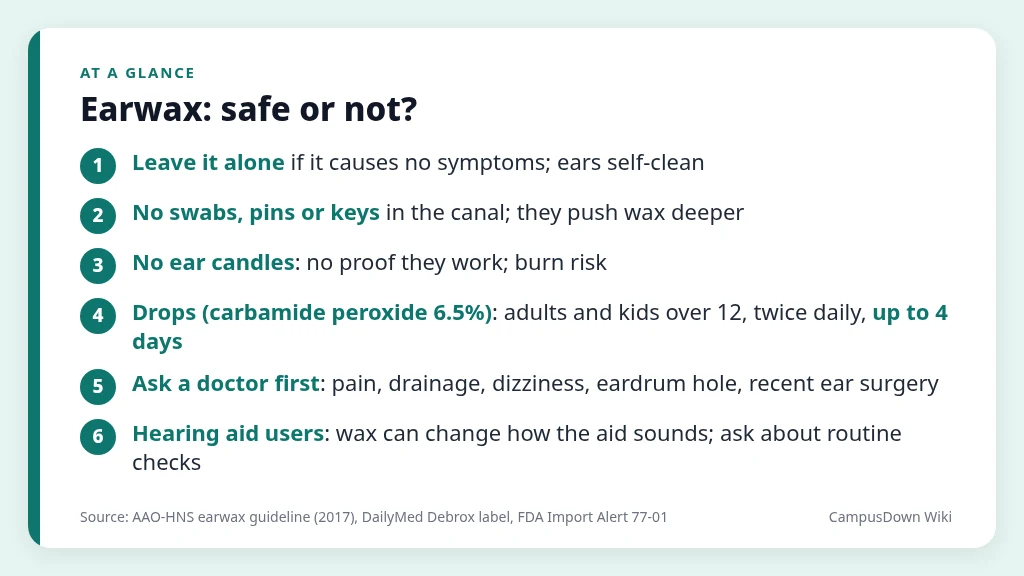
So the guideline's first rule is simple: earwax that causes no symptoms and does not block the canal should be left alone. Clean the outer ear with a washcloth if you like. The canal itself does not need scrubbing.

When buildup becomes "impaction"
The guideline uses the term cerumen impaction for wax that causes symptoms, keeps a clinician from seeing the eardrum, or both. AAO-HNS lists symptoms that can come with it:
- Muffled or reduced hearing
- A feeling of fullness or plugging
- Ringing in the ear (tinnitus)
- Itching, ear pain, odor or discharge
- Cough
- A change in how a hearing aid works, such as whistling or weaker sound
The AAO-HNS says excessive or impacted wax is found in about 1 in 10 children, 1 in 20 adults, and more than one-third of older adults and people with developmental disabilities. Hearing aids and earplugs can block wax from moving out on its own. That is one reason wax is worth asking about if you or a parent wears hearing aids.
Key point
Muffled hearing is not always wax. Fluid behind the eardrum, an ear canal infection and sudden inner ear hearing loss can all feel similar. If hearing drops quickly, read our sudden hearing loss guide and get care the same day.
Why cotton swabs backfire
The ear canal narrows partway in, a bit like an hourglass. A swab tip pushes wax past that narrow spot, where it packs against the eardrum. The guideline's patient table puts it memorably: don't put anything smaller than your elbow in your ear. It names cotton swabs, hairpins, car keys and toothpicks. These can:
- Cut or scratch the canal skin
- Punch a hole in the eardrum (perforation)
- In rare cases, dislocate the tiny hearing bones, causing hearing loss, dizziness or ringing
The guideline also warns that over-cleaning can irritate the canal, invite infection and even make impaction more likely.
Example scenario: the swab habit
- Who
- Harlan, 68, a retired bus mechanic in Tulsa, had cleaned his ears with cotton swabs every morning after his shower for as long as he could remember.
- What happened
- One week his right ear felt stuffed, as if he were on an airplane. The TV seemed quieter on that side, and a soft hum showed up at night. He pushed the swab a little deeper each day, trying to "get it all."
- How it felt
- He was frustrated, then scared. His father had gone deaf in his 70s, and Harlan wondered if this was the start. He also felt foolish for not being able to fix something as simple as earwax.
- What they did
- His wife talked him into calling his primary care office instead of buying a camera scope online. The nurse asked about pain, drainage and dizziness (none), then had him come in. The physician looked in, saw a wall of packed wax, and removed it in the office. She told him to stop the swabs and asked whether he had ever had a hole in his eardrum before suggesting drops for the future.
- How it turned out
- The hum faded with the blockage, and the TV volume went back down. Harlan now keeps the swabs for the outer ear only. He asked to have his ears checked at his yearly visit, because his doctor said some people simply make more wax.
This is an illustrative example, not a real patient or a review.
Harlan is an illustrative example, not a real patient. The right first step depends on your ears, so call your clinician if you are unsure.
Home options the guideline recognizes
The guideline lists three types of treatment a clinician may use or recommend: softening drops (cerumenolytics), irrigation (flushing with water or saline) and manual removal with instruments or suction. Some of these can be started at home, but only if your ears are otherwise healthy. Take a closer look at the details below before you buy anything.
Softening drops
Over-the-counter carbamide peroxide 6.5% drops are sold as Debrox and as store brands. The DailyMed label for Debrox says:
- Who: adults and children over 12. Under 12, ask a doctor.
2. How: tilt your head sideways, place 5 to 10 drops in the ear, and don't let the applicator tip enter the canal. 3. Hold: keep the drops in for several minutes by keeping your head tilted or placing cotton at the opening. 4. How often: twice daily for up to four days if needed, or as your doctor directs. 5. After: remaining wax may be gently flushed with warm water using a soft rubber bulb ear syringe.
The label notes the drops foam and may make a crackling sound as they release oxygen. Ask a doctor before use if you have ear drainage, ear pain, irritation or rash, dizziness, an eardrum injury or hole, or recent ear surgery. Stop and ask a doctor if you need them for more than four days or if wax remains.
Irrigation
Flushing works best after wax has been softened. Water should be close to body temperature; cold or hot water can cause dizziness. Irrigation is not for everyone. Ask first if you have diabetes, a weak immune system, a past or possible eardrum hole, ear tubes, or past ear surgery.
What about camera kits and scoops?
Search results are full of ear-wax "kits" with lighted scoops, spiral tips and tiny cameras. The guideline's warning about objects in the canal still applies: a scope helps you see, but a tool in the canal can still scratch skin or push wax. If home drops have not worked after the labeled four days, that is your cue to see a clinician, not to reach deeper.
Ear candles: a clear no
Ear candles (also called ear cones) are hollow wax tubes lit at one end. The AAO-HNS guideline recommends against candling for treating or preventing impaction. It says there is no evidence candling removes impacted wax, and it can damage the ear canal and eardrum. The FDA goes further. Its Import Alert 77-01 lets agents detain ear candles at the border. The FDA says there is no validated scientific evidence that they work and calls them dangerous when used as labeled, because a lit candle sits near the face.
Get help now if
Seek medical care, not home removal, if you have ear pain, drainage, bleeding, fever, dizziness or sudden hearing loss. The AAO-HNS notes pain, drainage and bleeding are not typical signs of wax and need evaluation. If a child or adult may have a button battery in the ear or nose, don't use any drops. Get emergency care.
Earwax and hearing aids
Hearing aids sit in the canal all day, and the guideline notes they can make impaction more likely. Wax can also clog the receiver or wax guard, which can make an aid sound weak or whistle. The FDA's labeling rule for over-the-counter hearing aids lists "a lot of ear wax" among the red flags that mean you should see a doctor, preferably an ENT, before using an OTC aid. If you are shopping for one, check it for yourself in our OTC vs prescription hearing aids guide. New wearers can learn more about cleaning domes and wax guards in getting used to new hearing aids.
Older adults and wax
The AAO-HNS figure above, more than one-third of older adults, is striking, and hearing aid use adds to it. Because the loss creeps in slowly, families sometimes blame aging when part of the problem is a plug of wax. Our age-related hearing loss guide explains in detail how to tell the patterns apart and why a quick ear check is a good first step.
Most-asked questions about earwax removal
What is the safest way to remove ear wax at home?
If your ears are healthy, carbamide peroxide 6.5% drops used as labeled (up to four days), followed by a gentle warm-water rinse with a soft bulb syringe, is the approach on the Debrox label. Don't use swabs, pins or candles in the canal.
Why people ask: "how to remove ear wax at home" is #2 and "how to remove ear wax safely at home" is #7 for "how to remove ear wax" (US autocomplete, November 2026).
Do ear wax removal drops work?
Softening drops are one of the treatments in the AAO-HNS guideline. The label says to stop and ask a doctor if wax remains after four days.
Why people ask: "ear wax removal drops" is #4 for "ear wax removal" (US, November 2026).
Are ear wax candles safe?
No. The AAO-HNS recommends against ear candling, and the FDA's Import Alert 77-01 calls ear candles dangerous with no validated evidence they work.
Why people ask: "ear wax removal candle" is #8 for "ear wax removal," and "ear wax candles" is #5 for "ear wax" (US, November 2026).
Should I buy an ear wax removal kit with a camera?
A camera lets you see, but any tool inside the canal can still scratch it or push wax deeper. If drops have not worked, see a clinician.
Why people ask: "ear wax removal kit" is #2 and "ear wax removal camera" is #7 for "ear wax removal" (US, November 2026).
Want to learn more about ringing that doesn't go away after wax is cleared? Our tinnitus guide covers the next steps.
Related on CampusDown
Middle ear infections can mimic wax; see ear infection (otitis media). If you or a parent is noticing gradual hearing changes, start with age-related hearing loss.
Frequently asked questions
- Should I clean my ears every day?
- No. The AAO-HNS says earwax that causes no symptoms should be left alone. Wash the outer ear only.
- Can I use hydrogen peroxide for earwax?
- Peroxide-based drops are among the softening options the guideline mentions. Use a product labeled for ears and follow its directions, and ask first if you might have an eardrum hole.
- How long can I use Debrox?
- The label says twice daily for up to four days. Stop and ask a doctor if you need longer or wax remains.
- Who removes impacted earwax?
- Primary care clinicians, nurse practitioners and ENT specialists can remove wax by irrigation, suction or instruments.
Earwax is your ear's own cleaning system, and most of the time it needs nothing from you. When it does cause symptoms, a short course of labeled drops or a quick office visit is safer than anything you push into the canal. Talk to your doctor or pharmacist before starting drops if you have diabetes, ear surgery history or any ear pain.
Browse more guides like this in the U.S. Health Topics hub.
This article is for general education and does not replace advice from your own doctor, nurse or pharmacist.
References
- Schwartz SR, et al. Clinical Practice Guideline (Update): Earwax (Cerumen Impaction). Otolaryngol Head Neck Surg. 2017
- AAO-HNS: Experts update best practices for earwax (press release)
- DailyMed: Debrox (carbamide peroxide 6.5%) label
- FDA Import Alert 77-01: Ear candles
- FDA: OTC hearing aids, what you should know