
Have you stood in front of a pharmacy shelf of hearing aids, then thought about the audiologist your doctor mentioned, and wondered which one is the "real" option? Both can be. Under federal rules, the difference comes down to how much hearing you have lost, what other symptoms you have, and how much help you want along the way.

This guide uses the FDA's consumer pages on hearing aids, checked in November 2026, and Medicare.gov's coverage pages. It explains who qualifies for over-the-counter (OTC) aids, when a prescription aid is the better fit, and how to choose. You can learn more about specific devices through the links along the way.
What the FDA rule did
The FDA created the OTC hearing aid category in a rule that took effect on October 17, 2022. Under it:
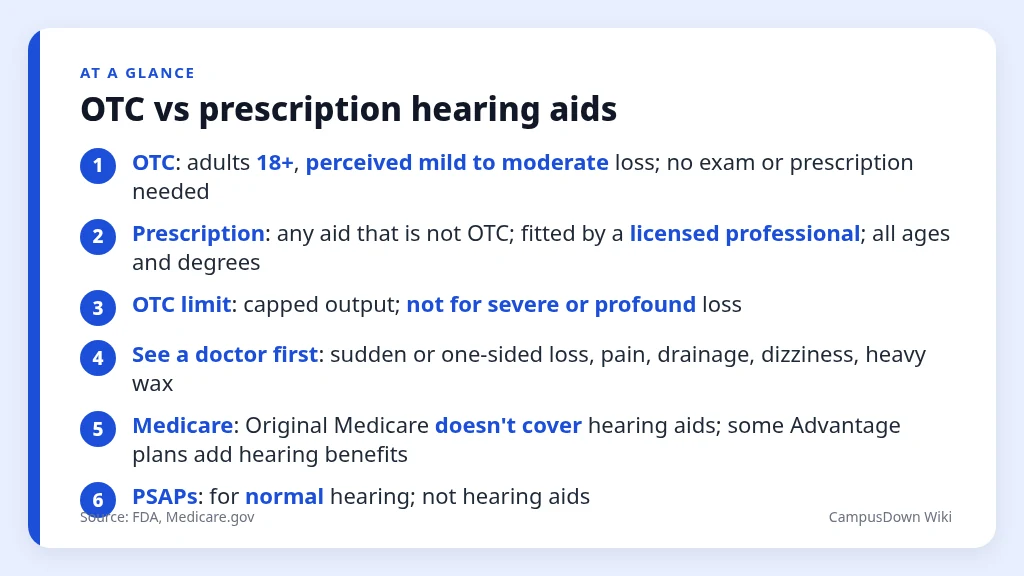
- Adults 18 and older who believe they have mild to moderate hearing loss can buy hearing aids in a store or online.
- No medical exam, prescription or fitting by an audiologist is required.
- OTC aids are air-conduction devices. They are not implanted, and they let users adjust settings themselves through controls, tests or apps.
The FDA defines a prescription hearing aid simply as any hearing aid that is not OTC. Prescription aids come through a licensed hearing professional, who programs them for your hearing loss, and they can be appropriate for all levels of loss and all ages.

Side by side
| OTC hearing aid | Prescription hearing aid | |
|---|---|---|
| Who | Adults 18+ | Any age (under 18 requires prescription) |
| Degree of loss | Perceived mild to moderate | Mild through profound |
| How you get it | Store or online, no exam | Licensed audiologist or dispenser |
| Who sets it up | You, with app or controls | Professional programs and fits it |
| Power | Limited maximum output | Can be fitted for greater loss |
| Follow-up | Varies by brand | Usually included with the fitting |
The FDA says OTC aids have limited maximum output, so they may not help enough with severe loss. If loud sounds such as power tools or engines are hard for you to hear, or you can't follow speech even in a quiet room, the FDA suggests seeing a hearing professional.
Red flags: see a doctor first
The FDA requires every OTC box to carry a warning, so take a closer look at the list. See a doctor, preferably an ear-nose-throat doctor (ENT), if:
- Your ear has a birth defect, unusual shape, or injury
- You saw blood, pus or fluid coming from your ear in the past six months
- Your ear feels painful or uncomfortable
- You have a lot of earwax, or think something is in your ear
- You get dizzy or have a spinning feeling (vertigo)
- Your hearing changed suddenly in the past six months
- Your hearing gets worse, then better again
- Hearing is worse in one ear, or you hear ringing in only one ear
Sudden loss can be an emergency; see sudden sensorineural hearing loss. Heavy wax has its own fix, covered in earwax buildup.
What must be on an OTC box
The FDA rule requires the outside package to show:
- The warnings above, plus signs of mild to moderate loss, such as trouble hearing speech in noisy places or groups, trouble on the phone, tiredness from listening, or needing the TV louder than others like
2. Whether the device is used or rebuilt 3. The words "OTC" and "hearing aid" 4. Battery type and number, and whether batteries are included 5. Whether you need a phone or remote to control it 6. The manufacturer's return policy
The FDA warns that phrases like "FDA Registered" or "FDA Certified" on a package may be misleading. It also notes the rule does not require a warranty, so check the return window before you buy.
Amplifiers and earbuds are not the same thing
Personal sound amplification products (PSAPs) are sold for people with normal hearing who want sounds louder in specific situations, such as birdwatching or hunting. The FDA says they are electronic products, not medical devices like hearing aids. If you have hearing loss, look for the words "OTC hearing aid" on the box.
Earbuds are a different case. Apple's Hearing Aid feature for AirPods Pro 2 and Pro 3 is FDA-authorized OTC hearing aid software; see AirPods Pro Hearing Aid feature.
Example scenario: the two quotes
- Who
- Otis, 69, a retired accountant in Sacramento, had noticed for years that restaurants sounded like "one big roar." His wife finally said she was tired of repeating herself.
- What happened
- He priced two options: an OTC pair at a big-box store, and a prescription pair quoted by an audiology clinic for several times as much. Original Medicare would not pay for either.
- How it felt
- He felt cheap for leaning toward the store pair and anxious that he might be "doing it wrong." He also did not want to admit the problem was bad enough for a clinic.
- What they did
- Before buying, he read the red-flag list on the box and realized his left ear had been worse than his right for about a year. He asked his primary care doctor, who ordered a diagnostic hearing test. The audiologist found more loss on the left and suggested an ENT visit first.
- How it turned out
- The ENT found no worrying cause. Because the gap between ears was large, Otis chose a prescription fitting with follow-up visits. His wife noticed the change at their next restaurant dinner. Otis said reading the box carefully saved him from guessing.
This is an illustrative example, not a real patient or a review.
Otis is an illustrative example, not a real patient. One-sided hearing loss always deserves a doctor's look.
What about cost and Medicare?
The NIDCD says hearing aids range from hundreds to several thousand dollars, and that price alone does not show which one is better for you. Medicare.gov says:
- Original Medicare doesn't cover hearing aids or exams for fitting them.
- Medicare Part B does cover diagnostic hearing and balance exams when your doctor orders them to decide on medical treatment.
- You can see an audiologist once every 12 months without an order for non-acute conditions, such as hearing loss that develops over many years.
- Some Medicare Advantage plans offer extra hearing benefits. Compare in our Medicare Advantage vs Medigap guide.
The NIDCD notes most manufacturers offer a 30- to 60-day trial. Ask what fees, if any, are nonrefundable.
How to decide
- Screen yourself honestly. If any FDA red flag applies, see a doctor first.
2. Consider a test. Even when not required, the FDA says a hearing evaluation can tell you the type and degree of loss. Our age-related hearing loss guide lists screening questions. 3. Match the support you want. Some OTC brands, such as Jabra Enhance Select, add remote audiology. Others leave fitting entirely to you. 4. Check the return policy and company stability. In 2026 several OTC brands left the U.S. market. 5. After purchase, check it for yourself. If an OTC aid does not help enough, the FDA suggests seeing a hearing professional.
Most-asked questions about OTC vs prescription hearing aids
What is the difference between OTC and prescription hearing aids?
OTC aids are for adults with perceived mild to moderate loss and need no exam. Prescription aids are fitted by a licensed professional and can serve all degrees of loss and all ages.
Why people ask: "otc hearing aids vs prescription" is #2 for "otc hearing aids vs" (US autocomplete, November 2026).
Are OTC hearing aids good for severe hearing loss?
No. The FDA says OTC aids are not for severe or profound loss because their maximum output is limited.
Why people ask: "otc hearing aids for severe hearing loss" is #5 for "otc hearing aids" (US, November 2026).
Do I still need an audiologist if I buy OTC?
It is not required, but the FDA says a hearing evaluation can tell you the type and degree of loss, and you should see a professional if OTC aids do not help enough.
Why people ask: "otc hearing aids vs audiologist" is #3 for "otc hearing aids vs" (US, November 2026).
Hearing aids vs amplifiers: what's the difference?
The FDA says personal sound amplification products are for people with normal hearing and are not medical devices. Hearing aids treat hearing loss.
Why people ask: "hearing aids vs amplifier" is #2 for "hearing aids vs" (US, November 2026).
Hearing aids vs AirPods: can AirPods replace hearing aids?
AirPods Pro 2 and Pro 3 with Apple's FDA-authorized Hearing Aid feature are an OTC hearing aid option for perceived mild to moderate loss. They are not meant for severe loss.
Why people ask: "hearing aids vs airpods" is #3 for "hearing aids vs" (US, November 2026).
Related on CampusDown
Ringing in the ears often travels with hearing loss; see tinnitus. Medicare enrollment windows are covered in Medicare open enrollment.
Frequently asked questions
- Can I buy OTC hearing aids for my 16-year-old?
- No. The FDA says people under 18 need hearing aids by prescription and should see a doctor, preferably an ENT.
- Can an audiologist sell me OTC hearing aids?
- Yes. The FDA notes hearing professionals can sell OTC aids and test your hearing; you can also take your records elsewhere.
- Does Medicare pay for OTC hearing aids?
- Original Medicare does not cover hearing aids. Some Medicare Advantage plans offer hearing benefits.
- Where do I report a problem with an OTC hearing aid?
- Through FDA MedWatch online or by calling 1-800-FDA-1088.
OTC hearing aids opened a faster, cheaper door for many adults, and prescription aids still matter for anyone with greater loss or warning signs. Read the box, take the red flags seriously, and talk to your doctor or an audiologist whenever you are unsure which side of the line you are on.
Browse more guides like this in the Home Medical Devices hub.
This article is for general education and does not replace advice from your own doctor, nurse or pharmacist.