
Your mother spent three nights in a hospital bed, so Medicare will pay for her rehab, right? Many families learn the hard way that the answer can be no. If those nights were "observation," Medicare counted her as an outpatient, and the 3-day clock for skilled nursing rehab never started.

This guide uses Medicare's own fact sheet and CMS rules to explain the difference, what it costs, and what you can do while your loved one is still in the hospital. If a parent is hospitalized right now, take a closer look at the questions to ask before discharge.
Inpatient vs outpatient: the official definitions
According to Medicare's "Medicare Hospital Benefits" fact sheet:
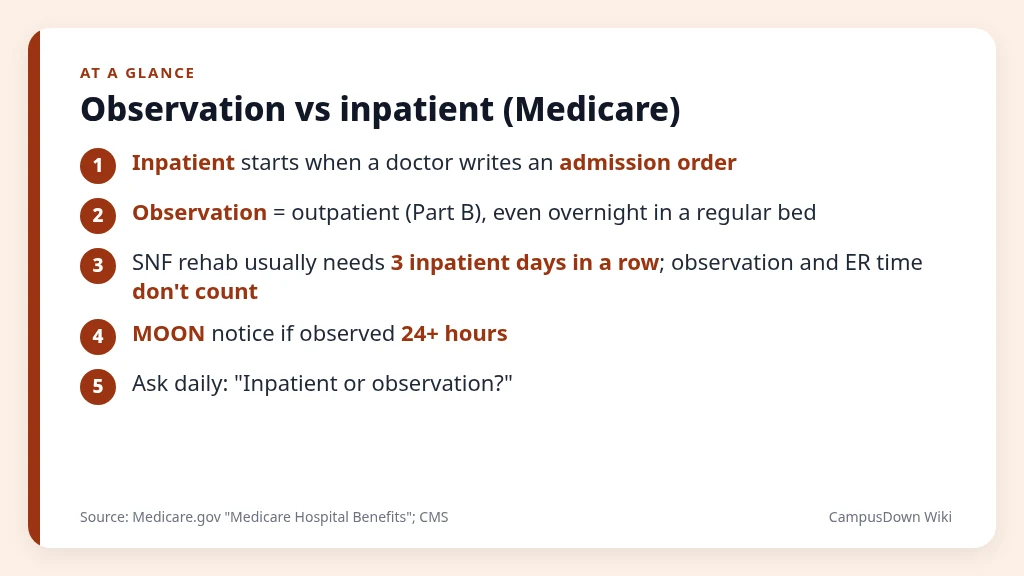
- You are an inpatient starting when a doctor writes an order formally admitting you. The day before discharge is your last inpatient day.
- You are an outpatient if you are getting emergency department services, observation services, outpatient surgery, lab tests, x-rays or other hospital services without an inpatient admission order, even if you spend the night.
- Observation services are outpatient services a doctor orders to help decide whether you need to be admitted or can go home.

Why it matters for what you pay
As an inpatient, Part A covers hospital services after a deductible per benefit period ($1,736 in 2026; $1,776 in 2027, per Medicare.gov). As an outpatient, Part B covers most services, and you generally pay a copayment for each hospital service plus 20% for doctor services after the Part B deductible. Medicare notes that a single outpatient service copayment cannot exceed the inpatient deductible, but several services together can.
Self-administered drugs, such as your usual blood pressure pills, are generally not covered by Part B in outpatient settings, and the hospital may bill you. Your Part D plan may reimburse some of them.
The 3-day rule for skilled nursing rehab
Medicare Part A generally covers skilled nursing facility (SNF) care only after a qualifying inpatient stay of at least 3 days in a row, counting the admission day but not the discharge day. Time in the emergency room or under observation does not count, even overnight. Medicare gives this example: one day in observation, then two days as an inpatient, is not a qualifying stay. Read the full SNF rules in detail in Medicare's 100-day SNF benefit.
Exceptions exist. Some doctors in Accountable Care Organizations have an approved SNF 3-Day Rule Waiver, and Medicare Advantage plans may waive the 3-day requirement. Ask the hospital and the plan.
Rules on paper are one thing. Here is how they play out on a Friday afternoon.
Example scenario: the wrist fracture weekend
- Who
- Dolores, 81, a retired seamstress with Original Medicare, fell at home and broke her wrist; she was weak, dizzy and lived alone.
- What happened
- She spent three nights in a hospital bed. On day three a therapist recommended short-term rehab, and Mike, 54, was told the rehab stay might not be covered because his mother had been "in observation" the whole time.
- How it felt
- Mike felt blindsided and angry; he had assumed a hospital bed meant an admission. Dolores was frightened of going home alone and ashamed of being a burden.
- What they did
- Mike asked the case manager for the MOON notice and her exact status, asked the doctor whether she met inpatient criteria, and asked about home health and other settings. The case manager also checked whether her doctor's ACO had a 3-day waiver.
- How it turned out
- She stayed in observation status, so Mike arranged Medicare home health with a physical therapist and a few weeks of paid help. Dolores recovered at home, and Mike now asks "inpatient or observation?" on the first day of any hospital stay.
This is an illustrative example, not a real patient or a review.
Dolores's story is an illustration, not a real case. Your options depend on your coverage, your doctor's judgment and your state's programs.
The MOON notice
CMS requires hospitals and critical access hospitals to give the Medicare Outpatient Observation Notice (MOON) to Medicare patients who receive observation services for more than 24 hours, no later than 36 hours after observation begins. It explains that you are an outpatient and how that affects what you pay and your SNF eligibility. If you do not get it, ask for it.
Appeals when status changes
If you were admitted as an inpatient and the hospital later changed your status to outpatient with observation, you may be able to request a fast appeal while still in the hospital, and Medicare.gov says some past stays can be appealed back to January 2009. See fast appeals when coverage ends.
Get help now if
Never delay needed hospital care to change your status. Status is a medical and billing decision; ask questions, but follow medical advice about whether it is safe to go home.
Most-asked questions about observation status
What is the difference between observation and inpatient?
Inpatient begins with a doctor's formal admission order; observation is outpatient care to decide whether admission is needed. The difference changes how Parts A and B pay and whether a later SNF stay can be covered.
Why people ask: "observation vs inpatient cost" is #2 and "observation vs inpatient status" is #3 for "observation vs inpatient" (US autocomplete, November 2026).
What is Medicare's 3-day rule for rehab?
Part A generally requires 3 consecutive inpatient days before covering SNF care; observation and ER time do not count.
Why people ask: "medicare 3 day rule for rehab" is #2 and "medicare 3 day rule skilled nursing" is #4 for "medicare 3 day rule" (US, November 2026).
Is there a waiver for the 3-day rule?
Yes, in some cases. Doctors in certain Accountable Care Organizations can use an approved SNF 3-Day Rule Waiver, and Medicare Advantage plans may waive it. Ask before discharge.
Why people ask: "medicare 3 day rule waiver" is #5 for "medicare 3 day rule" (US, November 2026).
Can I appeal observation status?
If you were admitted as an inpatient and then changed to observation, you may request a fast appeal. If you were only ever in observation, ask your doctor whether inpatient admission is appropriate and keep records.
Why people ask: "medicare observation status appeal" is #3 for "observation status medicare" (US, November 2026).
Before discharge, check it for yourself: ask for the MOON, the exact admission date and time if admitted, and a written plan for rehab or home care.
Related on CampusDown
Plan the next step with hospital discharge planning, compare coverage in Medicare Advantage vs Medigap, and learn recovery basics in hip fracture recovery.
Frequently asked questions
- Does staying overnight make me an inpatient?
- No. Medicare says you can be an outpatient under observation even if you stay overnight in a regular hospital bed.
- Who decides if I am an inpatient?
- Your doctor decides based on medical judgment and your need for hospital care, and the hospital must formally admit you.
- Do Medicare Advantage plans follow the same rule?
- Costs and coverage may differ, and plans may waive the 3-day requirement. Check with your plan.
- What if there is no qualifying stay but my parent needs care?
- Medicare suggests asking about other settings, such as home health care, or programs like Medicaid or veterans' benefits.
One word on a hospital chart can change a family's bill by thousands of dollars. Learn more about your status every day of a hospital stay, and ask for every answer in writing.
Browse more guides like this in the Senior Health and Medicare hub.
This article is for general education and does not replace advice from your own doctor, nurse or pharmacist.