
When someone you love breaks a hip, what do you ask first: "Will she walk again?" or "How long will this take?" Both are fair questions, and neither has a single answer. Recovery after a hip fracture depends on the type of fracture, the surgery, overall health and the support around the person.
This guide uses OrthoInfo from the American Academy of Orthopaedic Surgeons (AAOS), MedlinePlus and Medicare.gov's skilled nursing facility page. We explain in detail what typically happens. Your surgeon and care team know the person's situation; ask them what to expect.
What a hip fracture is
AAOS defines a hip fracture as a break in the upper portion of the femur (thighbone). Most occur in older adults whose bones are weakened by osteoporosis, and most come from household or community falls. AAOS says more than 300,000 people in the U.S. have a hip fracture each year. The most common types are femoral neck and intertrochanteric fractures.

Signs after a fall
AAOS describes sudden, severe pain in the groin or upper thigh, inability to stand or put weight on the leg, and sometimes a leg that looks shorter and twisted. A few fractures are less painful at first. Don't wait: call 911 after a fall with these signs. Our getting up after a fall guide explains what to do and not do.
Surgery: why speed matters
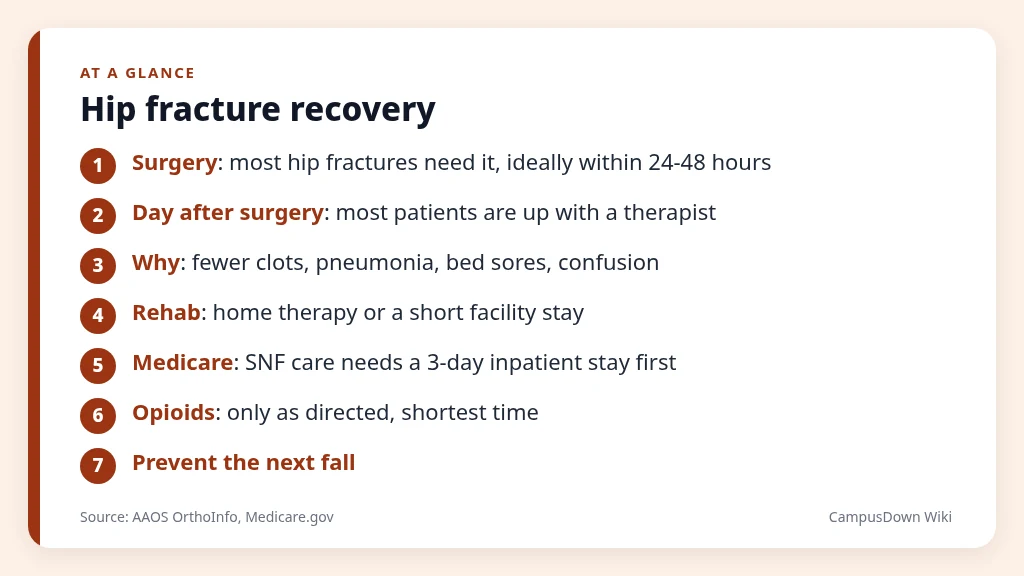
AAOS says most hip fractures require surgery, which relieves pain and lets the person get out of bed. Having surgery as soon as possible, within 24 to 48 hours, may reduce complications. If the person takes a blood thinner, doctors may need time to get them medically ready, and AAOS says it's better to be ready than rushed.
The operation depends on the fracture:
- Femoral neck, not displaced: pins, screws or a plate and screw device hold the bone.
- Femoral neck, displaced: often a hip replacement. For older patients, AAOS says a partial replacement (hemiarthroplasty) is typically the treatment of choice.
- Intertrochanteric: a sliding hip screw with a side plate, or an intramedullary nail.
- Greater trochanter alone: often healed without surgery, with a walker or crutches.
The first days: moving early
AAOS says most patients get out of bed and start physical therapy the day after surgery. Moving early helps prevent blood clots, pneumonia and bed sores, and for older patients it helps prevent disorientation and deconditioning. Our pressure sore guide explains skin care, and delirium in the hospital covers sudden confusion.
Medical care also includes antibiotics for 24 hours after surgery, a blood thinner to help prevent clots, and compression boots in bed. Your doctor decides how long a blood thinner is needed.
Pain medicine
AAOS says pain medicine may include opioids, NSAIDs or acetaminophen, often in combination. It warns that opioids can be addictive and dangerous, so use them only as directed, as little as possible for as short a time as possible, and stop as soon as pain improves. Don't take extra doses; ask your doctor or pharmacist about interactions with the person's other medicines.
Rehab: home or facility
AAOS says many patients go home after surgery, with in-home physical therapy, but some need short-term care in a rehabilitation facility, usually older patients or those without caregivers at home. At a facility, patients stay until they can walk independently and manage daily activities. Therapists also teach bathing, dressing and other daily tasks. You can take a closer look at Medicare skilled nursing coverage and Medicare home health.
Medicare.gov says Part A covers skilled nursing facility care, including physical therapy and occupational therapy, if you first have a qualifying inpatient hospital stay: the 3 inpatient days don't include time as an outpatient or under observation. You must generally enter the SNF within about 30 days of leaving the hospital and need skilled care related to the hospital stay.
What to expect honestly
AAOS says hip fractures in older adults often cause disability and lack of independence, and that people often experience a stepwise decrease in function after a hip fracture. It also says early movement and rehabilitation have been shown to improve long-term results. So ask your care team what rehab will target and who will check bone health and osteoporosis medicines.
How families can help
- Show up at therapy and learn the exercises and weight-bearing limits.
- Bring glasses, hearing aids and dentures to the hospital; they can help with orientation.
- Prepare the home: remove rugs, add lighting, install rails. Use our fall prevention checklist.
- Plan equipment such as a walker; see walker vs rollator.
- Ask about osteoporosis treatment before discharge.
Get help now if
Call the surgeon or 911 for sudden pain, new swelling, a hot or red incision, fever, calf pain or swelling, chest pain, or trouble breathing. Don't wait to see if it passes.
Example scenario: the day after surgery
- Who
- Rafferty, 81, a retired railroad dispatcher in Omaha, Nebraska, fell reaching for a cereal box and broke his hip. His daughter, Hortense, 54, a pharmacist, flew in that night.
- What happened
- The surgeon repaired the fracture the next day. The morning after surgery, a therapist arrived to get him standing, and Rafferty barely stood before he started shaking.
- How it felt
- Rafferty felt humiliated and sure his independence was over. Hortense felt dread seeing her father confused at 3 a.m., asking where he was.
- What they did
- The care team explained that moving early was part of recovery. Hortense brought his glasses and hearing aids, asked the team about his blood thinner and pain medicines, and went to therapy sessions. At discharge he moved to a rehab stay covered after his qualifying inpatient days, then went home with therapy. Before he left, his doctor ordered a bone health follow-up.
- How it turned out
- Rafferty said he measured progress by the walk to the mailbox. Hortense said the hardest part was letting him do the work himself.
This is an illustrative example, not a real patient or a review.
Rafferty's story is an illustrative example. Recovery varies a lot between people.
Most-asked questions about hip fracture recovery
What is hip fracture recovery like for the elderly?
Most patients have surgery and start moving the next day with therapists; some go home with therapy and some need a short rehab stay. AAOS says older patients often lose some function and need more help.
Why people ask: "hip fracture recovery elderly" is #1 for "hip fracture recovery elderly" (US autocomplete, November 2026).
How long is hip fracture recovery for the elderly?
It varies. AAOS describes rehab continuing until the person can walk independently and manage daily activities. Ask the surgeon for a personal outlook.
Why people ask: "hip fracture elderly recovery time" is #2 for "hip fracture recovery elderly" (US autocomplete, November 2026).
What is the prognosis for a hip fracture in the elderly?
AAOS says hip fractures can cause disability and loss of independence, and early movement and rehabilitation improve long-term results. Your doctor can discuss your family member's outlook.
Why people ask: "hip fracture prognosis elderly" is #3 for "hip fracture recovery elderly" (US autocomplete, November 2026).
What is the hip fracture recovery timeline?
The first step is surgery, ideally within 24 to 48 hours, then getting up the next day, then therapy at home or in a facility. Beyond that the timeline depends on the person.
Why people ask: "hip fracture recovery timeline" is #5 for "hip fracture recovery time" (US autocomplete, November 2026).
Hip fracture recovery time for an 80-year-old?
Age alone doesn't set the timeline. Health, the fracture type, surgery and rehab all matter. Ask the surgical team.
Why people ask: "hip fracture recovery time 80 year old" is #6 for "hip fracture recovery time" (US autocomplete, November 2026).
Broken hip recovery in the elderly with dementia?
AAOS says prolonged bed rest can cause disorientation that makes rehab harder, so early surgery and movement matter. Tell the team about dementia so they can plan for confusion.
Why people ask: "broken hip recovery elderly dementia" is #8 for "hip fracture recovery elderly" (US autocomplete, November 2026).
Related on CampusDown
Planning the move from hospital to rehab? You can learn more in hospital discharge planning. Caring for someone at home? See caregiver burnout too.
Frequently asked questions
- Does everyone with a broken hip need surgery?
- Most do. AAOS says only a small group of nondisplaced fractures or very ill patients may be treated without it.
- Why do they get patients out of bed so quickly?
- It helps prevent clots, pneumonia, bed sores and confusion, per AAOS.
- Will Medicare pay for rehab?
- Part A may cover SNF care after a 3-day inpatient stay. Check it for yourself with the hospital's case manager.
- Can another fall be prevented?
- Many are preventable. Ask about balance training, home changes, medicine review and bone health.
A hip fracture is a medical emergency and the start of a long road. Early surgery, early movement, good rehab and a plan to prevent the next fall give the best chance of staying independent.
Browse more guides like this in the Senior Health and Medicare hub.
This article is for general education and does not replace advice from your own doctor, nurse or pharmacist.