
What would you do in the first ten seconds after landing on the kitchen floor? Most people try to jump straight back up, out of embarrassment or panic. That is often the riskiest move you can make.
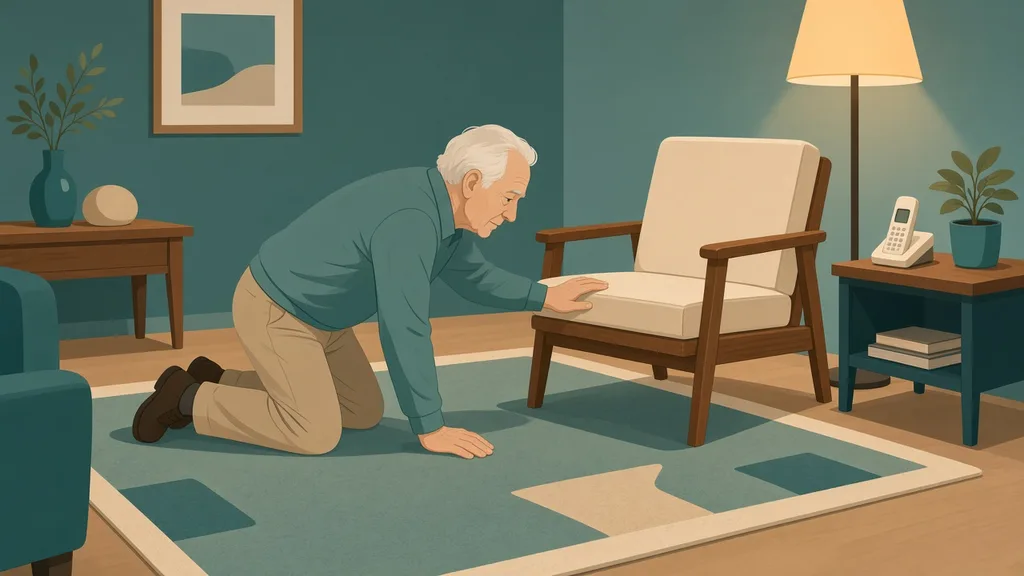
The National Institute on Aging (NIA) has a simple method for getting up safely, and the CDC has clear advice on when a fall needs medical care. Read it once now, in detail, so the steps are familiar before you ever need them. Practice the motions with a physical therapist, not alone on a hard floor.
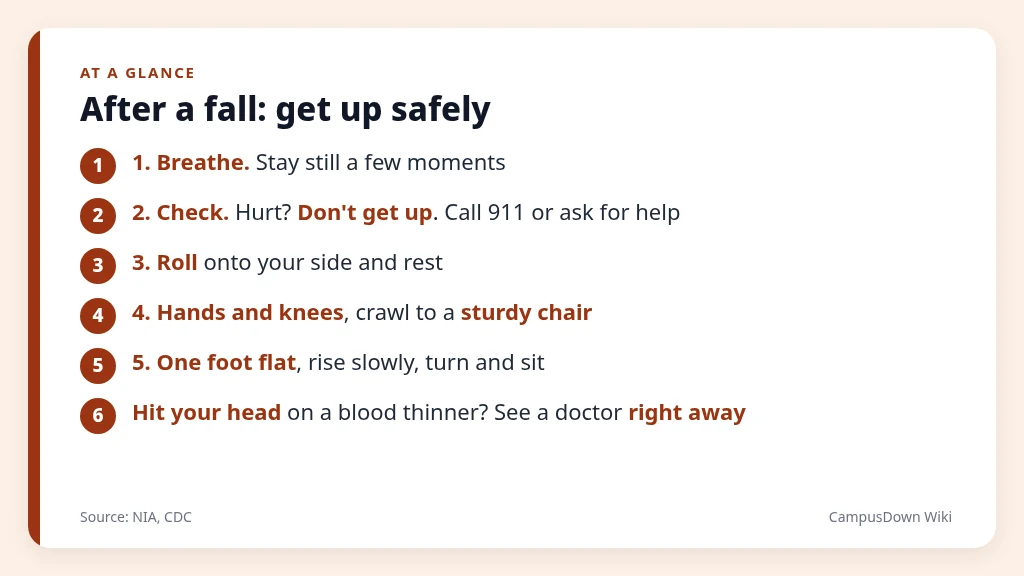
Step 1: Breathe and stay still
The NIA advises taking several deep breaths and staying still on the floor for a few moments. That helps you get over the shock. A racing heart and shaky hands are normal right after a fall.

Step 2: Decide if you are hurt
Getting up too quickly or in the wrong way could make an injury worse. It pays to take a closer look at your body before moving:
- Is there severe pain, especially in a hip, leg, wrist, back or neck?
- Can you move your arms and legs normally?
- Did you hit your head? Do you feel confused, dizzy or sick?
- Is there bleeding you can't control?
If any answer worries you, don't get up. Go to step 6.
Steps 3 to 5: The NIA method
If you think you can get up safely without help:
- Roll onto your side. Then rest again while your body and blood pressure adjust.
2. Get on your hands and knees. Move slowly. 3. Crawl to a sturdy chair. Choose one that will not tip or roll, not a rolling office chair. 4. Put your hands on the seat and slide one foot forward so it is flat on the floor. Keep the other knee on the floor. 5. Rise slowly from that kneeling position, then turn your body and sit in the chair.
Sit for a while before standing fully. Standing too fast can drop blood pressure; see orthostatic hypotension.
| Do | Don't |
|---|---|
| Breathe and pause first | Jump straight up |
| Roll to your side, then hands and knees | Push up from flat on your back |
| Use a sturdy, stable chair | Use a rolling chair, walker seat or towel bar |
| Call for help if hurt | "Tough it out" with hip pain or a head hit |
Step 6: When to stay down and get help
The NIA says that if you are hurt or cannot get up on your own, ask someone for help or call 911. If you are alone, get into a comfortable position and wait. Pull down a blanket or towel to stay warm if you can reach one safely, and move to a carpeted spot if you can do it without pain.
Get emergency care for a suspected broken hip, a head injury with confusion, vomiting or a severe headache, or any loss of consciousness.
Get help now if
The CDC says if an older adult hits their head in a fall, they should see a doctor right away, especially if they take blood thinners. Bleeding inside the skull can start slowly. Learn more in blood thinners in older adults.
Example scenario: the long morning
- Who
- Cornelius, 83, a retired mail carrier in Dayton, Ohio, reached for a coffee mug on a high shelf and lost his balance. He landed on his side on the kitchen tile.
- What happened
- His first instinct was to grab the counter edge and haul himself up. His hip ached, his wrist stung, and he felt foolish for climbing on his toes in the first place.
- How it felt
- He was also scared. A friend from church had lain on her bathroom floor for most of a night two winters earlier, and Cornelius remembered her saying the waiting was worse than the fall.
- What they did
- Then he remembered the steps from his physical therapist. He breathed, wiggled his toes and fingers, and decided nothing seemed broken. He rolled to his side, rested, got onto his hands and knees and crawled to the heavy oak dining chair. With one foot flat, he rose and turned to sit. He then called his doctor's office, which asked him to come in that afternoon.
- How it turned out
- The X-ray showed a bruise, not a fracture. His doctor adjusted a blood pressure medicine that had been making him lightheaded in the mornings, and his daughter moved the mugs to a lower shelf. Cornelius now wears his phone in a shirt pocket at home.
This is an illustrative example, not a real patient or a review.
Cornelius is an illustrative example. Your own plan should come from your doctor or physical therapist.
Prepare before you fall
The NIA recommends:
- Keep a well-charged cordless or mobile phone with you at all times, even at home.
- Arrange daily contact with a family member or friend.
- Consider an emergency response system: a button on a necklace or bracelet that calls for help. The NIA notes there is a fee and it is usually not covered by insurance.
- Some smartwatches can call for help; see Apple Watch fall detection.
- A smart speaker set up to call contacts can help if you can't reach a phone.
Most-asked questions about getting up after a fall
How do elderly people get up after a fall?
Breathe, check for injury, roll to the side, get on hands and knees, crawl to a sturdy chair, put one foot flat and rise to sit. If hurt, stay down and call for help.
Why people ask: "getting up after a fall elderly" is #2 for "getting up after a fall" (US autocomplete, November 2026).
How do you get up after falling without help?
Use a sturdy chair or low, stable furniture as support, using the NIA kneeling method. If you can't do it safely, call 911 rather than forcing it.
Why people ask: "how to get up after falling without help" is #10 for "how to get up after a fall" (US, November 2026).
How do you get up from a fall with bad knees?
Kneeling can be hard with knee pain or replacements. Ask a physical therapist to teach a method that fits your joints; a folded towel or cushion under the knee may help.
Why people ask: "how to get up from a fall with bad knees" is #4 for "how to get up after a fall" (US, November 2026).
What if an elderly person falls while on blood thinners?
If they hit their head, the CDC advises seeing a doctor right away. Don't wait for symptoms.
Why people ask: "elderly fall on blood thinners" is #4 for "elderly fall" (US, November 2026).
Related on CampusDown
To learn more about preventing the next fall, see our fall prevention checklist, and build leg strength with balance exercises. If a fall left you nervous to move, read fear of falling.
Frequently asked questions
- Should I see a doctor if I fell but feel fine?
- The NIA says always tell your doctor about a fall, even without pain. It can reveal a medical, medicine or vision issue.
- Should a caregiver lift a fallen older adult?
- Lifting someone who is hurt can make injuries worse and strain your back. Check for injury first, help them use the chair method if safe, and call 911 if they are hurt or can't get up.
- Can I practice getting up?
- Yes, with a physical or occupational therapist who can teach a method that fits your body. Don't practice alone.
A fall is frightening, but the next few minutes are something you can plan. Breathe, check, roll, crawl, rise, and call for help when you're hurt. Keep a phone on you, set up daily check-ins, and talk to your doctor about every fall.
Browse more guides like this in the Senior Health and Medicare hub.
This article is for general education and does not replace advice from your own doctor, nurse or pharmacist.