
Have you ever taken your blood pressure twice in a row and gotten two different numbers? That is normal, and it is also why technique matters so much. A home reading is only as good as the five minutes before it.
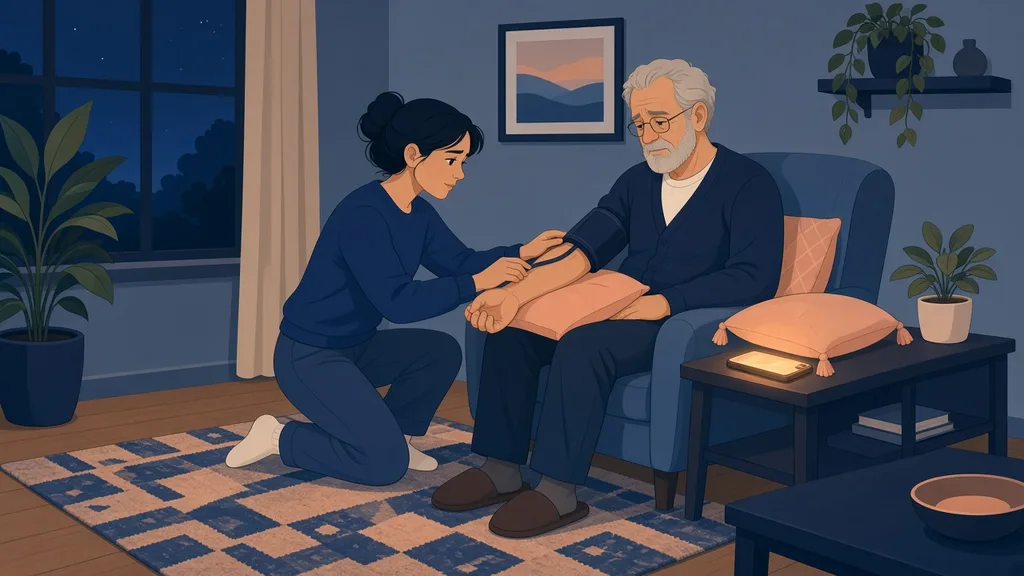
The American Heart Association (AHA) recommends home monitoring for everyone with high blood pressure, for people starting or changing treatment, and for confirming a diagnosis. The routine is simple once you know it, and it turns random numbers into a record your clinician can act on. Here is the full method, so you can take a closer look at each step before your next reading.
Why home readings matter
Clinic readings are a single moment, often taken in a rush. Home readings capture your ordinary days. The US Preventive Services Task Force recommends confirming high office readings with out-of-office measurements before treatment begins, and home monitoring is one of the accepted methods. It also helps reveal white coat hypertension and masked hypertension.
Home monitoring does not replace visits. The AHA says not to stop blood pressure medicine based on home readings without talking to your healthcare professional.

Example scenario: the 2 a.m. reading
- Who
- Priya, 34, a nurse's aide, living with her 72-year-old father who takes blood pressure medicine.
- What happened
- At 2 a.m. he woke up with a headache and asked her to check his pressure. Half-asleep, she wrapped the cuff over his pajama sleeve while he sat on the edge of the bed talking. The screen read 168/96.
- How it felt
- Her heart pounded. She pictured a stroke and reached for her phone to call 911.
- What they did
- She first checked him for warning signs: no chest pain, no weakness, no trouble speaking, no vision change. She moved him to a chair, took the sleeve off, rested his arm on a pillow at heart level, waited five quiet minutes and measured twice, one minute apart.
- How it turned out
- The readings were 142/86 and 138/84. She wrote them down, called the on-call line in the morning, and they brought the log to his appointment, where the doctor reviewed his medicine timing. Priya said she now keeps a laminated checklist next to the monitor.
This is an illustrative example, not a real patient or a review.
Priya's first number was real, but it was taken in the worst possible way: over clothing, mid-conversation, with dangling feet. Her second set was taken correctly, and only then could she judge it. If a reading ever frightens you, check for emergency symptoms first, then repeat it properly, as the steps below show in detail.
Before you measure
- Plan ahead: no smoking, caffeinated drinks or exercise within 30 minutes. Empty your bladder.
- Choose the right monitor: an automatic, cuff-style, upper-arm monitor. The AHA does not recommend wrist or finger monitors because they give less reliable readings. See upper arm vs wrist monitors.
- Check the cuff size: measure around your upper arm. A cuff that is the wrong size gives inaccurate readings. The cuff size guide explains how.
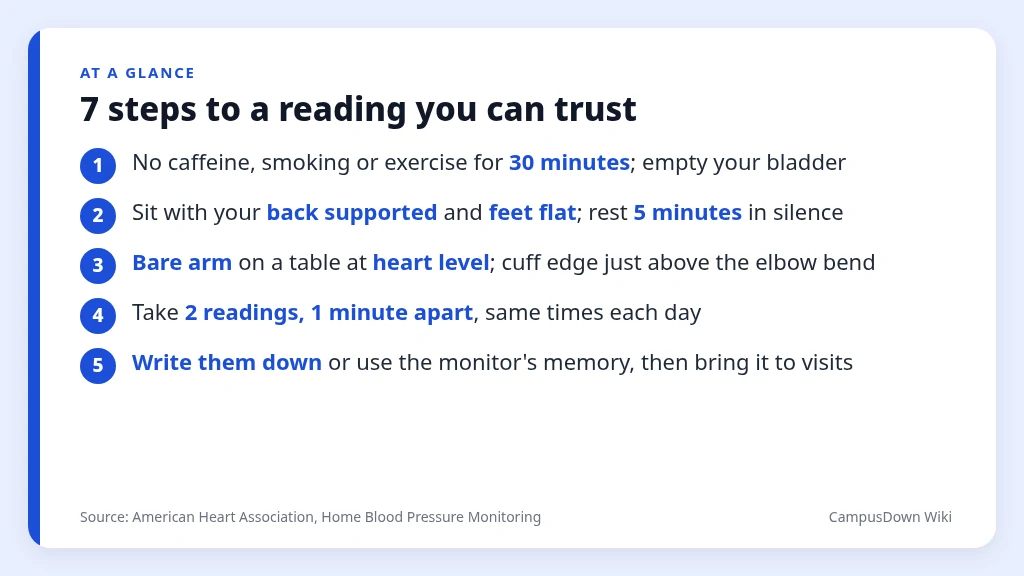
The 7 steps
- Sit in a chair with your back supported and both feet flat on the floor. Do not cross your legs.
2. Remove clothing from the arm you are using. You can use either arm; the difference is usually small. 3. Rest your arm on a flat surface so the middle of the cuff is at heart level. Use a pillow if needed. 4. Place the bottom of the cuff directly above the bend of the elbow, on bare skin. 5. Rest quietly for at least five minutes. Do not talk, read or use your phone. 6. Take two readings one minute apart. 7. Record both results, or let the monitor store them, and measure at the same times each day.
Most monitors come with an illustration of cuff placement. Models such as the Omron Platinum BP5450 can also store readings for two users, which helps couples sharing a device.
Keeping a useful log
Write the date, time, both readings, and anything unusual such as pain, a missed dose, or a poor night's sleep. Bring the monitor itself to a visit about once a year, or as the manufacturer directs, so staff can compare it with office equipment. The AHA offers a printable tracker, and many monitors sync to an app.
Key point
A single high number is not a reason to panic. Repeat it correctly, write both readings down, and share the pattern rather than the scariest moment.
When a reading needs action
Get help now if
If your reading is higher than 180/120, wait at least one minute and measure again. If it is still that high, contact your healthcare professional right away. If you also have chest pain, shortness of breath, back pain, numbness, weakness, vision changes or difficulty speaking, call 911 without waiting.
Readings that are consistently above your target, or unusually low with dizziness, are also worth a call.
Related on CampusDown
To understand what the numbers mean, read blood pressure of 130/80 and High Blood Pressure (Hypertension). Caregivers of older parents may find blood pressure targets for older adults helpful, and nursing students can compare home technique with mean arterial pressure at the bedside.
Frequently asked questions
- Which arm should I use for home blood pressure?
- Either arm can be used, and readings are usually similar. Use the same arm each time so your log is consistent, and ask your clinician if they want you to check both arms once.
- Why are my two readings different?
- Blood pressure changes from moment to moment. The AHA asks for two readings one minute apart so you see a fair picture instead of a single snapshot.
- What time of day should I take my blood pressure?
- Measure at the same times each day. Many people check in the morning before medicine and in the evening. Ask your clinician what schedule they want.
- Can I take my blood pressure lying down?
- The standard home routine is seated with back supported and feet flat. Your clinician may ask for standing readings if dizziness on standing is a concern.
A good home routine takes about ten minutes a day and saves a lot of guessing at the doctor's office. Print the steps, put them next to your monitor, and learn more about which cuff size and device fit you before your next round of readings.
Browse more guides like this in the Home Medical Devices hub.
This article is for general education and does not replace advice from your own doctor, nurse or pharmacist.