
Your patient's blood pressure is 90/45. Is that "a little low" or a reason to call the provider right now? Nursing students meet this question in clinical rotations and on the NCLEX, and the answer usually starts with one calculation: the mean arterial pressure (MAP).

MAP combines the two blood pressure numbers into a single estimate of the pressure pushing blood into organs. This guide covers the formula, two worked examples, and how MAP shows up in sepsis care, so you can take a closer look at the numbers your monitor is already giving you.
What MAP means
Blood pressure swings between systolic (when the heart contracts) and diastolic (when it relaxes). Because the heart spends longer in diastole, the average pressure sits closer to the diastolic number. MAP estimates that average and is used as a marker of organ perfusion: whether the brain, kidneys and heart receive enough blood flow.
Clinical references such as StatPearls (NCBI Bookshelf) describe a MAP below about 60 mm Hg as a level at which vital organs may not be adequately perfused. Many references describe roughly 70 to 100 mm Hg as a typical adult range, though your facility's protocols and the patient's baseline matter.
Key point
MAP is not a diagnosis. It is a quick perfusion check that tells you when to look harder at the patient: mental status, skin, urine output and trends.

The formula and two worked examples
The common bedside estimate is:
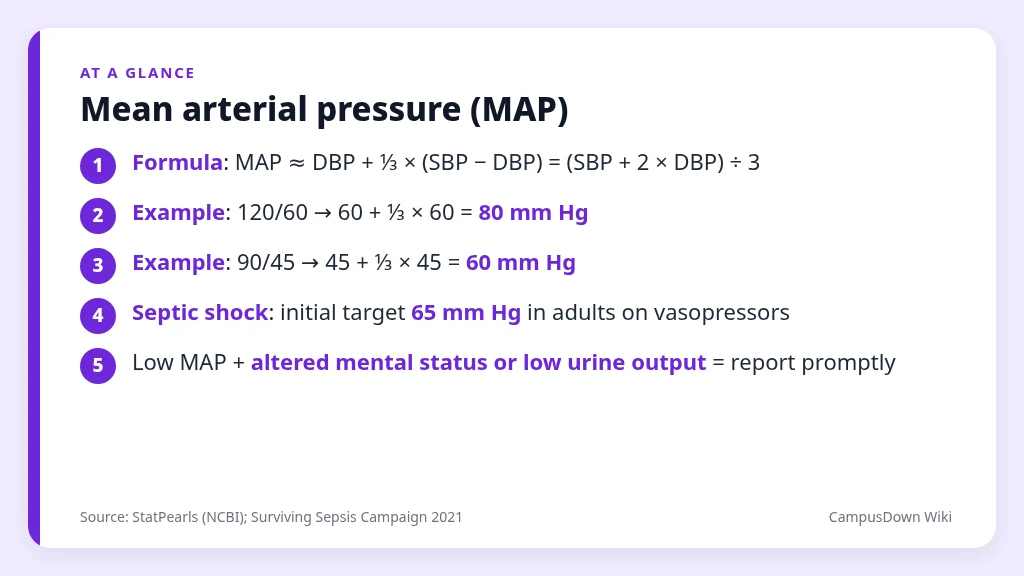
- MAP = DBP + ⅓ × (SBP − DBP), where SBP − DBP is the pulse pressure
- Equivalent form: MAP = (SBP + 2 × DBP) ÷ 3
Example 1: blood pressure 120/60. Pulse pressure is 60. One-third of 60 is 20. MAP = 60 + 20 = 80 mm Hg.
Example 2: blood pressure 90/45. Pulse pressure is 45. One-third of 45 is 15. MAP = 45 + 15 = 60 mm Hg.
Many monitors display MAP automatically, and an arterial line measures it directly. Knowing the formula still matters, because exam questions ask for it and because you need to recognize when a displayed value does not fit the patient in front of you. Practice a few by hand until you can check it for yourself in under 30 seconds.
Example scenario: the 3 a.m. pressure
- Who
- Jess, 23, a final-semester nursing student on a med-surg night shift with her preceptor.
- What happened
- At 3 a.m. her patient, admitted with a urinary tract infection, had a blood pressure of 88/46, a heart rate of 112 and was newly confused about where he was.
- How it felt
- Jess felt her hands go cold. She had calculated MAP on worksheets for months, but this was a real person, and she was afraid of calling too early or too late.
- What they did
- She calculated the MAP at about 60, repeated the vital signs, checked his urine output, and told her preceptor using an SBAR structure. Her preceptor called the rapid response team according to the hospital's sepsis protocol.
- How it turned out
- The team started the facility's sepsis bundle, and the patient was transferred for closer monitoring. Jess said afterward that the math took ten seconds, and the hard part was trusting it enough to speak up. Her preceptor told her that speaking up was exactly the right call.
This is an illustrative example, not a real patient or a review.
Jess's fear is the most normal part of the story. Students worry about bothering staff, but low MAP with new confusion is a pattern that should always be escalated. The next section explains the sepsis connection in detail.
MAP in sepsis and shock
The Surviving Sepsis Campaign 2021 guidelines recommend an initial MAP target of 65 mm Hg for adults with septic shock who need vasopressors. On the NCLEX and in practice, MAP is read together with other signs of poor perfusion:
- New confusion or decreased level of consciousness
- Low urine output
- Cool, mottled skin or delayed capillary refill
- Rising lactate, when available
Read more in sepsis recognition for nurses and types of shock.
How MAP appears on exams
Expect questions that give a blood pressure and ask for the MAP, or that list several patients and ask which one to see first. A MAP near or below 60 to 65 with signs of poor perfusion usually signals a priority. Read the whole stem: a patient's baseline, medicines and symptoms still matter. The NCLEX prioritization guide shows how to rank these.
Get help now if
In clinical practice, report low MAP with confusion, chest pain, low urine output or a sudden change immediately, following your facility's escalation and rapid response policy.
Related on CampusDown
Review Sepsis for the condition and lab values for the NCLEX for the labs that go with it. For outpatient blood pressure categories, compare blood pressure of 130/80, and practice handoffs with SBAR communication.
Frequently asked questions
- What is the formula for mean arterial pressure?
- MAP ≈ diastolic pressure + one-third of the pulse pressure, which equals (systolic + 2 × diastolic) ÷ 3.
- What is a normal MAP?
- Many references describe roughly 70 to 100 mm Hg as typical for adults. Interpretation depends on the patient's baseline and condition.
- Why is MAP 65 important?
- Surviving Sepsis Campaign guidelines recommend an initial MAP target of 65 mm Hg for adults with septic shock on vasopressors.
- Why is diastolic counted twice in the MAP formula?
- The heart spends about twice as long in diastole as in systole during a typical cycle, so the average pressure is weighted toward the diastolic number.
Every nursing student remembers the first time a calculation stopped being homework and started being a patient. Practice the MAP formula until it is automatic, then learn more about sepsis and shock so the number always leads you to the right next action.
Browse more guides like this in the Nursing Student and NCLEX hub.
This article is for general education and does not replace advice from your own doctor, nurse or pharmacist.