
Do you ever blank on a potassium range at the exact moment a question asks what to do next? You're not alone. Lab values are one of the most tested pieces of nursing school, and the numbers only stick when you attach them to a patient.

This cheat sheet uses the MedlinePlus Medical Encyclopedia and lab test pages. It is written for nursing students. The range printed on your facility's lab report always wins over any chart, including this one. If your exam is soon, take a closer look at the table and the habits section.
Why ranges vary
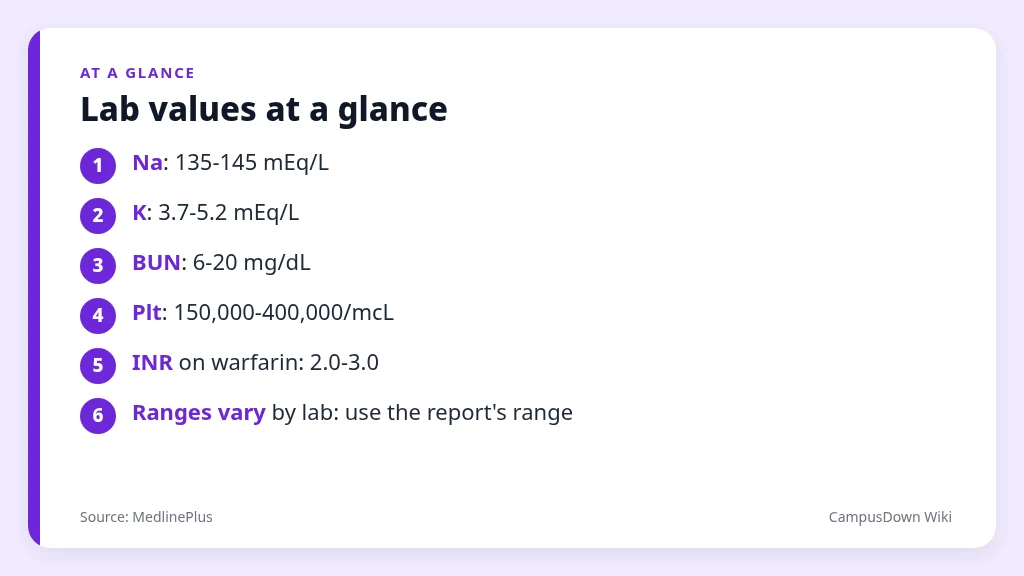
MedlinePlus says normal value ranges may vary slightly among different labs because some labs use different measurements or test different samples. So treat a cheat sheet as the "usual" range. On the unit, read the reference range on the report, and tell the provider about results you're worried about.

Electrolytes and kidney tests
| Test | Typical adult range (MedlinePlus) | Why it matters |
|---|---|---|
| Sodium | 135 to 145 mEq/L | Fluid balance; MedlinePlus lists confusion and seizures as symptoms of too little or too much |
| Potassium | 3.7 to 5.2 mEq/L | Needed by cells, nerves, heart and muscles; abnormal levels can cause irregular heartbeat and muscle weakness |
| Calcium | 8.8 to 10.3 mg/dL | Nerves, muscles and heart; abnormal levels can cause muscle cramps and irregular heartbeat |
| Magnesium | 1.7 to 2.2 mg/dL | Muscle and nerve function |
| CO2 (bicarbonate) | 23 to 29 mEq/L | Affected by kidney and lung function |
| BUN | 6 to 20 mg/dL | Waste from protein breakdown; higher levels may suggest kidneys aren't working well |
| Creatinine | Men 0.7 to 1.3 mg/dL; women 0.5 to 0.95 mg/dL | Waste from muscle use; builds up when kidneys don't filter well |
Our deeper guides cover potassium, sodium and calcium and magnesium. For how creatinine becomes a kidney score, see eGFR explained.
Glucose
MedlinePlus says a fasting blood glucose of 70 to 99 mg/dL is considered normal, and that a random result depends on when the person last ate (most of the time, 125 mg/dL or lower). Your facility's protocol decides what you do with a low or high result.
Blood counts
| Test | Typical adult range (MedlinePlus) |
|---|---|
| WBC | 4,500 to 11,000 per microliter |
| Hemoglobin | Male 13.8 to 17.2 g/dL; female 12.1 to 15.1 g/dL |
| Hematocrit | Male 37% to 48%; female 34% to 43% (as listed on MedlinePlus) |
| Red blood cells | Male 4.2 to 5.7 million/mcL; female 3.8 to 5.1 million/mcL |
| Platelets | 150,000 to 400,000 per microliter |
Clotting tests
MedlinePlus lists a PT of 11 to 13.5 seconds, an INR of 0.8 to 1.1, and a PTT of about 25 to 35 seconds in general. If someone takes warfarin, MedlinePlus says the provider will most likely aim to keep the INR from 2.0 to 3.0. Heparin is monitored differently; see heparin vs warfarin and INR and PTT explained.
Studying so it sticks
- Group values by system: electrolytes, kidney, blood, clotting, gases (see ABG interpretation).
- Learn what each value does in the body, not only the number.
- Ask "is this unexpected for this patient?" and use the priority framework.
- Practice with the hub's study guides.
Get help now if
This page is for education. Never treat a patient from a cheat sheet. Use your facility's lab report ranges, orders and policies, and ask your instructor or preceptor when a result worries you.
Example scenario: the flash card that lied
- Who
- Edwina, 24, a second-semester nursing student in Raleigh, North Carolina, built a color-coded set of lab flash cards from three different websites.
- What happened
- On clinical she saw a patient's calcium listed with a range slightly different from her cards, and she couldn't tell whether the result was normal.
- How it felt
- She felt flustered and embarrassed, afraid she had memorized the wrong thing and that her preceptor would think she hadn't studied.
- What they did
- She admitted the mismatch, and her preceptor showed her the reference range printed on the lab report and explained that labs differ. Edwina rewrote her cards as "usual range, then check the report."
- How it turned out
- She said it felt like losing a crutch, but she became faster at reading the actual report, and she stopped treating a card as the final word.
This is an illustrative example, not a real patient or a review.
Edwina's story is an illustrative example, not a real person or event.
Most-asked questions about nursing lab values
What lab values do nursing students need to know?
Electrolytes, kidney tests, glucose, blood counts and clotting tests are the usual core set; start with the table above.
Why people ask: "lab values nursing" is #1 for "lab values nursing" (US autocomplete, November 2026).
Is there a lab values nursing cheat sheet?
This page is one, built from MedlinePlus ranges, but check your own lab's ranges.
Why people ask: "lab values nursing cheat sheet" is #2 for "lab values nursing" (US autocomplete, November 2026).
What is a nursing lab values chart?
A one-page table of usual ranges; the table above covers the common adult tests.
Why people ask: "lab values nursing chart" is #3 for "lab values nursing" (US autocomplete, November 2026).
What lab values are on the NCLEX?
Questions often assume you know common ranges for electrolytes, kidney, blood and clotting tests; check NCSBN's materials.
Why people ask: "lab values nursing nclex" is #5 for "lab values nursing" (US autocomplete, November 2026).
Are there normal lab values for nursing in a chart?
Yes, and normal ranges vary slightly by lab.
Why people ask: "normal lab values nursing" is #2 for "normal lab values" (US autocomplete, November 2026).
What are normal lab values for adults?
See the tables above for MedlinePlus ranges.
Why people ask: "normal lab values for adults" is #6 for "normal lab values" (US autocomplete, November 2026).
Is there a normal lab values nursing cheat sheet to print?
You can build your own from the tables, but always check the facility's range.
Why people ask: "normal lab values nursing cheat sheet" is #3 for "lab values nursing cheat sheet" (US autocomplete, November 2026).
Related on CampusDown
You can learn more about NCLEX priority questions and check it for yourself with a practice report from your school.
Frequently asked questions
- Why do two charts show different ranges?
- MedlinePlus says normal ranges may vary slightly among labs.
- What's the normal INR on warfarin?
- MedlinePlus says providers will most likely aim for 2.0 to 3.0.
- Are these values the same for children?
- No. MedlinePlus lists different ranges for newborns and infants for some tests, such as hemoglobin.
- Can I use this on clinical?
- Use your facility's reference ranges and policies, and ask your instructor.
Numbers are the start, and the patient attached to them is the point. Build your ranges from reliable sources, then learn to read the report in front of you.
Browse more guides like this in the Nursing Student and NCLEX hub.
This article is for general education and does not replace advice from your own doctor, nurse or pharmacist.
References
- MedlinePlus: Sodium blood test
- MedlinePlus: Potassium blood test
- MedlinePlus: BUN (blood urea nitrogen)
- MedlinePlus: Creatinine blood test
- MedlinePlus: Blood glucose test
- MedlinePlus: Calcium blood test
- MedlinePlus: Magnesium blood test
- MedlinePlus: WBC count
- MedlinePlus: Platelet count
- MedlinePlus: Prothrombin time and INR
- MedlinePlus: Hemoglobin test
- MedlinePlus: Hematocrit test