
Your patient is usually chatty, and today she keeps losing her train of thought. Her sodium came back a little off. Could that be part of why, and what are you supposed to do with that?

This guide is for nursing students and draws on MedlinePlus's sodium blood test (encyclopedia), low blood sodium and Sodium Blood Test pages. It is for learning. Follow your instructor's expectations and your facility's policies, and report changes in a patient's thinking right away. To learn more about related labs, take a closer look at the lab values cheat sheet.
One test, two slightly different "normals"
MedlinePlus's sodium blood test article says the normal range for blood sodium is 135 to 145 mEq/L. Its low blood sodium article says 136 to 144 mEq/L (or mmol/L). Both note that ranges vary slightly among laboratories, and the test article adds that some labs use different measurements or samples.
The practical rule for clinical is simple: use the reference range printed on your facility's report and ask your nurse if something looks borderline. MedlinePlus also says that blood sodium reflects a balance between sodium and water, which is why dehydration and fluid overload can both change the number.

What sodium does
MedlinePlus says sodium is an electrolyte that helps control the amount of fluid and the balance of acids and bases in the body and helps nerves and muscles work properly. The body keeps sodium in a very narrow range, so a result that is too high or too low may point to a kidney problem, dehydration or another condition.
Low sodium (hyponatremia)
MedlinePlus explains that when sodium in the fluid outside cells drops, water moves into the cells and they swell. Brain cells are especially sensitive to swelling, which causes many of the symptoms.
Common symptoms: confusion, irritability, restlessness, convulsions, fatigue, headache, loss of appetite, muscle weakness, spasms or cramps, nausea and vomiting. Causes listed include diuretics (water pills), diarrhea, vomiting, sweating, heart failure, kidney disease, cirrhosis, large burns and SIADH, a condition in which the body holds on to too much water. The sodium test article also lists high blood sugar, an underactive thyroid, Addison disease and medicines such as morphine and SSRI antidepressants, and notes some over-the-counter pain relievers.
MedlinePlus describes three patterns, based on water and sodium in the body: euvolemic (water up, sodium unchanged), hypervolemic (both up, water more) and hypovolemic (both lost, sodium more). Treatment depends on the cause and may include fluids through a vein, medicines for symptoms or limiting water intake, as the provider orders. For the patient-level guide, see low sodium on a blood test and low sodium in older adults.
High sodium (hypernatremia)
MedlinePlus says high sodium may be a sign of dehydration (not drinking enough, diarrhea or diuretics), adrenal gland disorders, kidney disease or diabetes insipidus. The encyclopedia article also lists heavy sweating, burns, too much salt or sodium bicarbonate, and medicines such as corticosteroids, laxatives, lithium and NSAIDs such as ibuprofen or naproxen.
It also mentions people who can't recognize thirst because of cognitive impairment, or can't get enough to drink because they can't reach fluids. Symptoms include thirst, urinating very little, vomiting, diarrhea, confusion, muscle twitching and seizures; without treatment, extremely high levels may lead to coma. Related guides: dehydration in older adults and fluid volume excess and deficit.
Get help now if
Seizures, severe confusion, trouble waking a patient or collapse are emergencies. Call for help according to your facility's process and tell your nurse right away.
What a student can look at
These are learning prompts. Your instructor and facility policy decide what you may do.
- Mental status first: confusion, restlessness, headache or unusual sleepiness are listed symptoms of both low and high sodium.
- Fluid story: vomiting, diarrhea, sweating, poor intake or swelling. Does the patient seem dry or overloaded?
- Medicines: diuretics, SSRIs, opioids, lithium, NSAIDs, laxatives and corticosteroids all appear in the MedlinePlus lists.
- Conditions: heart failure, kidney disease and liver disease can hold extra water; see chronic kidney disease.
- IV fluids: the type of fluid ordered matters, and the orders come from the provider; for the basics, see isotonic and hypotonic IV fluids.
- Pair it with potassium: electrolytes are usually checked together; see potassium normal range and nursing care.
MedlinePlus says providers usually look at sodium together with other electrolytes and tests to find the cause, and that you shouldn't stop any medicine before a test unless the provider tells you to.
Reporting a result
Use a structured format such as SBAR: what you see, the number and the range on the report, how the patient looks and what you want to know. Writing it down first can calm your nerves.
Example scenario: the afternoon fog
- Who
- Nigel, 26, a nursing student in Providence, Rhode Island, was caring for an older woman who took a water pill and had been vomiting the night before.
- What happened
- In the afternoon she kept losing her train of thought mid-sentence, and Nigel remembered that her morning sodium had been flagged.
- How it felt
- He felt a knot in his stomach, unsure whether he was overreacting, and worried about interrupting a busy nurse.
- What they did
- He told the nurse what he noticed, what the lab showed and that her thinking seemed different from the morning. The nurse assessed her, called the provider following unit policy and kept a closer eye on her through the shift.
- How it turned out
- Nigel said he was glad he spoke up and that "something seems different" turned out to be useful information.
This is an illustrative example, not a real patient or a review.
Nigel's story is an illustrative example. Follow your instructor's direction and your facility's policies.
Most-asked questions about the sodium range
What is the normal sodium range by age?
MedlinePlus gives adult ranges only, 135 to 145 or 136 to 144 mEq/L; ask your lab or instructor for age-specific values.
Why people ask: "sodium normal range by age" is #2 for "sodium normal range" (US autocomplete, November 2026).
Is the sodium range different for women?
MedlinePlus gives one adult range and says it varies slightly by laboratory; check the report.
Why people ask: "sodium normal range female" is #3 for "sodium normal range" (US autocomplete, November 2026).
What is the normal sodium range in blood?
MedlinePlus reports 135 to 145 mEq/L in its sodium blood test article and 136 to 144 in its low blood sodium article.
Why people ask: "sodium normal range in blood" is #4 for "sodium normal range" (US autocomplete, November 2026).
What is the sodium normal range in mmol/L?
For sodium, mEq/L and mmol/L are the same number; MedlinePlus lists 136 to 144 mmol/L in its low sodium article.
Why people ask: "sodium normal range mmol/l" is #5 for "sodium normal range" (US autocomplete, November 2026).
What does a low sodium level mean?
Lower than normal sodium is hyponatremia; causes include vomiting, diarrhea, diuretics, heart, kidney or liver conditions.
Why people ask: "sodium normal range low" is #8 for "sodium normal range" (US autocomplete, November 2026).
Related on CampusDown
You can learn more about low sodium for patients and check it for yourself in the nursing student hub. For the lab list in detail, open lab values for the NCLEX.
Frequently asked questions
- Why do two MedlinePlus pages give different sodium ranges?
- Labs differ slightly; the test article lists 135 to 145 and the low sodium article lists 136 to 144. Use your facility's range.
- Why does low sodium cause confusion?
- MedlinePlus says water moves into cells when outside sodium drops, and brain cells are especially sensitive to swelling.
- Can dehydration raise sodium?
- Yes. MedlinePlus lists dehydration as a possible reason for a high sodium result.
- Which medicines can affect sodium?
- MedlinePlus lists diuretics, SSRIs and morphine for low sodium and corticosteroids, laxatives, lithium and NSAIDs for high sodium.
- What should I do if my patient seems confused?
- Tell your nurse or instructor right away and follow your facility's process; confusion has many causes.
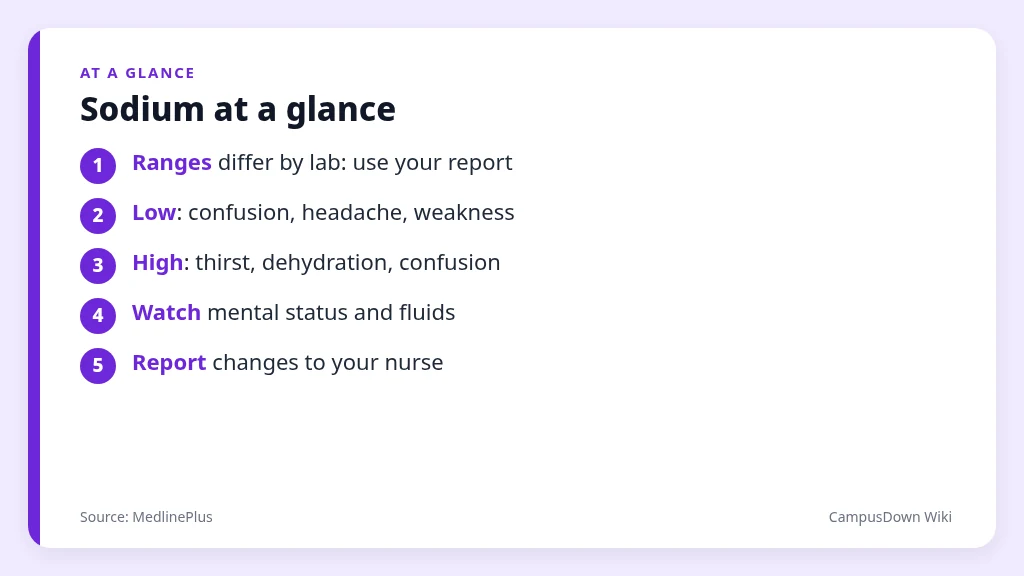
Sodium numbers help you ask better questions. Use your lab's range, watch the patient's thinking and fluids, and report changes early.
Browse more guides like this in the Nursing Student and NCLEX hub.
This article is for general education and does not replace advice from your own doctor, nurse or pharmacist.