
You're about to call a provider about a patient who looks "off," your heart is pounding, and your mind is full of facts. Where do you start? A structure like SBAR gives you the first word, and the next three.

This guide uses AHRQ's TeamSTEPPS SBAR tool and the Institute for Healthcare Improvement (IHI) SBAR tool. It is written for nursing students. Follow your facility's policy and your instructor's expectations. If you want a quick start, take a closer look at the template.
What SBAR stands for
AHRQ says SBAR is a structured communication framework that can help teams share information about a patient's condition or another issue the team needs to address. IHI calls it an easy-to-remember, concrete mechanism for framing any conversation, especially critical ones requiring a clinician's immediate attention and action.
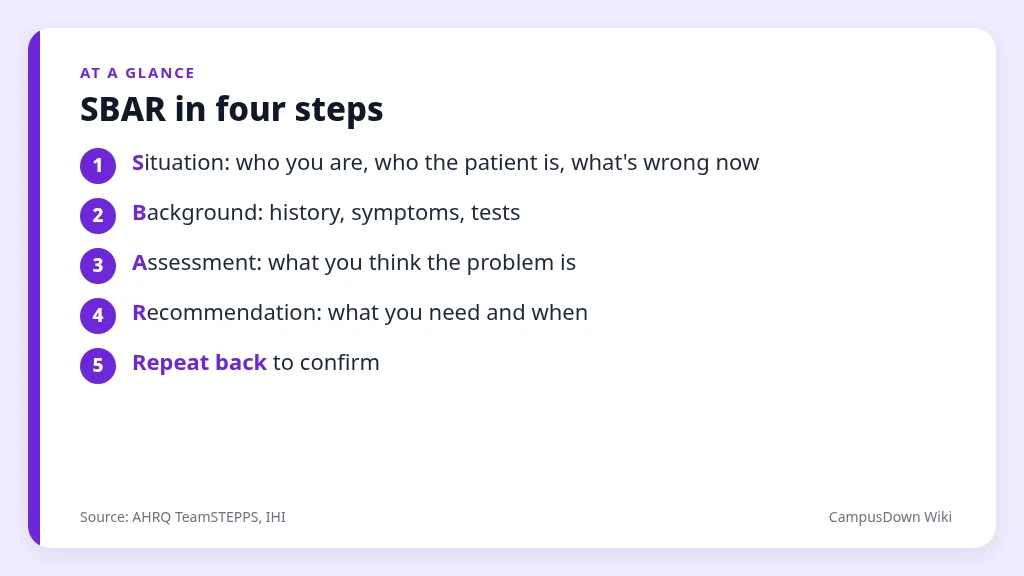
- Situation: what is happening now. AHRQ says it usually begins with who you are, patient identifiers such as age and gender, and a brief statement of the current problem.
- Background: clinical context such as patient history related to the situation, signs and symptoms, and test results such as labs or imaging.
- Assessment: what you think the problem is, based on the background and your observations. AHRQ says assessment can include objective data such as vital signs.
- Recommendation (or Request): what you need and when, with repeat-back of the response to ensure accuracy.

A fill-in template
Write this on a card and fill the blanks before you call:
- S: "This is [your name, role] on [unit]. I'm calling about [patient, age]. The problem is [one sentence]."
2. B: "The patient was admitted for [reason]. Relevant history is [history]. Current symptoms are [symptoms]. Recent results are [labs/imaging]." 3. A: "Vital signs are [vitals]. I think the problem is [your assessment]. I'm concerned because [reason]." 4. R: "I need you to [come see the patient / order X / review Y] by [when]. Do you want me to do anything in the meantime?" 5. Repeat back: "To confirm, you want me to [order]."
AHRQ also suggests that you consider saying the actual words to keep yourself on track: "The situation is…, The background is…, My assessment is…, I recommend…".
Use it as a menu
AHRQ says SBAR is adaptable: think of it as a menu, and choose the parts and order your team needs. It can also be modified for patients or family caregivers to communicate with the care team. AHRQ's clinic example uses SBAR to confirm a patient's symptoms, state a working diagnosis with uncertainty, and say what the patient should do next.
SBAR for handoff vs calling a provider
- Calling a provider: urgent, short, ends with a clear request.
- Shift handoff: the same four parts, with more detail on routine care. Pair it with a report sheet and the charting basics.
- Delegation: be clear about what an LPN or aide should watch for; see delegation.
SBAR and I-PASS
AHRQ says I-PASS has become the preferred handoff tool for patient transitions in many organizations, and that your facility should set a standard protocol for handoffs and make it known to everyone. I-PASS stands for Illness severity (stable, "watcher", unstable), Patient summary, Action list, Situation awareness and contingency planning, and Synthesis by receiver. SBAR is often used for urgent calls, while some units use I-PASS for shift handoff; use whichever your facility requires.
For an example of when to escalate, see sepsis recognition and transfusion reactions.
Common mistakes
- Starting with long background before saying the problem.
- Leaving out your assessment ("I'm not sure, but I'm worried" is still useful).
- Not stating what you need and by when.
- Skipping repeat-back.
- Not using the chain of command if the response doesn't match the concern.
Get help now if
SBAR is a communication tool, not a substitute for clinical judgment or facility policy. Escalate according to your facility's rules, and ask your instructor or preceptor if unsure.
Example scenario: the long background
- Who
- Xavier, 27, a first-year BSN student in Phoenix, Arizona, had to call the provider about a patient with new shortness of breath.
- What happened
- He began with the patient's whole history and got interrupted twice, then forgot the request he had planned to make.
- How it felt
- He felt his face burn with embarrassment and fear that the provider thought he didn't know anything.
- What they did
- His instructor had him rewrite the call as four short sentences, one for each part of SBAR, and rehearse it aloud twice with a classmate.
- How it turned out
- The next call took under a minute, and he said hearing "Situation" in his head felt like a handrail.
This is an illustrative example, not a real patient or a review.
Xavier's story is an illustrative example, not a real person or event.
Most-asked questions about SBAR
What is SBAR in nursing?
A four-part communication framework: Situation, Background, Assessment and Recommendation.
Why people ask: "sbar nursing" is #1 for "sbar nursing" (US autocomplete, November 2026).
Where can I find an SBAR nursing example?
Use the template above and AHRQ's examples; practice with your instructor.
Why people ask: "sbar nursing example" is #2 for "sbar nursing" (US autocomplete, November 2026).
Is there an SBAR nursing template?
Yes; this page has a fill-in version, and IHI offers a worksheet.
Why people ask: "sbar nursing template" is #3 for "sbar nursing" (US autocomplete, November 2026).
What does SBAR mean in nursing?
Situation, Background, Assessment, Recommendation (or Request).
Why people ask: "sbar nursing meaning" is #4 for "sbar nursing" (US autocomplete, November 2026).
What is an SBAR handoff report?
Using the SBAR structure to hand off patient information between caregivers.
Why people ask: "sbar handoff report" is #2 for "sbar handoff" (US autocomplete, November 2026).
Is there an SBAR handoff template?
Use the fill-in template above and your facility's form.
Why people ask: "sbar handoff template" is #5 for "sbar handoff" (US autocomplete, November 2026).
Is there an SBAR handoff example?
The scenario and template above show the structure.
Why people ask: "sbar handoff example" is #4 for "sbar handoff" (US autocomplete, November 2026).
Related on CampusDown
You can learn more about NCLEX priorities and check it for yourself with the new grad first-year guide.
Frequently asked questions
- Who developed SBAR?
- IHI says Michael Leonard, MD, with colleagues at Kaiser Permanente of Colorado, developed the technique.
- Is SBAR only for nurses?
- No. AHRQ says it helps teams, and IHI says it can be adapted for all health professionals.
- Can patients use SBAR?
- AHRQ says it can be modified for patients or family caregivers.
- Does the R mean recommendation or request?
- AHRQ uses "Recommendation (or Request)".
SBAR won't make a hard call easy, but it gives you a clear order for the words. Practice it aloud until it sounds like you.
Browse more guides like this in the Nursing Student and NCLEX hub.
This article is for general education and does not replace advice from your own doctor, nurse or pharmacist.