
Your preceptor says, "If you didn't chart it, it didn't happen." You know that's an exaggeration, but it still raises a fair question: what exactly should a good nursing note look like?
This guide is for nursing students. It draws on ANA's Principles for Nursing Documentation (2010) and RN.org's course Documentation: Accurate and Legal (reviewed March 2025). Your facility's policies, its electronic record system and your instructor's expectations come first; they may differ from what's here. To learn more about related skills, take a closer look at report sheets.
Why documentation matters
ANA says documentation should be accurate, timely, contemporaneous, concise, thorough, organized and confidential, and that written and electronic records provide durable and retrievable information for the team. It adds that documentation that is not timely, accurate, accessible, complete, legible and standardized can interfere with the ability of other caregivers to use it and that records can be important evidence in legal matters; entries that are incomplete, inaccurate, untimely, illegible, false or misleading can lead to a number of undesirable outcomes.
The Joint Commission also lists inadequate, incomplete or nonexistent documentation among the factors when a hand-off fails. In short: the chart is how the team knows what has happened with a patient. It's also how you show your own care.

What a good entry looks like
ANA says documentation should be:
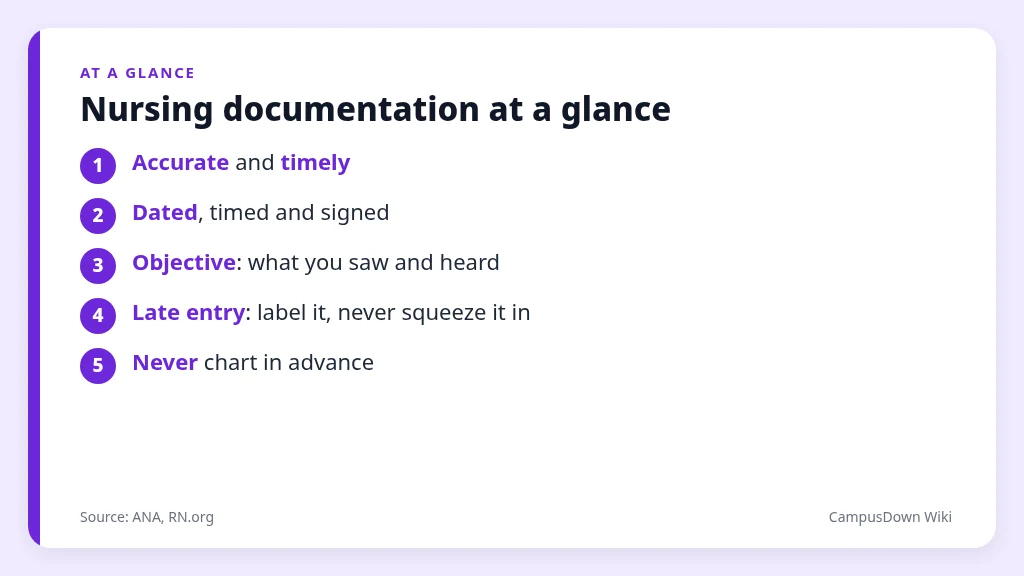
- Accurate, valid and complete
- Authenticated: the information is truthful, the author is identified and nothing has been added or inserted
- Dated and time-stamped by the person who created the entry
- Legible and readable
- Written using standardized terminology, including acronyms and symbols
RN.org adds practical rules: record the time of interventions, put the patient's identifying information on every page, sign every entry, document allergies per policy, and note any omitted or delayed medication or treatment with the reason. On abbreviations, it advises limiting them to a few unambiguous terms and checking them against your facility's approved list.
Objective, not judgmental
RN.org says to avoid subjective descriptive words, especially negative ones, such as tired, angry, confused, bored or rude, and to use observable descriptions instead. Its example is "Yawning every few seconds." You can quote the patient directly: "I'm really angry that I can't get more pain medication when I need it." Compare "patient is anxious" with "patient states, 'My chest feels tight,' and is breathing quickly with hands shaking." The second helps the next person act.
Four common formats
RN.org describes several styles; your facility will use one or a mix.
- Narrative: the most traditional, a written story of care in time order. It's flexible but can be long and hard to scan.
- Problem-oriented (SOAP): problems are numbered and each is charted as Subjective (the patient's statement), Objective (your observations), Assessment and Plan.
- Focus (DAR): a focus is a problem, a change in condition or a concern, charted as Data, Action and Response.
- Charting by exception (CBE): developed to cut time-consuming charting. It uses comprehensive flow sheets with normal findings, references to pre-established standards of nursing practice and bedside charting. Notes are required only when findings differ from what's expected.
Whatever the format, RN.org notes that flow sheets don't replace nursing notes completely.
A DAR example, without drugs or doses
- Focus: Dizziness on standing
- D: Patient states, "I feel dizzy when I stand up." Pulse and blood pressure recorded in the flowsheet. Skin warm and dry.
- A: Patient assisted to sit on the edge of the bed. Nurse notified at this time and the provider contacted per unit policy. Call light placed within reach.
- R: Patient states dizziness has eased after sitting. Remains seated with no fall.
This is an illustration of structure, not a clinical protocol; your instructor will give you the style your program uses.
Late entries
RN.org says late entries must carry the date and time they were actually entered and the words "Late entry" followed by the date and time of the event. A late entry should never be written between or above existing lines to keep the notes chronological. It also points out that timely charting may eliminate late entries. Electronic systems usually have their own late entry or addendum function, so use it rather than trying to "fit" information into an earlier time.
Corrections
In a paper record, RN.org says an error cannot be erased, whited-out or made illegible: draw a line through it and write "error," then sign. In an electronic record, use the system's own correction or addendum process, because systems differ, and keep in mind ANA's point that entries should be authenticated, with nothing added or inserted. When in doubt, ask your instructor or charge nurse.
Never chart in advance
RN.org is blunt: charting in advance is never acceptable, never legal and can lead to errors. Guessing that care will be routine can leave you having to correct entries. This connects to the rule about medications: document after giving, never before. See the rights of medication administration.
Get help now if
If something goes wrong, such as a medication error, tell your instructor or nurse right away and follow your facility's reporting process. RN.org says nursing notes must show what was given, even if it was incorrect, and typically include the medication, who was notified and when, the interventions and the patient's response. Incident reports are handled by facility policy, and whether they are mentioned in the chart varies.
How documentation connects to everything else
- Assessment documentation should follow what you saw; see head to toe assessment.
- Report to the next nurse uses the same facts; see SBAR.
- The nursing process links assessment, planning, intervention and evaluation; see the nursing process.
- High-alert drugs often have extra documentation steps; see high-alert medications.
- When you start your first job, the new grad guide covers how charting speeds up with practice.
Example scenario: the note she wanted to squeeze in
- Who
- Ignatz, 30, a second-career nursing student in Duluth, Minnesota, realized at the end of a busy morning that he hadn't charted a patient's repositioning from earlier in the shift.
- What happened
- His first instinct was to squeeze a note into the space above a later entry so the times would look tidy.
- How it felt
- He felt embarrassed about the oversight and worried what his instructor would think.
- What they did
- He remembered the rule about late entries, labeled his note "Late entry" with the actual time he wrote it and the time of the event, and told his instructor what happened. She reviewed the format with him and showed him how his unit's electronic record handles late entries.
- How it turned out
- Ignatz said the label felt like admitting a mistake at first, but it was just honest charting.
This is an illustrative example, not a real patient or a review.
Ignatz's story is an illustrative example. Follow your instructor's direction and your facility's policies.
Most-asked questions about nursing documentation
What are examples of nursing documentation?
Narrative notes, SOAP progress notes, DAR focus notes and charting-by-exception flow sheets, as RN.org describes.
Why people ask: "nursing documentation examples" is #2 for "nursing documentation" (US autocomplete, November 2026).
Where can I find nursing documentation guidelines?
ANA's Principles for Nursing Documentation and your facility's policies are good places to start.
Why people ask: "nursing documentation guidelines" is #5 for "nursing documentation" (US autocomplete, November 2026).
Is there a nursing documentation PDF?
ANA's principles document and RN.org's course are both available as PDFs; your school may provide templates.
Why people ask: "nursing documentation pdf" is #3 for "nursing documentation" (US autocomplete, November 2026).
What does a sample nursing note look like?
A dated, timed, signed entry that states what you observed, what you did and how the patient responded, in objective language.
Why people ask: "nursing documentation sample" is #7 for "nursing documentation" (US autocomplete, November 2026).
Are there nursing documentation templates?
Many facilities build templates into the electronic record; use the one your facility and school require.
Why people ask: "nursing documentation templates" is #9 for "nursing documentation" (US autocomplete, November 2026).
Related on CampusDown
You can learn more about SBAR and check it for yourself in the nursing student hub. For the report-sheet side in detail, see nursing report sheets.
Frequently asked questions
- What does DAR stand for?
- Data, Action and Response, according to RN.org's description of focus charting.
- What is charting by exception?
- A format using flow sheets of normal findings and standards of practice, with notes only when findings differ from expected, per RN.org.
- How do I write a late entry?
- Label it "Late entry," include the actual date and time written and the date and time of the event, and don't squeeze it above existing lines, per RN.org. Follow your electronic system's process.
- Can I chart before I give a medication?
- No. RN.org says charting in advance is never acceptable.
- How should I fix a charting error?
- On paper, draw a line through it, write "error" and sign; never erase or white it out. In an electronic record, use the system's correction process.
Good documentation is accurate, timely and honest. Write what you saw and did, label late entries and never chart ahead, and ask when your facility's rules are unclear.
Browse more guides like this in the Nursing Student and NCLEX hub.
This article is for general education and does not replace advice from your own doctor, nurse or pharmacist.