
You passed the NCLEX, your badge is laminated and your first shift is in two weeks. What helps new nurses make it through the first year, and how do you pick a unit that will support you?

This guide uses the NCSBN Transition to Practice study, the AACN page on the Vizient/AACN Nurse Residency Program and the U.S. Bureau of Labor Statistics (BLS) Occupational Outlook Handbook. It is general education and has no job listings. Ask your school's career office, your state board and employers for specifics. To learn more about your first-year skills, see SBAR handoff, and take a closer look at the sections below.
What a residency or transition program is
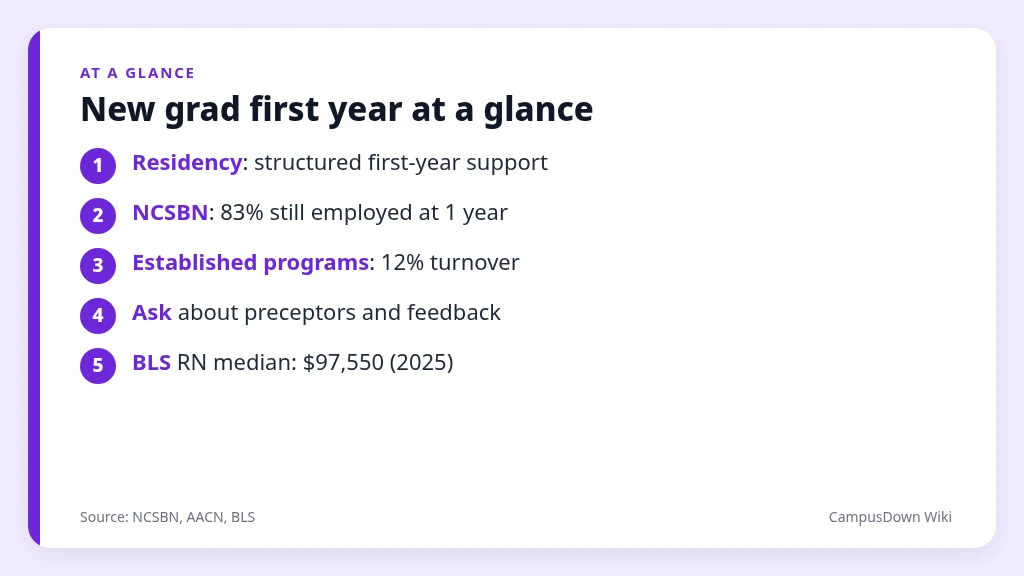
A nurse residency or transition-to-practice program is a structured period of support for new graduate nurses, usually combining classroom or seminar time with unit-based mentoring. Programs differ a lot. AACN describes the Vizient/AACN Nurse Residency Program as focused on new entry-level nurses as they transition into practice, with an evidence-based curriculum in seven key areas:
- Knowledge for nursing practice
- Interprofessional practice
- Person-centered care
- Leadership and systems-based practice
- Development of the professional nurse
- Scholarship for nursing practice
- Foundations of nursing: quality and safety
AACN also says the program helps organizations compare themselves with peers and that it can increase retention and improve patient safety. Those are the program's own claims, so read them as such.

What NCSBN found
NCSBN's multisite Transition to Practice study included 105 hospitals in three states. Hospitals were randomly assigned to adopt NCSBN's model program or to continue their usual onboarding. Surveys at baseline, 6, 9 and 12 months asked new nurses about errors, safety practices, stress and job satisfaction.
Key results from the published paper:
- Retention: turnover data were available for 1,464 new nurses in 97 hospitals. Overall 83% were still employed at the end of the first year; voluntary turnover was 16% and involuntary turnover 1%.
- By program type: established programs had the lowest turnover at 12%, NCSBN's program 14.7% and limited programs nearly 25%.
- Experience: the study group and control group showed few statistically significant differences overall, but when control hospitals were split into established and limited programs, established programs had higher retention, fewer reported errors, higher competence, lower stress and better job satisfaction.
- What good programs include: structured programs with at least six elements, such as patient-centered care, communication and teamwork, quality improvement, evidence-based practice, informatics, safety, clinical reasoning, feedback, reflection and specialty knowledge, supported new nurses better.
The data come from hospitals in 2011, so use them as context, not as a promise about any one program.
Questions to ask in interviews
- Is there a formal residency or transition program, and how long does it last?
- How are preceptors chosen and trained, and how long will I work with one?
- How is feedback given, and how often will I meet with a mentor or educator?
- What is the nurse-to-patient assignment on my unit for new nurses at first, and when does it change?
- How do you support reflection and debriefing after hard shifts?
- What are the unit's turnover and orientation experiences for recent graduates?
What BLS says about the profession
The BLS Occupational Outlook Handbook reports for registered nurses overall (not new grads): a 2025 median pay of $97,550 per year ($46.90 per hour), about 3,465,400 jobs in 2025, projected growth of 6% from 2025 to 2035 (faster than average) and about 180,800 openings each year on average. BLS also notes that many openings come from workers who move to other occupations or leave the workforce. New graduate pay varies by region, setting and employer, so ask for specifics.
Survival skills for the first year
- Organize your shift. See a nursing report sheet "brain".
- Chart carefully. See nursing charting and documentation.
- Speak up clearly. Practice SBAR for calls and handoffs.
- Assess systematically. Review head-to-toe assessment.
- Know the risky drugs. Read high-alert medications.
- Mind your own health. Stress is real; learn about burnout and use your employer's support services.
Get help now if
If you ever feel unsafe in an assignment, tell your charge nurse, preceptor or manager right away and follow your facility's process. Patient safety comes before pride.
Example scenario: the Tuesday that went sideways
- Who
- Yasmin, 23, a new graduate nurse on a medical-surgical unit in Tampa, Florida, was two weeks into her residency program.
- What happened
- A patient's condition changed while two other patients needed her at once, and she froze for a moment.
- How it felt
- She felt embarrassed and sure that the experienced nurses were judging her.
- What they did
- She told her preceptor what had happened at the end of the shift, and her preceptor walked through the events with her and helped her practice an SBAR call for next time. Her residency seminar that week covered prioritizing.
- How it turned out
- Yasmin said she felt less alone, and the structure of the program made it easier to say "I need help."
This is an illustrative example, not a real patient or a review.
Yasmin's story is an illustrative example. Real orientation programs vary; ask your employer about yours.
Most-asked questions about new grad nurses
Where are new grad nurse jobs?
This guide doesn't list jobs; use your school's career office, your state's hospitals and each employer's careers page.
Why people ask: "new grad nurse jobs" is #1 for "new grad nurse" (US autocomplete, November 2026).
What are new grad nurse residency programs?
Structured first-year programs; AACN's Vizient/AACN Nurse Residency Program is one example with a seven-area curriculum.
Why people ask: "new grad nurse residency programs" is #4 for "new grad nurse" (US autocomplete, November 2026).
What should a new grad nurse resume include?
Ask your school's career office; it can review your clinical rotations, certifications and licensure status.
Why people ask: "new grad nurse resume" is #7 for "new grad nurse" (US autocomplete, November 2026).
What is a new grad nurse residency?
A structured transition period with mentoring and education to support the first year.
Why people ask: "new grad nurse residency" is #8 for "new grad nurse" (US autocomplete, November 2026).
What is the new grad nurse salary?
BLS reports a $97,550 median for all RNs in 2025, not for new grads; ask each employer.
Why people ask: "new grad nurse salary" is #9 for "new grad nurse" (US autocomplete, November 2026).
Related on CampusDown
You can learn more about a 6-week NCLEX study plan and check it for yourself with the Nursing Student and NCLEX hub.
Frequently asked questions
- Do I need a residency program?
- Not required, but NCSBN found hospitals with established programs had higher first-year retention and better reported outcomes.
- How many new nurses leave in the first year?
- In NCSBN's study, 83% of new nurses were still employed at the hospital after a year; 17% were not, including 16% voluntary turnover.
- Is the BLS pay figure what a new grad earns?
- No. It is the 2025 median for all registered nurses.
- What is the Vizient/AACN program?
- A nurse residency program for new entry-level nurses with a seven-area, evidence-based curriculum.
The first year is easier with structure, a good preceptor and honest feedback. Ask about all three before you accept an offer, and keep asking for help once you've started.
Browse more guides like this in the Nursing Student and NCLEX hub.
This article is for general education and does not replace advice from your own doctor, nurse or pharmacist.