
Are you studying for the NCLEX by doing whatever topic feels urgent today? Many graduates do, and then realize in week five that they barely touched pharmacology or safety. A plan built on the official test plan fixes that.

NCSBN does not publish an official study calendar. What it does publish is exactly how much of the NCLEX-RN comes from each area. Here is how to turn those numbers into 6 to 8 weeks of steady work. Take a closer look at the percentages first.
Start with the official percentages
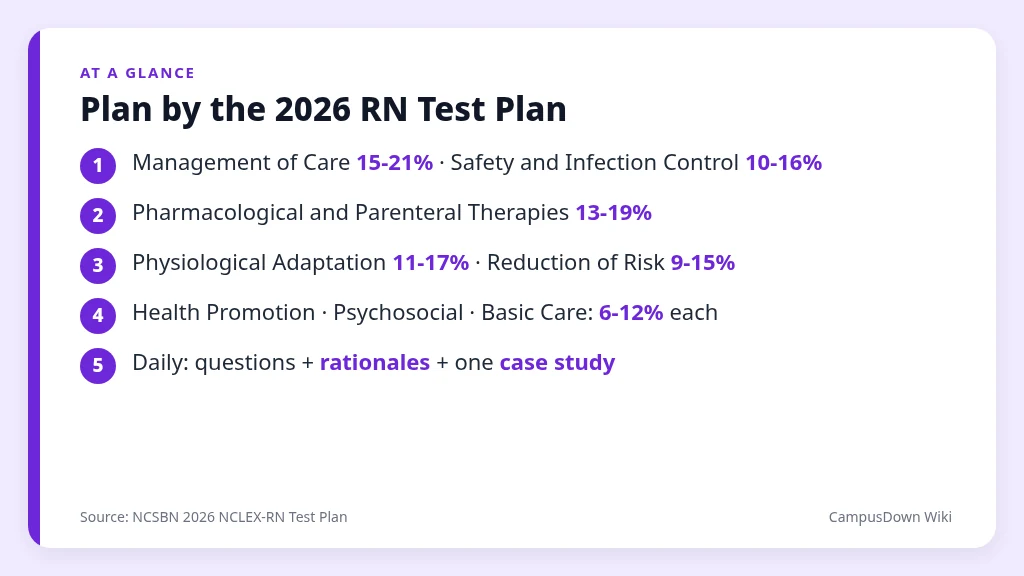
The 2026 NCLEX-RN Test Plan, effective April 1, 2026, lists these ranges:
| Client Needs category | Share of items |
|---|---|
| Management of Care | 15-21% |
| Safety and Infection Prevention and Control | 10-16% |
| Health Promotion and Maintenance | 6-12% |
| Psychosocial Integrity | 6-12% |
| Basic Care and Comfort | 6-12% |
| Pharmacological and Parenteral Therapies | 13-19% |
| Reduction of Risk Potential | 9-15% |
| Physiological Adaptation | 11-17% |
Clinical judgment case studies span content areas and are counted separately; see the NGN format.

A sample 6-week framework
This is one way to organize, not an official schedule. Stretch it to 8 weeks if you work.
- Week 1: baseline practice test, then Management of Care: prioritization, delegation and ethics.
- Week 2: Safety and Infection Prevention: isolation, fall and restraint safety, error prevention.
- Week 3: Pharmacology: drug classes, high-alert medications, dosage calculation, lab values.
- Week 4: Physiological Adaptation and Reduction of Risk: complications, monitoring, emergencies.
- Week 5: Health Promotion, Psychosocial, Basic Care and Comfort.
- Week 6: mixed practice, full-length timed practice, light review, rest before test day.
What a study day looks like
- A block of mixed questions, then read every rationale, including for items you got right.
- One full case study to practice all six clinical judgment steps.
- A short written list of what you missed and why: knowledge gap, misread, or changed answer.
- Practice select-all-that-apply items on their own rules.
Track your weak areas honestly
Keep a simple log with three columns: topic, why you missed it, and what you will review. After two weeks, patterns appear. If most misses are misreads, slow down and identify what the question is really asking. If most are knowledge gaps, go back to content. If you often change right answers to wrong ones, practice committing once you have a reason. NCSBN's Candidate Performance Report uses the same test plan categories, so tracking by category now mirrors how results are reported to candidates who need to retest.
Build stamina for five hours
The NCLEX allows five hours including breaks, with up to 150 items. Do at least one or two long timed sessions so your focus holds late in the exam.
A schedule only works if real life fits around it. Here is how one graduate made it fit.
Example scenario: the plan that bent but did not break
- Who
- Hannah, 27, a new graduate and single mom in Wisconsin, was working part-time as a nursing assistant while preparing for the NCLEX-RN.
- What happened
- By week three she was two days behind, had skipped pharmacology twice, and was getting low scores on medication questions.
- How it felt
- She felt guilty and discouraged, and wondered if she should push her test date back.
- What they did
- She moved to an 8-week version, studied in two short blocks around her daughter's bedtime, and swapped weekends for longer timed practice while her mother babysat.
- How it turned out
- Her medication scores climbed steadily, she kept her rescheduled date, and she said the calendar on the fridge made her daughter cheer her on every night.
This is an illustrative example, not a real patient or a review.
Hannah is an illustrative example, not a real person.
Get help now if
If stress is affecting sleep, eating or mood, that matters as much as your scores. See NCLEX test anxiety and talk to your doctor or a counselor.
Most-asked questions about NCLEX study plans
How do I make an NCLEX study plan?
Weight your weeks by the official test plan percentages, practice daily questions with rationales and case studies, and schedule timed practice.
Why people ask: "nclex study plan" is the #1 Google suggestion for that query (US autocomplete, November 2026).
Is there a free NCLEX study plan template or PDF?
NCSBN publishes the free test plan PDF and a candidate tutorial; build your own calendar from the percentages.
Why people ask: "nclex study plan pdf free" is #2 and "nclex study plan template" is #3 (US, November 2026).
How long should I study for the NCLEX?
There is no official number. Many students plan several weeks; choose a length that lets you cover every category with practice and rest.
Why people ask: "how long to study for nclex" is #1 for that query, and "how long to study for nclex after graduation" is #2 (US, November 2026).
Is there an NCLEX study plan for 2026?
Use the 2026 NCLEX-RN Test Plan, effective April 1, 2026, through March 31, 2029.
Why people ask: "nclex study plan 2026" is #4 for "nclex study plan" (US, November 2026).
Frequently asked questions
- Should I study by system or by test plan category?
- Either can work; check your coverage against the test plan percentages each week.
- When should I schedule my exam?
- After your Authorization to Test arrives; you must test within its validity dates.
- What about the PN exam?
- Use the 2026 PN Test Plan, which has its own percentages.
- Should I study the day before?
- Many people do light review and rest; plan what works for you.
A plan built on the test plan keeps you honest about weak areas. You can learn more from the official percentages in detail and check it for yourself each week, and adjust your weeks to protect sleep and health.
Browse more guides like this in the Nursing Student and NCLEX hub.
This article is for general education and does not replace advice from your own doctor, nurse or pharmacist.