
Do you freeze when you see "select all that apply"? Many students do, partly because the old rumor was that one wrong click meant zero credit. On the Next Generation NCLEX, that is not how it works, and knowing the real rule changes your strategy.

Here is how NCSBN scores SATA items, plus a practical method you can use on every one. Take a closer look at the plus/minus rule before your next practice set.
What a SATA item looks like
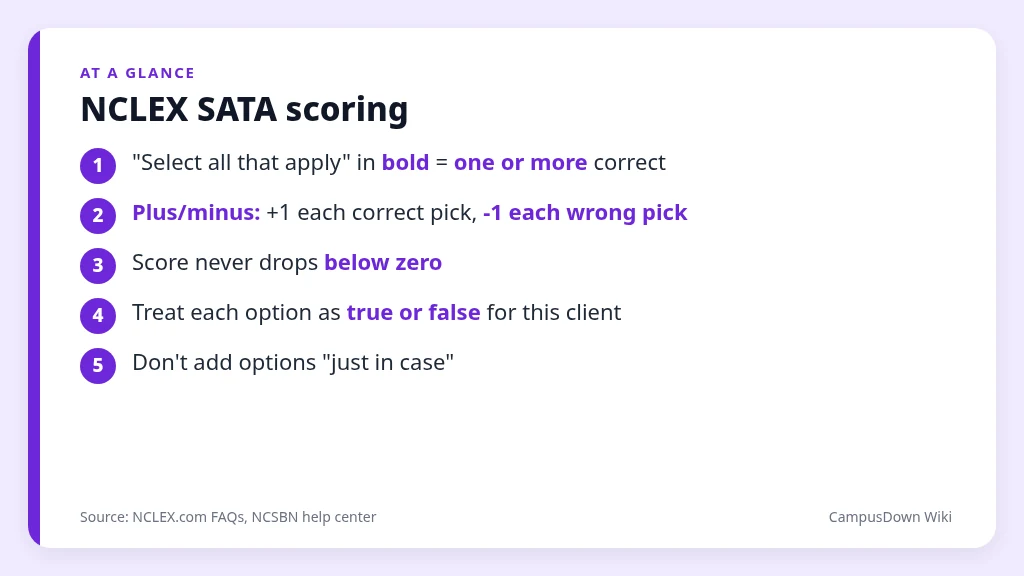
NCSBN says the multiple response (select all that apply) format shows "select all that apply" in bold, and that one or more of the options will be correct. That means a single correct option is possible, and so is "all of them." On NGN, a bigger version called extended multiple response offers more options with partial credit; see the NGN format.

How SATA is scored now
NCSBN's help center says SATA items are scored using a polytomous method that allows partial scoring. The NCLEX FAQ explains the plus/minus rule used when you may select an unspecified number of options:
- You earn a point for each correct option you select.
- You lose a point for each incorrect option you select.
- The maximum equals the number of correct options; the minimum is zero.
So adding an option "just in case" can erase a point you earned. Items that tell you to choose a specific number use the zero/one rule instead, with no deduction.
A step-by-step method
- Read the stem first and name the client, the problem and what is being asked: assessment, action, teaching, or expected finding.
2. Cover the options and predict what belongs. 3. Judge each option as true or false for this client, on its own. Do not compare options to each other. 4. Watch absolutes and scope: options that are outside the nurse's role or not specific to the client's condition are often false. 5. Stop when you run out of reasons. Select only options you can justify. 6. Use the nursing process: assessment before action when the situation is unclear; see the nursing process.
A worked example of the scoring
Imagine an item with six options, three of which are correct. If you choose all three correct options and nothing else, you earn the maximum of 3. If you choose those three plus one incorrect option, you earn 3 minus 1, or 2. If you choose one correct and two incorrect options, the math gives -1, but the score is set at the minimum of zero. This is an illustration of the rule NCSBN describes, not an actual exam item, but it shows why each extra click should have a reason behind it.
Common traps
- Selecting true statements that do not answer the question asked, like a correct fact about a different complication.
- Picking actions that need a provider's order when the stem asks for an independent nursing action.
- Choosing everything that sounds "safe" without linking it to this client.
Strategy is easier to read than to do under pressure. Here is how one student rebuilt her approach.
Example scenario: the "just in case" habit
- Who
- Ji-woo, 22, a BSN student in California, consistently scored low on practice SATA items even though she knew the content.
- What happened
- Reviewing rationales, she found she almost always clicked one or two extra options "just in case," which cost her points under plus/minus scoring.
- How it felt
- She felt frustrated and a little foolish, because she had been losing points she had already earned.
- What they did
- Her study partner suggested saying "true because..." out loud for each option and leaving it blank if she could not finish the sentence. She practiced 20 SATA items a day this way.
- How it turned out
- Within two weeks her SATA scores rose, and she said the questions felt less like traps and more like a checklist she understood.
This is an illustrative example, not a real patient or a review.
Ji-woo is an illustrative example, not a real person.
Get help now if
Third-party question banks may score SATA differently from the NCLEX. You can check it for yourself in NCSBN's official FAQ and tutorial.
Most-asked questions about SATA
How are NCLEX SATA questions scored?
With partial credit. Under plus/minus scoring you gain a point for each correct pick and lose one for each wrong pick, never below zero.
Why people ask: "nclex sata scoring" is the #1 Google suggestion for "nclex sata" (US autocomplete, November 2026).
Do NCLEX SATA questions give partial credit?
Yes. NCSBN says SATA items use a polytomous method that allows partial scoring.
Why people ask: "nclex sata questions partial credit" is #7 for "nclex sata", and "partial credit select all that apply nclex" is #9 for "select all that apply nclex" (US, November 2026).
What are the NCLEX SATA rules?
One or more options are correct; the qualifier appears in bold. Over-selecting can cost points.
Why people ask: "nclex sata rules" is #10 for "nclex sata", and "select all that apply nclex rules" is #4 (US, November 2026).
What are the best NCLEX SATA tips?
Judge each option independently against the client in the stem, and select only what you can justify.
Why people ask: "nclex sata tips" is #4 for "nclex sata" (US, November 2026).
Frequently asked questions
- Can a SATA item have only one correct answer?
- Yes. NCSBN says one or more options will be correct.
- Can every option be correct?
- Yes, it is possible.
- Is there a set number of SATA items on the exam?
- No. NCSBN says there is no predetermined percentage of item formats.
- How do I practice?
- Daily mixed sets with rationales inside your study plan, and prioritization practice with ABCs and Maslow.
SATA rewards precision more than coverage. You can learn more about NCLEX scoring in detail on NCLEX.com, and practice until "true because" becomes automatic. The exam length does not tell you how you did; see why the NCLEX stops.
Browse more guides like this in the Nursing Student and NCLEX hub.
This article is for general education and does not replace advice from your own doctor, nurse or pharmacist.