
Why does the NCLEX now feel more like a shift on the floor than a quiz? Because since April 1, 2023, the Next Generation NCLEX (NGN) asks you to read a client's chart, notice what matters and decide what to do, step by step.

This guide explains the format using the official 2026 NCLEX-RN Test Plan, effective April 1, 2026, through March 31, 2029. If your test date is coming up, take a closer look at the case study and scoring sections.
What changed with NGN
NCSBN says the NGN launched to better measure candidates' clinical judgment and decision making using new item types. The need came from its 2013-2014 Strategic Practice Analysis, which showed new nurses are increasingly expected to make complex decisions.

The exam length, in numbers
According to the 2026 RN Test Plan:
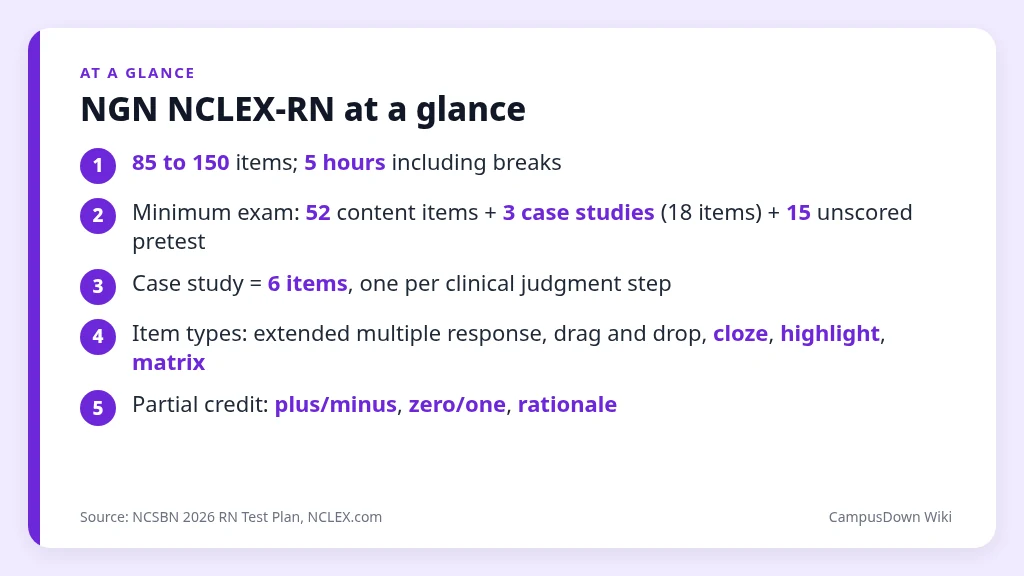
- Minimum: 85 items. Maximum: 150 items.
- Time: five hours, including all breaks.
- In a minimum-length exam: 52 items from the eight content areas, 18 items in three clinical judgment case studies, and 15 unscored pretest items you cannot tell apart from scored ones.
- About 10% stand-alone clinical judgment items may be selected, depending on exam length.
The length of your exam is not a sign of pass or fail. See why the NCLEX can stop at 85.
Case studies: six items, six steps
Each case study has six items about the same client, with information that unfolds. Each item measures one step of the NCSBN Clinical Judgment Measurement Model: recognize cues, analyze cues, prioritize hypotheses, generate solutions, take action and evaluate outcomes. It builds on the nursing process you already know.
The five NGN item types
NCSBN's help center lists five item types that measure clinical judgment:
- Extended multiple response: select one or more options, with more options than old SATA and partial credit.
2. Extended drag and drop: move options into answer spaces; not every option has to be used. 3. Cloze (drop-down): pick one option from one or more drop-down lists in a sentence, table or chart. 4. Enhanced hot spot (highlighting): highlight words or phrases in a chart excerpt, such as a nursing note or lab results. 5. Matrix/grid: choose options for each row or column.
NCSBN says there is no predetermined percentage of item formats; items are chosen by ability and difficulty.
How partial credit works
Per NCLEX.com FAQs, items with more than one key use three methods:
- Plus/minus: you earn a point for each correct option and lose one for each incorrect option, with a minimum of zero. Used when you can select any number of options, so guessing extra options can cost points. More in SATA strategy.
- Zero/one: used when told to choose a specific number; correct picks earn points, wrong picks do not subtract.
- Rationale: both parts of a linked pair, such as a cause and its effect, must be correct.
Knowing the rules is half of it. Here is what the change felt like for one student.
Example scenario: from memorizing to thinking
- Who
- Aaliyah, 23, a BSN senior in Georgia, had always scored well on unit exams by memorizing lab values.
- What happened
- On her first NGN-style practice case, she rushed through the nurses' notes, highlighted every abnormal vital sign, and lost points on a plus/minus item.
- How it felt
- She felt embarrassed and worried that her study method was wrong all along.
- What they did
- Her clinical instructor showed her how to read the case in order: what is the cue, what does it mean, what is most urgent, then act. She practiced one case study a day and wrote the six steps on her note board.
- How it turned out
- Two weeks later she finished cases more slowly but more accurately, and she told her study group the questions finally felt like real patients instead of trivia.
This is an illustrative example, not a real patient or a review.
Aaliyah is an illustrative example, not a real person.
Get help now if
Practice question banks are not official NCLEX items. Use the free NCLEX tutorial and NCSBN's exam preview to see real formats, and check it for yourself on NCLEX.com.
Most-asked questions about the NGN
What are the NCLEX next gen question types?
Extended multiple response, extended drag and drop, cloze (drop-down), enhanced hot spot (highlighting) and matrix/grid, per NCSBN's help center.
Why people ask: "nclex next gen question types" is the #4 Google suggestion for "nclex next gen" (US autocomplete, November 2026).
How many case studies are on the NCLEX next gen?
The 2026 RN Test Plan describes three case studies of six items each in a minimum-length exam. Some searches mention five, but the test plan says three.
Why people ask: "nclex next gen case studies" is #10 for "nclex next gen", and "nclex 85 questions 5 case studies" is #5 for "nclex 85 questions" (US, November 2026).
How many questions are on the NCLEX?
Between 85 and 150 items, including 15 unscored pretest items, within five hours.
Why people ask: "how many questions on nclex" is #1 for that query, and "how many questions on nclex next gen" is #6 (US, November 2026).
Is there a fixed number of SATA questions on the NCLEX?
No. NCSBN says there is no predetermined percentage of item formats.
Why people ask: "how many sata questions on nclex" is #10 for "how many questions on nclex" (US, November 2026).
Frequently asked questions
- Does the PN exam use the same format?
- The 2026 PN Test Plan is also effective April 1, 2026; check its own details on NCLEX.com.
- Can I go back to change an answer?
- No. Once you confirm and press Next, you cannot return to a previous item.
- Is there a calculator?
- An on-screen calculator and an erasable note board are provided.
- How should I round calculation answers?
- NCSBN says round at the end, and enter a decimal point when the item asks for decimals.
NGN rewards the same thinking you use with real patients. Learn more in detail from the official test plan, and practice full case studies, not just single questions, inside a realistic study plan.
Browse more guides like this in the Nursing Student and NCLEX hub.
This article is for general education and does not replace advice from your own doctor, nurse or pharmacist.