
Four call lights, one of you: who do you see first? NCLEX priority questions put you exactly there, and they are hard because every option usually sounds important.

The good news is that a few frameworks cover most of these items. Here is how they work, where they conflict, and how to use them without ignoring the client in front of you. Take a closer look at the ABC versus CAB section, because it trips people up.
Where prioritization shows up on the NCLEX
The 2026 NCLEX-RN Test Plan lists "prioritize the delivery of client care based on acuity" under Management of Care, which makes up 15-21% of the exam. Prioritizing is also step three of the clinical judgment model: prioritize hypotheses by urgency, likelihood, risk, difficulty and time constraints.

Framework 1: ABCs
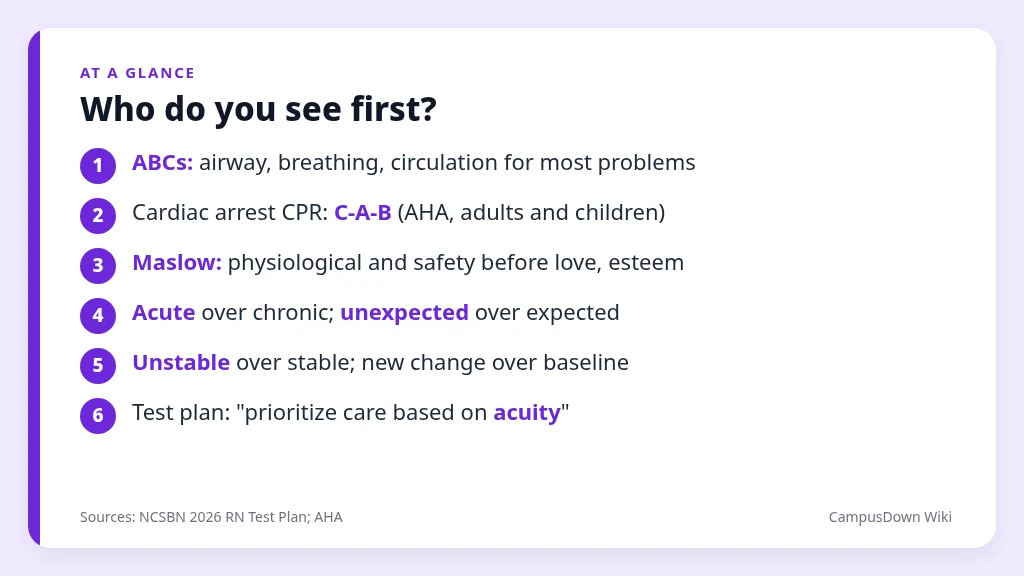
For most physiological problems, think airway, breathing, circulation. An airway threat, such as stridor or swelling after a new medication, usually comes before a breathing problem, which usually comes before a circulation problem. Lab patterns like those in ABG interpretation can show how urgent a breathing problem is.
ABC vs CAB
For cardiac arrest, the American Heart Association changed CPR in 2010 from A-B-C to C-A-B (compressions, airway, breathing) for adults and children, excluding newborns, so compressions start without delay. On the NCLEX, use C-A-B for an unresponsive client without normal breathing or pulse, and ABCs for the client who is still alive and in distress.
Framework 2: Maslow's hierarchy
Physiological needs and safety come before love and belonging, esteem and self-actualization. A client's anxiety about a diagnosis matters, but a low oxygen saturation comes first.
Framework 3: acute vs chronic, unexpected vs expected
- Acute and new problems usually come before chronic, stable ones.
- Unexpected findings come before findings expected for the condition. Crackles in a client with known chronic heart failure at baseline may be less urgent than new confusion in a post-op client, which can signal sepsis or other problems.
A worked example
After report you have four clients: a client with chronic kidney disease whose potassium is in their usual range, a post-op client who is newly restless with a rising heart rate, a client with diabetes asking about discharge teaching, and a client with a hip fracture rating pain as moderate after a recent dose. Using the frameworks, the newly restless post-op client is unexpected, acute and possibly unstable, so that client comes first. The pain and teaching needs are real, but they can follow a quick safety check. This is a teaching example, not an actual NCLEX item.
Framework 4: stable vs unstable
The unstable client, whose condition is changing or unpredictable, comes first. Stable clients with predictable outcomes are also the ones you can delegate or assign to others.
Frameworks are a starting point. Here is how one student learned to use them.
Example scenario: the loudest call light
- Who
- Brandon, 26, a second-career nursing student in Ohio who used to be a restaurant manager, kept missing priority questions on practice exams.
- What happened
- He often picked the client who was most upset or had the most diagnoses, like a client in pain demanding medication, instead of the quiet client with new restlessness after surgery.
- How it felt
- He felt confused and annoyed, because in his old job the loudest customer always came first.
- What they did
- His instructor had him label each client in a question as stable or unstable and expected or unexpected before reading the options.
- How it turned out
- His scores improved, and during his preceptorship he caught a quietly declining patient early, which made him proud and a little shaken at how easy it would have been to miss.
This is an illustrative example, not a real patient or a review.
Brandon is an illustrative example, not a real person.
Get help now if
On a real unit, follow your facility's policies and rapid response criteria and escalate concerns. You can check it for yourself in your clinical orientation materials.
Most-asked questions about prioritization
How do I answer NCLEX priority questions?
Identify which client or finding is an immediate threat using ABCs, Maslow, acute vs chronic and unstable vs stable, then confirm against the specific details.
Why people ask: "nclex priority questions" is the #1 Google suggestion for that query, with "nclex priority questions tips" at #2 (US autocomplete, November 2026).
What is ABC vs CAB on the NCLEX?
ABCs guide most priorities; for cardiac arrest CPR, the AHA uses C-A-B for adults and children.
Why people ask: "abc vs cab nclex" is #6 for "abc nclex" (US, November 2026).
What are examples of NCLEX priority questions?
Typical examples ask which client to see first after report, or which finding to report first to the provider.
Why people ask: "nclex priority questions examples" is #3 for "nclex priority questions" (US, November 2026).
Are prioritization questions on the NCLEX-RN only?
Prioritizing by acuity is in the RN test plan; PN candidates should check the PN test plan for their activities.
Why people ask: "nclex rn priority questions" is #10 for "nclex priority questions" (US, November 2026).
Frequently asked questions
- Does pain always come after ABCs?
- Often, but severe or new pain can be a sign of an acute problem; read the details.
- Is assessment always first?
- When the situation is unclear, gather data first; when danger is clear, act.
- What about SATA priority items?
- Judge each option on its own; see SATA strategy.
- How do I practice?
- Mixed priority sets daily, explaining out loud why the first client comes first.
Priority questions reward calm, consistent thinking. You can learn more in detail from the test plan's Management of Care section, and practice naming the threat before you choose.
Browse more guides like this in the Nursing Student and NCLEX hub.
This article is for general education and does not replace advice from your own doctor, nurse or pharmacist.