
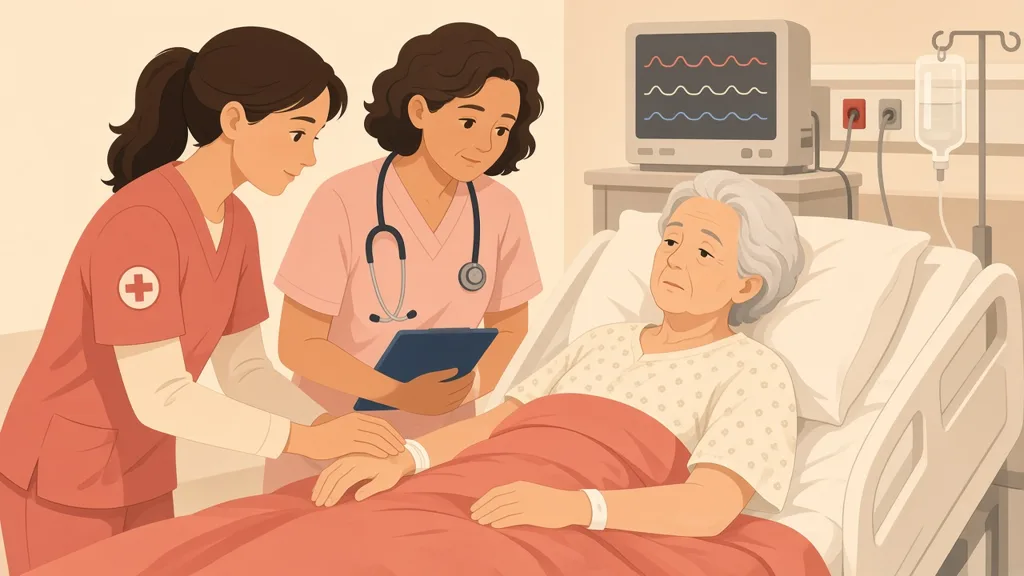
A patient with a urinary infection was fine at 8 a.m. and "just a little sleepy" at noon. Is that a normal bad day, or the first quiet sign of sepsis? Learning to notice the change is one of the most valuable skills in nursing school.
This guide uses CDC, MedlinePlus and the 2021 Surviving Sepsis Campaign (SSC) adult guidelines. It is written for nursing students. Your facility's sepsis protocol and your instructor come first. If you have an exam soon, take a closer look at the escalation section.
What sepsis is
CDC says sepsis is the body's extreme response to an infection and a life-threatening medical emergency. It happens when an infection you already have triggers a chain reaction throughout the body. Infections that lead to sepsis most often start in the gastrointestinal tract, lung, skin or urinary tract. Without fast treatment, sepsis can quickly lead to tissue damage, organ failure and death. MedlinePlus adds that severe cases can lead to septic shock, where blood pressure drops to a dangerous level and multiple organs can fail.
CDC estimates about 1.7 million adults in the U.S. develop sepsis each year, and at least 1 in 5 of them die during hospitalization or are discharged to hospice. It also says most cases start before a patient goes to the hospital. For the broader topic, see our sepsis overview.

Who is at higher risk
MedlinePlus lists adults 65 or older, people with chronic conditions such as diabetes, lung disease, cancer and kidney disease, people with weakened immune systems, pregnant women, and children younger than one. CDC says most people who develop sepsis have at least one underlying medical condition or recent hospitalization.
What it can look like
CDC and MedlinePlus list signs that can occur in any combination:
- Clammy or sweaty skin
- Confusion or disorientation
- Extreme pain or discomfort
- Fever, shivering or feeling very cold
- High heart rate or a weak pulse (rapid breathing and heart rate)
- Shortness of breath
MedlinePlus notes that many signs also fit other conditions, so sepsis can be hard to diagnose early. That is why a new change in someone with an infection matters. Your lab reference is in the lab values cheat sheet.
Screening: what the SSC guideline says
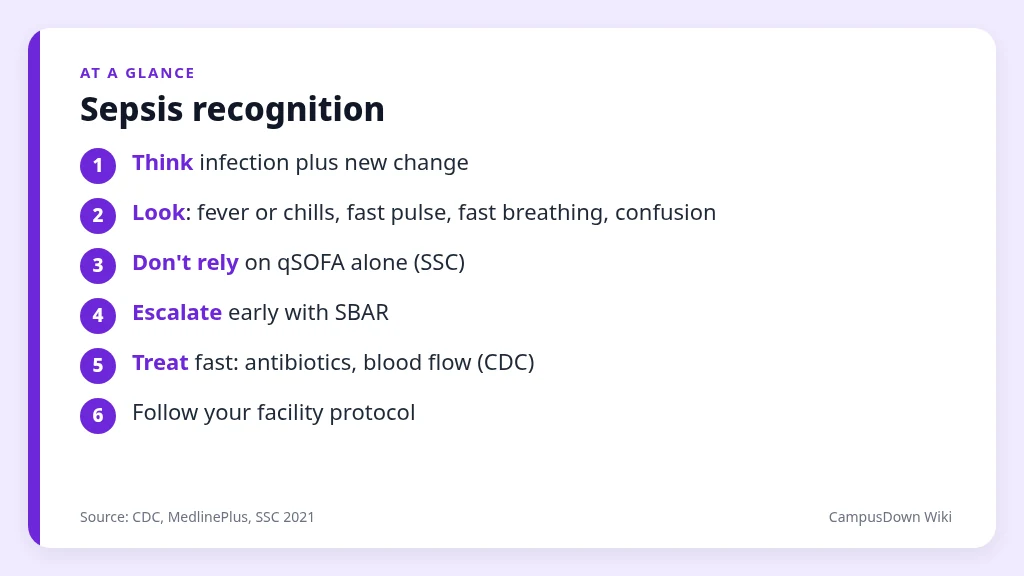
The 2021 SSC guidelines (for adults) recommend that hospitals and health systems use a performance improvement program for sepsis, including screening for acutely ill, high-risk patients and standard operating procedures for treatment. They state a strong recommendation against using qSOFA as a single screening tool compared with SIRS, NEWS or MEWS, because of its poor sensitivity. They also suggest measuring blood lactate in adults suspected of having sepsis, while noting lactate alone is not sensitive or specific enough to rule sepsis in or out.
For students, the lesson is: screening tools help, but they don't replace your assessment of the patient in front of you.
Treatment concepts (adults)
CDC says rapid, effective treatment includes antibiotics as soon as possible and maintaining blood flow to organs, and that surgery is sometimes needed to remove damaged tissue. MedlinePlus lists oxygen and IV fluids, treating the source of infection, and medicines to raise blood pressure if needed.
From the 2021 SSC guidelines (adults; recommendations vary in strength):
- Treatment and resuscitation should begin immediately.
- For sepsis-induced hypoperfusion or septic shock, at least 30 mL/kg of IV crystalloid within the first 3 hours is suggested (a weak recommendation), and crystalloids are recommended as first-line fluid.
- For possible septic shock or a high likelihood of sepsis, antimicrobials immediately, ideally within 1 hour of recognition.
- Norepinephrine is recommended as the first-line vasopressor in septic shock, and an initial MAP target of 65 mm Hg is recommended for patients who need vasopressors.
These are the guideline's recommendations, not orders. A provider writes orders, and your facility's protocol governs your actions. You can learn more about the lab side in the lab values guide.
Your job: notice, escalate, document
- Compare with the patient's baseline: mental status, breathing, heart rate, temperature, skin.
2. Escalate early using your facility's chain of command or rapid response criteria. 3. Use SBAR so the message is clear; see SBAR handoff. 4. Document what you saw and when, and who you told. 5. Prioritize with the priority framework and the clinical judgment model.
CDC notes that antibiotics can cause side effects and contribute to antimicrobial resistance, which is why they are used when they provide a clear benefit; see antibiotic resistance.
Get help now if
For patients and families: if you think you or someone you love has sepsis, or an infection is getting worse, seek medical care right away, and call 911 for severe symptoms such as confusion, trouble breathing or fainting.
Example scenario: the quiet change
- Who
- Clarissa, 22, a junior nursing student in Madison, Wisconsin, was assigned to a 79-year-old woman recovering from a urinary tract infection.
- What happened
- Just before lunch the patient seemed sleepier than at breakfast, a little confused about where she was, and her skin felt clammy.
- How it felt
- Clarissa felt nervous about interrupting her busy nurse over "a sleepy lady," and worried she was overreacting.
- What they did
- She found her nurse and used SBAR: she described the change, the infection, the vital signs she had taken and what she was worried about. The nurse reassessed and followed the unit's protocol, notified the provider, and thanked Clarissa for speaking up.
- How it turned out
- Clarissa said her hands shook afterward, and she learned she would rather be wrong out loud than right too late.
This is an illustrative example, not a real patient or a review.
Clarissa's story is an illustrative example, not a real person or event.
Most-asked questions about sepsis in nursing
What is the nursing diagnosis for sepsis?
Nursing diagnoses depend on the patient's assessment; ask your instructor or care-plan resources, using NANDA-I labels you've been taught.
Why people ask: "sepsis nursing diagnosis" is #1 for "sepsis nursing" (US autocomplete, November 2026).
What are the nursing interventions for sepsis?
Recognize early signs, escalate, and carry out ordered treatments such as fluids and antibiotics under your facility's protocol.
Why people ask: "sepsis nursing interventions" is #2 for "sepsis nursing" (US autocomplete, November 2026).
What does a sepsis nursing care plan include?
Assessment, prioritized problems, interventions and evaluation; see your school's template.
Why people ask: "sepsis nursing care plan" is #4 for "sepsis nursing" (US autocomplete, November 2026).
What is the sepsis nursing protocol?
Facilities use screening and treatment protocols based on guidelines like the SSC; follow yours.
Why people ask: "sepsis nursing protocol" is #8 for "sepsis nursing" (US autocomplete, November 2026).
What does a sepsis nursing assessment look at?
Vital signs, mental status, skin, breathing and the source of infection, compared with the patient's baseline.
Why people ask: "sepsis nursing assessment" is #9 for "sepsis nursing" (US autocomplete, November 2026).
What are the signs and symptoms of sepsis in adults?
CDC lists clammy skin, confusion, extreme pain, fever or chills, fast pulse and shortness of breath.
Why people ask: "sepsis signs and symptoms in adults" is #3 for "sepsis signs" (US autocomplete, November 2026).
What are sepsis signs and symptoms for nursing?
The same signs, plus knowing risk groups and when to escalate.
Why people ask: "sepsis signs and symptoms nursing" is #9 for "sepsis signs" (US autocomplete, November 2026).
Related on CampusDown
You can check it for yourself with an SBAR template and learn more about the nursing student hub.
Frequently asked questions
- Is qSOFA enough to screen for sepsis?
- The 2021 SSC guideline strongly recommends against using qSOFA as a single screening tool.
- How fast should antibiotics start?
- For possible septic shock or a high likelihood of sepsis, SSC says ideally within 1 hour of recognition; the provider decides.
- Is sepsis only a hospital problem?
- CDC says most cases start before a patient goes to the hospital.
- Is this the same for children?
- No. The SSC 2021 guidelines discussed here are for adults; pediatric care follows different guidance.
Sepsis is a race against time that often begins with a quiet change. Look, compare, speak up, and follow your protocol.
Browse more guides like this in the Nursing Student and NCLEX hub.
This article is for general education and does not replace advice from your own doctor, nurse or pharmacist.