
Why does the NCLEX now break one patient into six separate questions? Because each question measures a different step of how nurses think, using a framework called the NCSBN Clinical Judgment Measurement Model, or NCJMM.
Understanding the model makes case studies far less mysterious. Here is what it is, the six steps, and how to practice them. Take a closer look at the step-by-step example near the end.
Where the model came from
NCSBN researchers built the NCJMM to measure clinical judgment and decision making within a standardized, high-stakes exam. They drew on research in nursing, education, cognitive psychology and decision science, plus investigations involving more than 100 nursing experts and data from more than 200,000 NCLEX candidates. The result is the framework behind the Next Generation NCLEX.

The layers
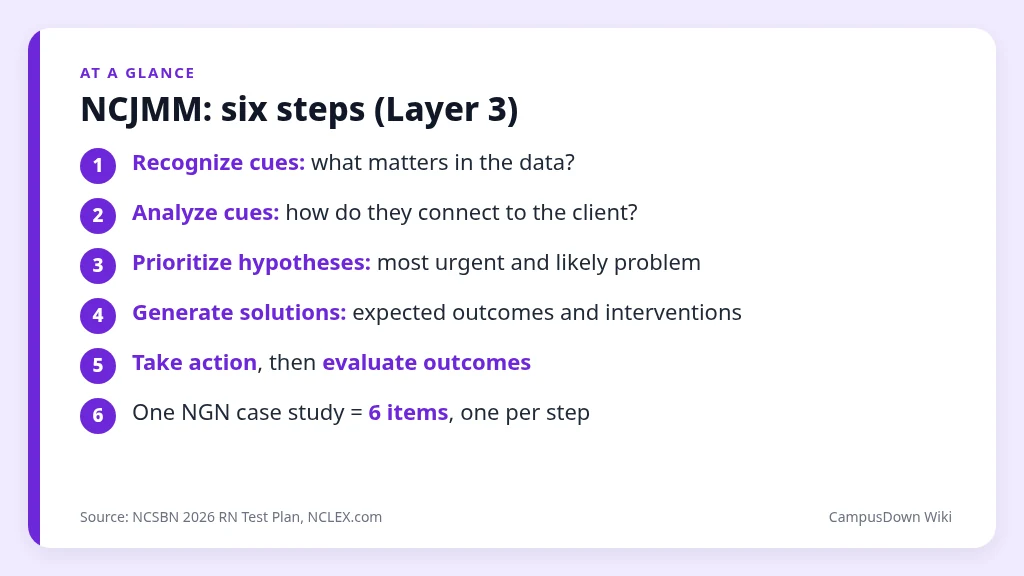
NCSBN describes the model in layers, from the broadest layer 0, the context of the clinical situation, to the most specific layer 4, contextual factors identified in nursing decision-making research. Layer 3 holds the cognitive steps that can be directly measured, and it is the basis for NCLEX items and case studies.
The six steps
The 2026 NCLEX-RN Test Plan defines them as:
- Recognize cues: identify relevant and important information from sources like history and vital signs.
2. Analyze cues: organize and connect the cues to the client's presentation. 3. Prioritize hypotheses: evaluate and rank possible problems by urgency, likelihood, risk, difficulty and time constraints. See prioritization frameworks. 4. Generate solutions: identify expected outcomes and the interventions to reach them. 5. Take action: implement the solutions that address the highest priority. 6. Evaluate outcomes: compare what happened with what you expected.
Each NGN case study has six items about one client, one per step, with information that unfolds.
NCJMM, the nursing process and Tanner
NCSBN says the nursing process underlies the model and that the NCJMM was not built to replace any nursing process model. If you learned ADPIE in the nursing process, the steps map closely. Many programs also teach Tanner's clinical judgment model (noticing, interpreting, responding, reflecting), which describes similar thinking in different words.
How to practice each step
- Recognize cues: read the whole chart excerpt and list what is abnormal or changed, not just what is abnormal.
- Analyze cues: connect cues to the client's history; ask which ones belong together.
- Prioritize hypotheses: rank by risk if untreated, not by what you studied most recently.
- Generate solutions: write the expected outcome first, then the interventions.
- Take action: choose what addresses the top priority within the nurse's scope.
- Evaluate outcomes: decide which findings show improvement, no change or decline.
A walk-through example
A client is two days after abdominal surgery. Recognize cues: new heart rate of 112, temperature 38.4 C, and new confusion. Analyze cues: these together may point to infection rather than pain alone. Prioritize hypotheses: possible sepsis ranks above dehydration or anxiety because of risk. Generate solutions: expected outcomes include stable vital signs; interventions follow the facility's sepsis protocol and the provider's orders. Take action: notify the provider and start ordered actions. Evaluate outcomes: recheck vital signs and mental status. This is a teaching example, not an actual NCLEX item.
Seeing the steps is one thing; using them under pressure is another.
Example scenario: slowing down to speed up
- Who
- Diego, 30, an LPN in Florida finishing an LPN-to-RN bridge program, was fast at patient care but kept missing NGN case study items.
- What happened
- He jumped straight to actions, choosing interventions before he had sorted which cues mattered, and his scores on "analyze" and "prioritize" items stayed low.
- How it felt
- He felt frustrated, because on the job he was known as the nurse who acted quickly.
- What they did
- His instructor asked him to say each step aloud with his note board divided into six boxes, filling one before moving on.
- How it turned out
- His case study scores rose, and he noticed he was explaining his thinking more clearly at work too, which made him feel more confident as he prepared to step into the RN role.
This is an illustrative example, not a real patient or a review.
Diego is an illustrative example, not a real person.
Get help now if
The NCJMM is available for personal and educational, non-commercial use under NCSBN's terms. You can check it for yourself on NCLEX.com before copying the diagram.
Most-asked questions about the NCJMM
What are the NCJMM steps?
Recognize cues, analyze cues, prioritize hypotheses, generate solutions, take action and evaluate outcomes.
Why people ask: "ncjmm steps" is #6 for "ncjmm" (US autocomplete, November 2026).
What is the clinical judgment model on the NCLEX?
NCSBN's framework for measuring clinical judgment; its six steps shape each NGN case study.
Why people ask: "clinical judgment model nclex" is the #1 suggestion for that query (US, November 2026).
What is clinical judgment in nursing?
The test plan describes it as an iterative, multistep process using nursing knowledge to assess situations, identify a prioritized concern and generate evidence-based solutions.
Why people ask: "what is clinical judgement in nursing" is #6 for "clinical judgment model nclex" (US, November 2026).
How does the NCJMM relate to the nursing process?
NCSBN says a nursing process underlies the model, and it was not built to replace any nursing process model.
Why people ask: "ncjmm nursing process" is #7 for "ncjmm" (US, November 2026).
Frequently asked questions
- Do stand-alone items use the model too?
- Yes; the test plan says clinical judgment can appear as a case study or stand-alone item.
- Is clinical judgment its own content area?
- Case studies span content areas and are counted separately from the eight Client Needs categories.
- Does delegation use clinical judgment?
- Yes. Judgment cannot be delegated; see delegation.
- Where are the official skills cards?
- NCSBN offers Clinical Judgment Skills Cards on NCLEX.com.
The NCJMM is a map of thinking you already do. You can learn more about each step in detail from NCSBN, and practice naming the step before you answer.
Browse more guides like this in the Nursing Student and NCLEX hub.
This article is for general education and does not replace advice from your own doctor, nurse or pharmacist.