
Is your heart racing just reading the word "NCLEX"? You are in good company. MedlinePlus notes that feeling anxious before taking a test is a normal reaction to stress, and it can even give you energy and focus. The goal is not zero nerves; it is nerves that do not run the show.

This guide gives you a week-before routine, an exam-day plan built on NCLEX.com's own check-in rules, and clear signs that anxiety needs more support. Take a closer look at the exam-day facts, because uncertainty feeds anxiety.
Normal test anxiety vs an anxiety disorder
MedlinePlus describes anxiety as fear, dread and uneasiness that can cause sweating, restlessness and a rapid heartbeat. Anxiety disorders are different: the anxiety does not go away, can get worse over time, and interferes with work, school or relationships. If that sounds like you, read about generalized anxiety disorder and panic disorder, and talk to your doctor.

The week before
- Taper new content. Shift to mixed review and rationales from your study plan.
- Protect sleep and meals. Keep your usual wake time so test morning feels normal.
- Rehearse the logistics. Know the route, parking and your acceptable ID.
- Plan a short calming routine you already know works for you, such as slow breathing, a walk or a playlist.
- Limit forums that trade horror stories.
Exam day: what NCLEX.com says will happen
Knowing the steps removes surprises:
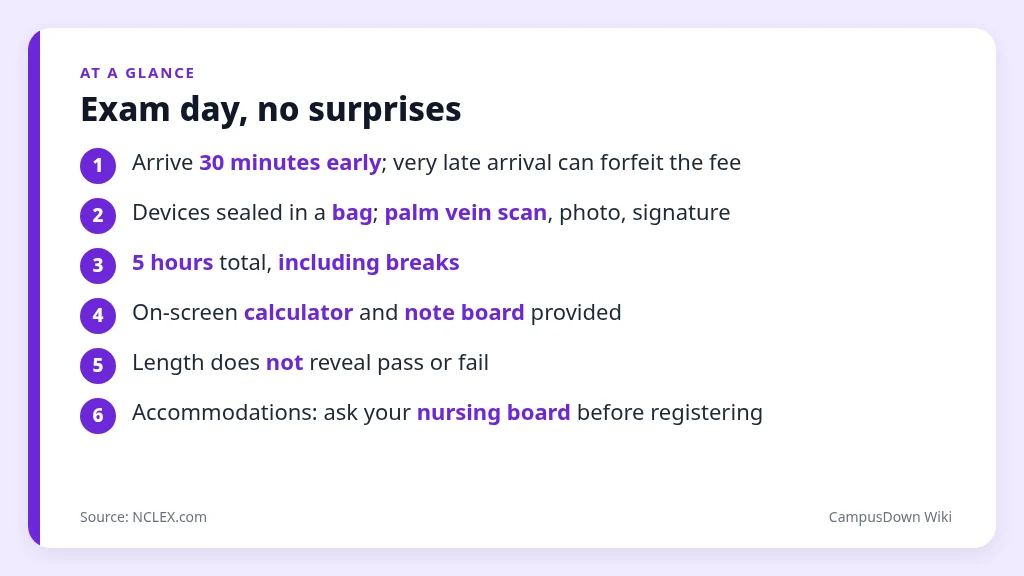
- Arrive at least 30 minutes early. Arriving more than 30 minutes late may mean forfeiting the appointment and fee.
- Devices are powered off and sealed in a plastic bag; any unauthorized device can end your exam.
- Biometrics: signature, photograph and palm vein scan, plus security scanning, including after breaks.
- Materials: an on-screen calculator and an erasable note board.
- Time: five hours, including breaks. You cannot go back to a previous item.
- The exam ends with a short survey.
During the exam
- If a question feels impossible, remember the exam is adaptive and is designed to feel hard; see why the NCLEX stops.
- Take a planned break if you need one; it counts toward your five hours.
- Read each item fully, choose your best answer and move on.
Reframe the self-talk
Anxious thoughts tend to predict disaster: "I'm failing," "everyone else knows this." Try swapping them for accurate statements you can check: "Hard questions are part of how the exam works." "I have answered thousands of practice items." "Length does not tell me the result." Writing two or three of these on an index card during the week before can make them easier to reach under stress.
Accommodations
NCLEX.com says if you need testing accommodations, request them with your nursing regulatory body before you register. Some comfort aids do not need pre-approval; check the current list on NCLEX.com.
Plans help most when they are personal. Here is how one graduate made hers.
Example scenario: the second attempt at calm
- Who
- Nadia, 24, a BSN graduate in New Jersey, had panicked during a timed practice exam two weeks before her NCLEX and could not finish.
- What happened
- She was terrified the same thing would happen on test day, and she stopped sleeping well.
- How it felt
- She felt ashamed, because she was the classmate everyone asked for help.
- What they did
- She talked with her campus counselor, practiced a short breathing and grounding routine, drove the route to the test center twice, and wrote the check-in steps on an index card.
- How it turned out
- On exam day her hands still shook at the palm scan, but she used her routine at the first hard case study, finished on time, and later told her classmates that asking for help was the strongest thing she did.
This is an illustrative example, not a real patient or a review.
Nadia is an illustrative example, not a real person.
Get help now if
If you have thoughts of harming yourself, call or text 988 (Suicide and Crisis Lifeline) or go to the nearest emergency room. Talk to your doctor before starting or stopping any medicine for anxiety.
Most-asked questions about NCLEX anxiety
How do I deal with NCLEX anxiety?
Make the unknown known: rehearse logistics, protect sleep, keep a short calming routine, and get support if anxiety is persistent.
Why people ask: "nclex anxiety" is the #1 Google suggestion for that query, and "nclex test anxiety" is #6 (US autocomplete, November 2026).
Is it normal to have anxiety after the NCLEX?
Yes. Waiting for results is stressful; plan the wait and use official Quick Results instead of rumors.
Why people ask: "post nclex anxiety" is #7 for "nclex anxiety" (US, November 2026).
What are good NCLEX test-taking tips for anxiety?
Read each item fully, answer, and move on; you cannot return to items, and difficulty is by design.
Why people ask: "nclex test taking tips" is #5 for "nclex test anxiety" (US, November 2026).
Are "anxiety NCLEX questions" about my nerves or psych content?
Often about content: anxiety disorders appear under Psychosocial Integrity. This page covers test anxiety.
Why people ask: "nclex anxiety questions" is #3 and "nclex questions anxiety disorders" is #9 for "nclex anxiety" (US, November 2026).
Frequently asked questions
- Can I bring water or snacks?
- Rules on personal items and comfort aids change; check NCLEX.com and the candidate bulletin before test day.
- Does a break stop the clock?
- No. Breaks count toward the five hours.
- Can I get extra time?
- Only as an approved accommodation through your nursing board.
- What if I keep worrying after the exam?
- See Quick Results and talk with someone you trust.
Nerves mean the exam matters to you. You can learn more about exam day in detail on NCLEX.com, check it for yourself before test morning, and lean on your doctor or counselor if anxiety feels bigger than the test.
Browse more guides like this in the Nursing Student and NCLEX hub.
This article is for general education and does not replace advice from your own doctor, nurse or pharmacist.