
Can the nursing assistant do this, or does it have to be you? On the NCLEX and on every shift, that question comes up constantly, and getting it wrong in either direction is a safety problem.

This guide uses the official NCSBN and ANA National Guidelines for Nursing Delegation (2019) and the 2026 NCLEX-RN Test Plan. Take a closer look at what can never be delegated, because NCLEX questions often hinge on it.
Who delegates to whom
The 2019 guidelines apply to:
- APRNs delegating to RNs, LPN/VNs and assistive personnel (AP).
- RNs delegating to LPN/VNs and AP.
- LPN/VNs, as allowed by their state or jurisdiction, delegating to AP.
Handing care from one RN to another RN, or one LPN/VN to another, is treated as a handoff, not delegation. The test plan's term for AP on the NCLEX is unlicensed assistive personnel (UAP).

Assignment vs delegation
The guidelines draw a line many students miss. When a delegatee performs a fundamental skill that was part of their basic education, such as routine care for a stable client, that is an assignment. Delegation means allowing a delegatee to perform a specific nursing activity that is beyond their traditional role, after added education, training and validated competence. Either way, the licensed nurse remains responsible for making sure the work is done completely and correctly. The guidelines also note that "unlicensed assistive personnel" is the older term for what they now call assistive personnel, which includes CNAs, patient care technicians and home health aides.
The five rights of delegation
From the guidelines:
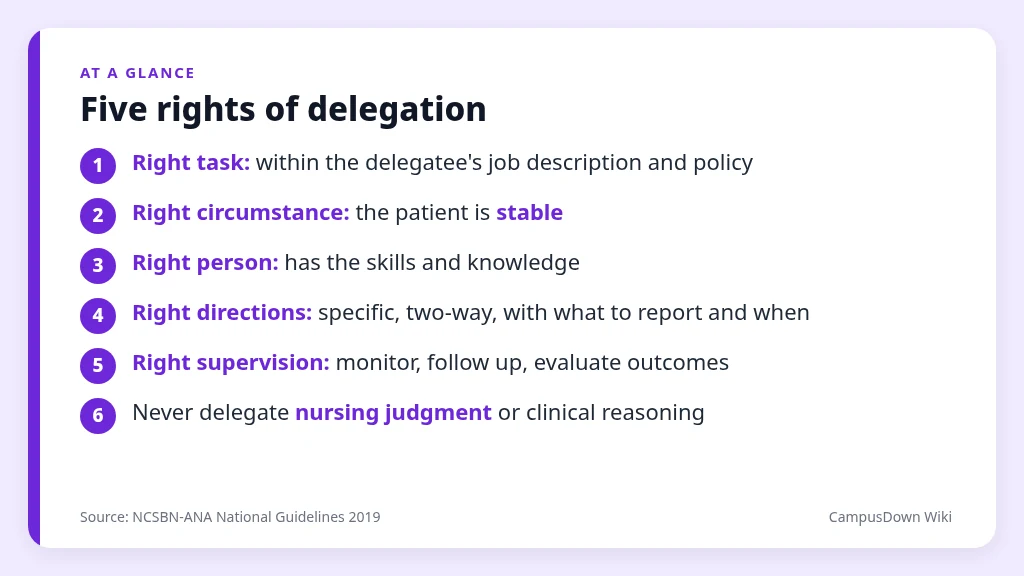
- Right task: within the delegatee's job description or the setting's written policies.
2. Right circumstance: the patient's condition must be stable. If it changes, the delegatee reports and the nurse reassesses. 3. Right person: the delegatee has the skills and knowledge. 4. Right directions and communication: specific instructions, including what data to collect, how, and when to report; the delegatee can ask questions and must agree to accept. 5. Right supervision and evaluation: the nurse monitors, follows up and evaluates outcomes.
The 2026 test plan lists "utilize the rights of delegation" under Management of Care.
What cannot be delegated
The guidelines state that a licensed nurse cannot delegate nursing judgment or any activity involving clinical reasoning, nursing judgment or critical decision making. The nurse who delegates keeps overall accountability for the patient; the delegatee is responsible for the delegated activity.
On NCLEX items, that usually means initial assessments, teaching that requires judgment, evaluating a response, and care of unstable clients stay with the RN. Routine, predictable tasks for stable clients, within policy and training, may be delegated. What is allowed varies by state and facility, so the NCLEX focuses on the principles.
How to answer delegation questions
- Ask: is the client stable and the outcome predictable?
- Does the task require assessment, teaching or evaluation? Keep it.
- Is it within the delegatee's role and training? If unsure, choose the more qualified person.
- Pair it with prioritization: the unstable client is yours.
- Case-based NGN items may ask you to sort tasks by who should do them.
- Clear communication tools like SBAR help with handoffs and reports.
Rules are clearer on paper than at 3 a.m. Here is how one new nurse learned the difference.
Example scenario: the vital signs that came back late
- Who
- Tasha, 25, a new graduate RN on a busy medical-surgical floor in North Carolina, asked a nursing assistant to "grab vitals on 12" during a hectic morning.
- What happened
- The assistant got a low blood pressure but did not tell anyone for an hour, because Tasha had not said what numbers to report or when.
- How it felt
- Tasha felt a cold rush of guilt when she saw the chart, and the patient's daughter was understandably upset.
- What they did
- Her charge nurse helped her assess the patient and notify the provider, then coached her to give specific instructions: what to check, by when, and which values to report right away.
- How it turned out
- The patient was treated and recovered, and Tasha now tells every assistant exactly what she needs to hear and when, which has made their teamwork stronger and her shifts calmer.
This is an illustrative example, not a real patient or a review.
Tasha is an illustrative example, not a real person.
Get help now if
Delegation laws and policies differ by state and facility. Follow your state's nurse practice act and your employer's policies, and check it for yourself with your nurse leader.
Most-asked questions about delegation
What is delegation in nursing?
Allowing a delegatee to perform a specific nursing activity, skill or procedure beyond their traditional role, while the delegating nurse keeps overall accountability.
Why people ask: "delegation nursing definition" is the #2 Google suggestion for "delegation nursing" (US autocomplete, November 2026).
What can an LPN delegate to a UAP?
Under the 2019 guidelines, LPN/VNs may delegate to assistive personnel only where their state allows, using the same five rights.
Why people ask: "what can an lpn delegate to a uap" is #2 and "can lpns delegate to uaps" is #3 for "what can lpn delegate to uap" (US, November 2026).
What can be delegated to a UAP?
Routine fundamental skills for stable clients are assigned; activities beyond their usual role need training, validated competence and policy support. Assessment, teaching and evaluation stay with the nurse.
Why people ask: "what can be delegated to a uap" is #5 for "what can lpn delegate to uap" (US, November 2026).
How is delegation tested on the NCLEX?
Through Management of Care items about the rights of delegation, assignments and supervision.
Why people ask: "delegation nursing nclex" is #9 for "delegation nursing" (US, November 2026).
Frequently asked questions
- Is assignment the same as delegation?
- No. The guidelines distinguish assigning care within a person's existing role from delegating an activity beyond it.
- Can a UAP refuse a task?
- The guidelines say the delegatee must agree to accept the delegated activity.
- Who is accountable if something goes wrong?
- The delegating nurse keeps overall accountability; the delegatee is responsible for the activity.
- Where does ethics fit?
- Delegation decisions connect to patient safety and privacy; see nursing ethics and HIPAA.
Delegation is a skill, not a shortcut. You can learn more in detail from the NCSBN-ANA guidelines, and connect each decision to the clinical judgment model.
Browse more guides like this in the Nursing Student and NCLEX hub.
This article is for general education and does not replace advice from your own doctor, nurse or pharmacist.