
You get a blood gas result with five numbers and a question that asks what it means. Do you know which number to look at first? Many nursing students stall right there, and ROME is a small mnemonic that gets the first answer on the table.

This guide uses MedlinePlus, StatPearls and the American Thoracic Society (ATS) guide to ABGs. It is for learning, not for treating a patient. Always use your facility's ranges and ask your provider about a real result. If you have an exam soon, take a closer look at the step list and the worked examples.
What an ABG measures
MedlinePlus says blood gases measure how much oxygen and carbon dioxide are in your blood and the acidity (pH). Blood is usually taken from an artery (for example the radial, femoral or brachial). It evaluates respiratory disease, helps judge oxygen therapy or non-invasive ventilation, and gives clues about acid-base balance and lung and kidney function. See also the lab values cheat sheet.

Normal values (and why they differ)
| Value | MedlinePlus (sea level) | StatPearls (acceptable range) |
|---|---|---|
| pH | 7.38 to 7.42 | 7.35 to 7.45 |
| PaCO2 | 38 to 42 mm Hg | 35 to 45 mm Hg |
| HCO3 (bicarbonate) | 22 to 28 | 22 to 26 mEq/L |
| PaO2 | 75 to 100 mm Hg | 75 to 100 mm Hg |
| SaO2 | 94% to 100% | 95% to 100% |
Both sources say ranges vary among labs, and MedlinePlus says the oxygen value is lower at altitudes of 3,000 feet or more. Use your facility's reference range.
What ROME means
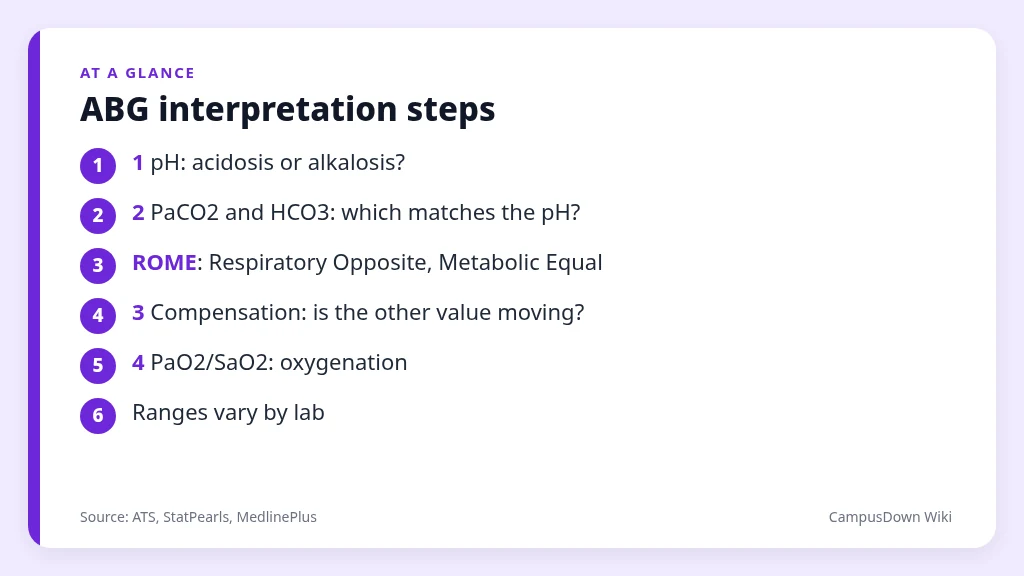
ROME = Respiratory Opposite, Metabolic Equal. The ATS describes the rule behind it: in primary respiratory disorders, pH and PaCO2 change in opposite directions; in metabolic disorders, pH and PaCO2 change in the same direction. Memorize the four patterns:
- Respiratory acidosis: pH low, PaCO2 high (opposite)
- Respiratory alkalosis: pH high, PaCO2 low (opposite)
- Metabolic acidosis: pH low, HCO3 low (the ATS table lists PaCO2 moving the same direction as pH)
- Metabolic alkalosis: pH high, HCO3 high (the ATS table lists PaCO2 moving the same direction as pH)
For metabolic problems, nursing courses often use HCO3 directly: low pH with low HCO3 points to metabolic acidosis; high pH with high HCO3 points to metabolic alkalosis.
A step-by-step method
StatPearls describes a simple approach:
- Look at the pH. Below 7.35 is acidemia; above 7.45 is alkalemia. If it's normal, StatPearls says to use 7.40 as the cutoff (so 7.37 leans acidosis and 7.42 leans alkalosis).
2. Look at PaCO2 and HCO3. Which one matches the pH direction? That is the primary problem. A PaCO2 above 40 with pH below 7.4 indicates respiratory acidosis; a PaCO2 below 40 with pH above 7.4 indicates respiratory alkalosis. 3. Look for compensation. The other value moving the opposite way to the pH shows the body is compensating. StatPearls notes metabolic compensation takes days to become effective, so it suggests a non-acute respiratory problem. The ATS says compensation usually doesn't return the pH to normal. 4. Look at PaO2. Low values point to an oxygenation problem; the history and exam show how urgent it is.
Two worked examples (from StatPearls)
Example 1: pH 7.39, PaCO2 51 mm Hg, PaO2 59 mm Hg, HCO3 30 mEq/L, SaO2 90% on room air.
- pH is in the normal range and below 7.40, so acidosis.
- The high PaCO2 matches: respiratory acidosis.
- The high HCO3 suggests metabolic compensation, so the problem is not acute.
- The low PaO2 shows an oxygenation problem.
Example 2: pH 7.45, PaCO2 32 mm Hg, PaO2 138 mm Hg, HCO3 23 mEq/L, base deficit 1, SaO2 92% on room air.
- pH is above 7.40, so alkalemia.
- The low PaCO2 matches: respiratory alkalosis.
- HCO3 is in range, so no compensation yet.
These come from the StatPearls article. Real interpretation also uses the clinical picture, the electrolytes and the anion gap. See COPD and oxygen, kidney failure and sepsis recognition for examples of conditions that change acid-base status.
Mixed disorders
The ATS says that if observed compensation doesn't match the expected amount, more than one acid-base disorder is likely present. That is beyond a basic ROME exercise; ask your instructor for the formulas your course uses.
Practice tips for NCLEX
- Always write pH, PaCO2, HCO3 in a column, label each as low, normal or high, then apply ROME.
- Practice with three to five problems a day rather than a marathon.
- Pair each pattern with a patient story (for example, shallow breathing and CO2 retention).
- Use priority frameworks to decide what you'd do first.
Get help now if
This page teaches a method. It does not tell you how to treat a patient. Use your facility's protocols, and ask your instructor or provider about real results.
Example scenario: the four cards
- Who
- Gareth, 29, a former paramedic in an accelerated BSN program in Richmond, Virginia, understood patients but froze when he saw an ABG with five numbers on a practice exam.
- What happened
- He kept guessing "acidosis" and missing whether it was respiratory or metabolic.
- How it felt
- He felt frustrated that he could manage a real emergency calmly but panicked at a table of numbers.
- What they did
- His instructor had him write four cards: pH, PaCO2 and HCO3, compensation, oxygenation, and say ROME aloud before looking at the answer choices. He practiced a few problems each day and then walked through a real patient's story with his preceptor.
- How it turned out
- Gareth said the cards turned a wall of numbers into a short checklist, and his scores improved.
This is an illustrative example, not a real patient or a review.
Gareth's story is an illustrative example, not a real person or event.
Most-asked questions about ABG interpretation
How do you interpret an ABG?
Check pH, find whether PaCO2 or HCO3 matches it, look for compensation and then oxygenation.
Why people ask: "abg interpretation" is #1 for "abg interpretation" (US autocomplete, November 2026).
Is there an ABG interpretation calculator?
Calculators exist, but learn the method first and use facility-approved tools.
Why people ask: "abg interpretation calculator" is #2 for "abg interpretation" (US autocomplete, November 2026).
Where can I find ABG interpretation practice?
Use your course's problems and the StatPearls examples summarized here.
Why people ask: "abg interpretation practice" is #3 for "abg interpretation" (US autocomplete, November 2026).
Is there an ABG interpretation chart?
The tables above are a starting chart; ranges vary by lab.
Why people ask: "abg interpretation chart" is #4 for "abg interpretation" (US autocomplete, November 2026).
What is ABG compensation?
When the other system moves to bring the pH back toward normal; it usually doesn't fully return it.
Why people ask: "abg interpretation compensation" is #8 for "abg interpretation" (US autocomplete, November 2026).
What is the ABG interpretation ROME method?
Respiratory Opposite, Metabolic Equal.
Why people ask: "abg interpretation rome" is #1 for "abg interpretation rome" (US autocomplete, November 2026).
What does ROME mean in ABG analysis?
It's a mnemonic for how pH moves relative to PaCO2 in respiratory vs metabolic problems.
Why people ask: "abg rome meaning" is #8 for "abg interpretation rome" (US autocomplete, November 2026).
Related on CampusDown
You can learn more about lung sounds and check it for yourself with fluid volume problems.
Frequently asked questions
- Is ROME always right?
- It's a memory aid for primary disorders; mixed disorders need more steps.
- Which is the primary problem if both PaCO2 and HCO3 are abnormal?
- The one that matches the pH direction.
- Why do ranges differ between sources?
- MedlinePlus and StatPearls say ranges can vary by lab, age and altitude.
- Can I use a venous gas the same way?
- MedlinePlus notes venous gases exist; your facility's references say how to interpret them.
An ABG is a short story told in numbers. Learn the four steps, say ROME aloud, and always pair the result with the patient.
Browse more guides like this in the Nursing Student and NCLEX hub.
This article is for general education and does not replace advice from your own doctor, nurse or pharmacist.