
You place the stethoscope on your patient's back and hear something you can't name. Crackle? Wheeze? And does it matter right now?

Lung sounds are one of the first skills nursing students feel unsure about, and a good chart helps. This guide follows OpenStax's Clinical Nursing Skills chapter 23.3, Breath Sounds and Lung Assessment. It is a study aid, not an emergency protocol. If a patient has noisy breathing, struggles to breathe or has a high-pitched sound when breathing in, tell your instructor or nurse immediately. To learn more about the full exam, take a closer look at the head-to-toe assessment.
Before you listen
OpenStax says to use the diaphragm of the stethoscope and to:
- have the patient sit upright if possible
- listen on bare skin, not over clothing or hair, and avoid bone and breast tissue
- ask the patient to take deep breaths through the mouth
- listen through the entire breath cycle, since sounds can differ on inspiration and expiration
- compare side to side, moving across symmetrical lung fields, front and back
OpenStax also teaches assessing the breathing pattern: a normal adult rate is 12 to 20 breaths per minute with symmetrical chest rise and no use of accessory muscles. Look and count before you listen.

Where to listen
Auscultation follows a pattern on the anterior and posterior chest wall, moving from top to bottom and comparing the left and right sides at each level. Your skills lab will give you a specific sequence; practice it until it's automatic. The sounds you hear depend on where you listen because the airway size changes across the lung fields.
Normal sounds
| Sound | Where | What it sounds like |
|---|---|---|
| Bronchial | Over the trachea and larynx | High-pitched and loud; lasts longer on expiration |
| Bronchovesicular | Over the major bronchi, near the first and second intercostal spaces | Medium-pitched, with a pause between inspiration and expiration |
| Vesicular | Throughout the lung fields | Lower-pitched and soft; heard through the whole breath cycle |
Learn normal first so you can compare.
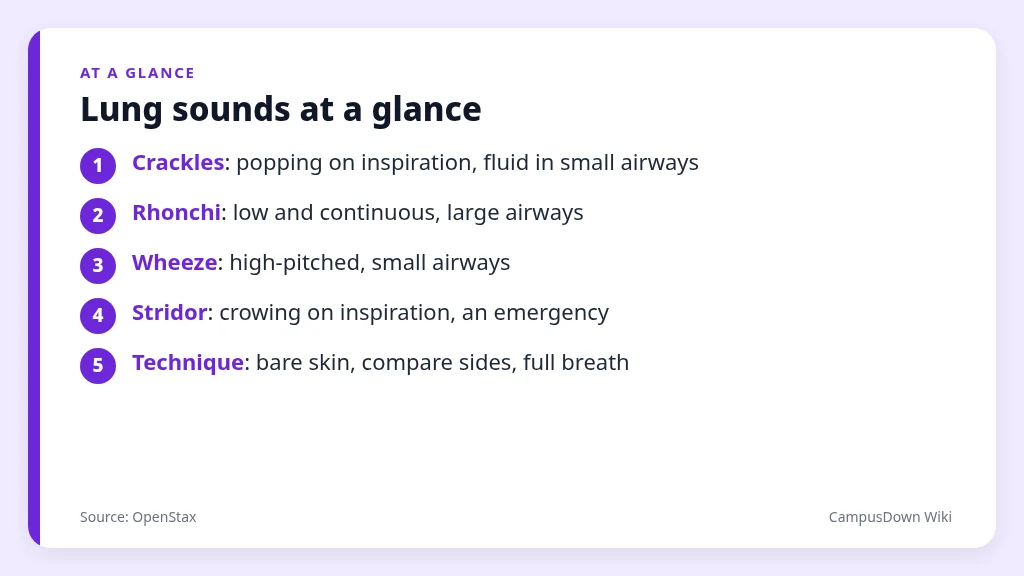
Adventitious sounds chart
OpenStax says adventitious sounds are heard in addition to normal breath sounds and most often indicate an airway problem or disease, such as mucus or fluid in the airways, obstruction, inflammation or infection.
| Sound | What it sounds like | May suggest |
|---|---|---|
| Fine crackles (rales) | Intermittent high-pitched popping on inspiration | Fluid in the alveoli and interstitial spaces, such as pneumonia or heart failure |
| Coarse crackles | Intermittent low-pitched gurgling on inspiration; lungs sound "wet" | Not specified by OpenStax; the lungs sound "wet" |
| Rhonchi | Continuous, low-pitched sounds, mainly on expiration | Narrowing of large airways or mucosal edema, such as bronchitis |
| Wheeze | Continuous, high-pitched whistling, mainly on expiration | Narrowing of small airways or mucosal edema, such as asthma |
| Stridor | High-pitched "crowing" on inspiration | Mechanical obstruction at the trachea or upper airway, life-threatening if not treated |
| Pleural friction rub | Grating sound on inspiration or expiration | Inflamed pleura rubbing together, such as pleuritis |
A sound alone doesn't make a diagnosis; combine it with symptoms, vital signs and the patient's history. See heart failure and fluid volume excess for fluid-related cues.
Get help now if
Stridor, severe shortness of breath, blue lips, new confusion or a patient who can't speak in full sentences needs immediate help. Call for the nurse or rapid response; don't wait to finish your exam.
Lung sounds with pneumonia
OpenStax gives pneumonia as an example of a condition that can cause fine crackles, because of fluid in the alveoli. A real patient with pneumonia may have other findings as well, such as fever, cough or low oxygen, so use the whole picture. For infection-related deterioration, see sepsis recognition.
What to report
- New or worsening crackles, wheezes or rhonchi
- Absent sounds in an area, or unequal sounds from side to side
- Stridor, always urgently
- A change in breathing rate or effort, or in oxygen saturation
- Cough with new sputum or a patient who looks tired from breathing
Give a structured report; see SBAR handoff. A sample: "I heard crackles at both bases that weren't there this morning, and his breathing rate is higher."
Charting
Document where you listened, which sounds you heard (for example "fine crackles at the right lower base"), whether they were heard on inspiration or expiration and any change from earlier. Follow your facility's format; your instructor will tell you which terms to use.
Study tips
- Use a normal vs abnormal chart and say the words aloud.
- Link each sound to pitch, timing and location (OpenStax gives these for each).
- Practice with the audio resources in your course; OpenStax links to breath sound examples.
- Pair every sound with one cause and one priority: crackles with fluid, wheeze with narrowed airways, stridor with emergency.
- Repeat the exam on classmates and compare notes.
Questions for your instructor
- Which auscultation sequence does our program expect?
- Which sounds trigger an immediate call on our unit?
- How should I chart sounds we heard on one side only?
- How does a patient's position change what we hear?
- Can I get extra stethoscope practice in the lab?
Example scenario: the new crackles
- Who
- Hester, 22, a nursing student in Albuquerque, New Mexico, listened to an older patient's lungs and heard popping at both bases that she hadn't noticed the day before.
- What happened
- She doubted her ears and worried she'd cry wolf.
- How it felt
- She felt nervous but knew the pattern from her notes.
- What they did
- She asked her nurse to listen too, who agreed the sounds were new and called the provider with the breathing rate and weight change. Hester then practiced the SBAR script in her notes.
- How it turned out
- Hester said double-checking with a nurse made her feel braver, not smaller.
This is an illustrative example, not a real patient or a review.
Hester's story is an illustrative example. Real care follows your instructor, your facility and the provider's orders.
Most-asked questions about lung sounds
What do lung sounds with pneumonia sound like?
OpenStax lists pneumonia as an example cause of fine crackles, high-pitched popping heard on inspiration.
Why people ask: "lung sounds with pneumonia" is #2 for "lung sounds" (US autocomplete, November 2026).
Is there a lung sounds chart?
Yes; see the tables above for normal and adventitious sounds.
Why people ask: "lung sounds chart" is #3 for "lung sounds" (US autocomplete, November 2026).
Where is the location for lung sounds?
Anterior and posterior chest wall, comparing both sides at each level; normal sounds also differ by location.
Why people ask: "lung sounds location" is #4 for "lung sounds" (US autocomplete, November 2026).
What do lung sounds mean?
They suggest what's happening in the airways, such as fluid, narrowing or obstruction, but need to be combined with other findings.
Why people ask: "lung sounds and what they mean" is #6 for "lung sounds" (US autocomplete, November 2026).
How do I do lung auscultation?
Diaphragm of the stethoscope on bare skin, deep mouth breaths, compare sides and listen through full breaths.
Why people ask: "lung sounds auscultation" is #8 for "lung sounds" (US autocomplete, November 2026).
What are rhonchi lung sounds?
Continuous, low-pitched sounds mostly on expiration, from large-airway narrowing or mucus, such as bronchitis.
Why people ask: "lung sounds rhonchi" is #9 for "lung sounds" (US autocomplete, November 2026).
What are examples of lung sounds?
Crackles, rhonchi, wheezes, stridor and pleural friction rub, plus normal bronchial, bronchovesicular and vesicular sounds.
Why people ask: "lung sounds examples" is #10 for "lung sounds" (US autocomplete, November 2026).
Where do I listen on the lung sounds chart?
Across symmetrical fields on the front and back chest wall, side to side.
Why people ask: "lung sounds chart where to listen" is #2 for "lung sounds chart" (US autocomplete, November 2026).
Related on CampusDown
You can learn more about the nursing student hub and check it for yourself in the head-to-toe assessment guide. For handoff in detail, see SBAR handoff.
Frequently asked questions
- Which lung sound is an emergency?
- Stridor, a high-pitched crowing on inspiration, can mean upper airway obstruction.
- Where are bronchial sounds heard?
- Over the trachea and larynx.
- Do crackles always mean pneumonia?
- No; OpenStax also lists heart failure as a cause of fluid and fine crackles.
- Should I listen over clothing?
- No; use bare skin and avoid hair, bone and breast tissue.
- What's the difference between a wheeze and rhonchi?
- Wheezes are high-pitched, from small airways; rhonchi are low-pitched, from large airways.
Lung sounds become easier with a pattern: learn the normal sounds, listen on bare skin, compare both sides and report anything new. Treat stridor as an emergency.
Browse more guides like this in the Nursing Student and NCLEX hub.
This article is for general education and does not replace advice from your own doctor, nurse or pharmacist.