
Your patient's blood pressure is 142/82 and the heart rate is 112. Is that too much fluid, too little, or something else entirely? Fluid status is where students most often get tangled.
This guide lays out assessment findings for fluid volume excess and fluid volume deficit, using OpenStax's Clinical Nursing Skills and Fundamentals of Nursing chapters. It is a study aid, not orders; your instructor, your facility's policy and the provider's orders decide care. To learn more about the fluids themselves, take a closer look at isotonic and hypotonic IV fluids.
The two problems in one line
- Fluid volume deficit (FVD or hypovolemia): fluid loss is greater than intake.
- Fluid volume excess (FVE or hypervolemia): too much fluid is retained or taken in.
OpenStax lists common causes of deficit as vomiting, diarrhea, fever with sweating and inadequate intake, with young children and older adults at higher risk. See dehydration in older adults. For overload, OpenStax lists conditions such as heart failure, kidney failure, cirrhosis and pregnancy; see heart failure.

Side-by-side findings
| Assessment | Fluid volume excess | Fluid volume deficit |
|---|---|---|
| Blood pressure | May be high; may or may not change | May drop, especially when standing |
| Heart rate and pulses | Bounding pulses; S3 heart sound | Heart rate may rise when upright |
| Neck veins | Visible jugular veins at 45 degrees or more | Flat neck veins are often described in teaching materials |
| Lungs | Crackles and shortness of breath may occur | Usually clear unless another problem exists |
| Skin | Edema, tight shiny skin | Poor turgor and dry skin (interpret carefully) |
| Mucous membranes | Usually moist | Dry; dry tongue and gums |
| Urine | May be dilute; ask about output | More concentrated: darker yellow or brown |
| Weight | Gain over time | Loss over time |
Treat this as a starting point rather than a rule: the table comes from the sources noted and from standard teaching; verify each row against your course text.
Why blood pressure can mislead
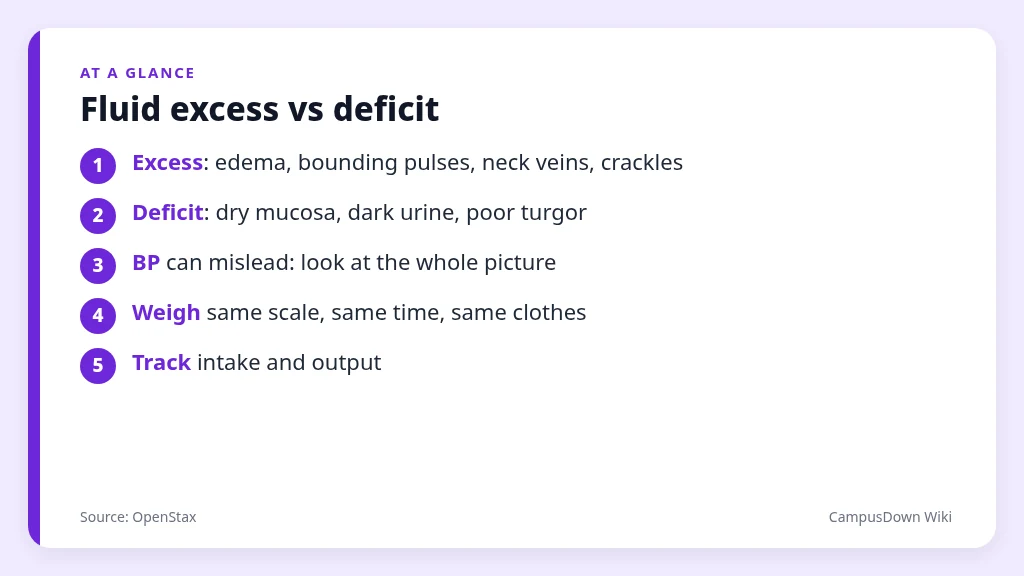
OpenStax says blood pressure may or may not be altered with fluid balance changes, because the body compensates by changing heart rate and by constricting or dilating blood vessels. It also says that where excess fluid sits matters: if it stays in the vascular space, blood pressure may rise; if it moves to the interstitial space, it causes edema. So look at the whole picture, including heart rate, pulses, lungs, skin, weight and intake and output.
Orthostatic changes
OpenStax explains that when a person stands, gravity shifts fluid toward the trunk and legs; if volume isn't adequate, blood pressure falls and heart rate rises. It reminds the nurse to address safety during this check, since lower brain perfusion can cause dizziness and falls. Rule out other causes with the team, such as fever, prolonged bed rest, medication reactions or nervous system problems.
Skin and mucous membranes
OpenStax describes checking skin turgor by gently pinching the skin to make a "tent" and observing how quickly it returns. In older adults, check over the sternum or just under the clavicle, not the back of the hand, because age-related skin changes make hand turgor unreliable. Dry skin can also come from hot bathing or normal aging, so don't rely on it alone. For mucous membranes, OpenStax says gums and tongue should be pink and moist; dry membranes can suggest deficit, and pale or ash-gray membranes may signal reduced perfusion.
Urine clues
OpenStax says that as fluid volume decreases, urine becomes more concentrated and appears darker yellow or brown. It also says an increased urine osmolarity can indicate FVD and a decreased result can indicate dilute urine from excess fluid intake. Note the amount and color on every output measurement; see the sodium range guide and the potassium range guide for the electrolytes that often move with fluid shifts.
Daily weights and intake and output
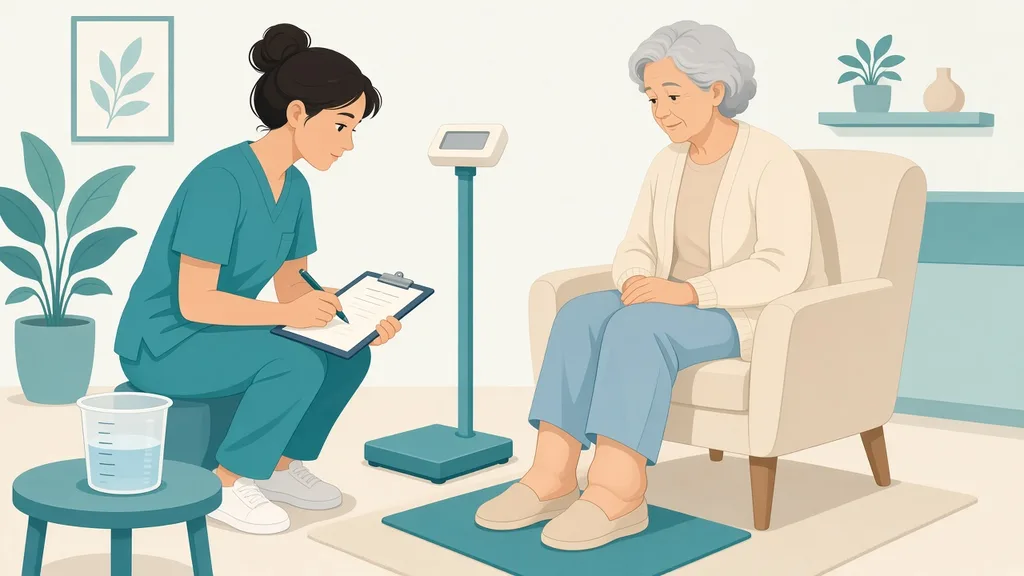
OpenStax says that for both FVD and FVE, nurses pay close attention to intake, output and daily weights. For weights, document how the patient was weighed (scale, time of day, clothing and footwear), and weigh at the same time on the same scale with the same clothing or bedding for each comparison. OpenStax notes that one liter of water weighs about 1 kilogram, or about 2.2 pounds, so a sudden unexplained weight change can reflect fluid loss or retention.
For intake and output, OpenStax says output includes urine, liquid stool, emesis, drains and other losses, and that intake includes IV fluids and tube feedings. Measure and record accurately, and include everything your facility counts.
Common management themes
OpenStax says mild deficit is treated with oral rehydration and severe cases need IV fluids, while overload is treated by restricting sodium and fluid and giving diuretics when ordered. These are for the provider to order; your role is to monitor, report and carry out orders accurately. For overall lab context, see the lab values cheat sheet.
What to report
Report changes promptly per your instructor or facility policy, such as:
- new shortness of breath, crackles or swelling
- a sudden weight change
- low urine output or very dark urine
- dizziness on standing, a fast heart rate or low blood pressure
- new confusion
Get help now if
If a patient looks unwell, such as short of breath, faint or newly confused, tell your instructor or the nurse immediately, and follow the unit's rapid response process.
Study tips
- Build a two-column page like the table above, and fill in details from your textbook.
- Practice with case questions that include weights, I&O and vital signs together.
- Tie each finding to a pathophysiology reason so you can reason through unfamiliar questions; see the head-to-toe assessment checklist.
Questions for your instructor
- How does our unit define a reportable weight change or urine output?
- What intake and output items do we count?
- Which scale and time do we use for daily weights?
- When do we call for orthostatic vital signs?
- What does the exam expect for fluid volume nursing diagnoses?
Example scenario: the weight gain
- Who
- Elias, 23, a nursing student in Omaha, Nebraska, noticed on clinical that a patient with heart failure had gained weight over two days and had puffy ankles.
- What happened
- He wasn't sure the numbers mattered because the blood pressure looked fine.
- How it felt
- He felt unsure about speaking up.
- What they did
- He told his instructor, who showed him how weights, swelling and breath sounds fit together and how the nurse reported the findings to the provider. Elias wrote down the pattern as a story, not as separate numbers.
- How it turned out
- Elias said it clicked once he looked at the whole picture.
This is an illustrative example, not a real patient or a review.
Elias's story is an illustrative example. Orders and reporting follow your facility's own policy.
Most-asked questions about fluid volume excess
What are the symptoms of fluid volume excess?
Edema, bounding pulses, visible neck veins, weight gain and sometimes shortness of breath or crackles.
Why people ask: "fluid volume excess symptoms" is #2 for "fluid volume excess" (US autocomplete, November 2026).
What are the signs and symptoms of fluid volume excess?
See the table above: edema, bounding pulses, S3, jugular vein distension and a rising weight.
Why people ask: "fluid volume excess signs and symptoms" is #3 for "fluid volume excess" (US autocomplete, November 2026).
What lab values go with fluid volume excess?
Providers may order electrolytes and urine tests; dilute urine can go with excess fluid intake. Follow your course text for the exact values.
Why people ask: "fluid volume excess lab values" is #4 for "fluid volume excess" (US autocomplete, November 2026).
What causes fluid volume excess?
Heart failure, kidney failure, cirrhosis and pregnancy, among others.
Why people ask: "fluid volume excess causes" is #6 for "fluid volume excess" (US autocomplete, November 2026).
What is fluid volume excess vs deficit?
Excess is too much fluid retained; deficit is fluid loss greater than intake.
Why people ask: "fluid volume excess vs deficit" is #8 for "fluid volume excess" (US autocomplete, November 2026).
What are the interventions for fluid volume excess?
Per orders: monitoring weights and I&O, sodium and fluid limits and diuretics.
Why people ask: "fluid volume excess interventions" is #9 for "fluid volume excess" (US autocomplete, November 2026).
Does a bounding pulse mean fluid volume excess?
It can be one finding; it is not diagnostic on its own.
Why people ask: "fluid volume excess symptoms bounding pulse" is #4 for "fluid volume excess symptoms" (US autocomplete, November 2026).
Related on CampusDown
You can learn more about the nursing student hub and check it for yourself in the head-to-toe checklist. For IV fluids in detail, see isotonic and hypotonic fluids.
Frequently asked questions
- Can blood pressure be normal in fluid overload?
- Yes. OpenStax says blood pressure may or may not change, depending on compensation.
- How do I weigh a patient correctly?
- Same scale, same time of day, same clothing or bedding, and document it.
- How much does a liter of fluid weigh?
- About 1 kilogram, or 2.2 pounds, per OpenStax.
- What does dark urine suggest?
- More concentrated urine, which can accompany fluid volume deficit.
- Who decides treatment?
- The provider orders it; nurses monitor, report and carry out orders.
Fluid volume problems show up in patterns, not single numbers. Combine vital signs, skin, lungs, weights and intake and output, and report changes promptly.
Browse more guides like this in the Nursing Student and NCLEX hub.
This article is for general education and does not replace advice from your own doctor, nurse or pharmacist.