
Your doctor mentions a CGM, and you've been pricking your finger for years. Do you still need the meter? Often yes, at least sometimes. The two tools measure differently, and each is good at something the other isn't.
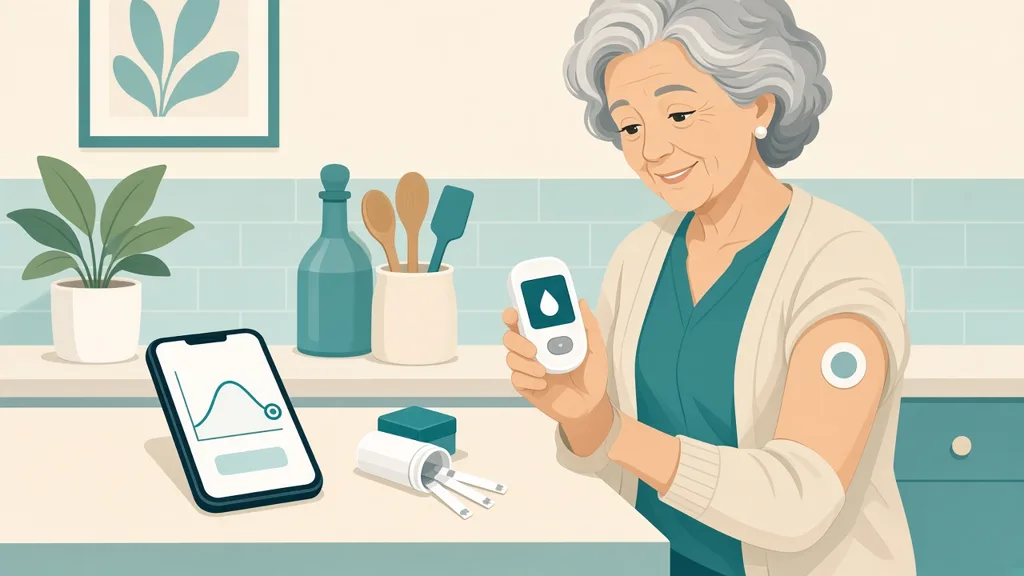
This guide uses NIDDK's continuous glucose monitoring page, the ADA's meter guide and Medicare.gov coverage information. We explain in detail how they differ. Your diabetes care team decides which tool, or both, is right for you.
How a fingerstick meter works
You prick the side of a fingertip, touch a test strip to the drop, and the meter shows your glucose at that moment. The American Diabetes Association says people using insulin may need to check fasting, before meals and snacks, at bedtime, before exercise, when low blood sugar is suspected, after treating a low, and before and during critical tasks like driving. Steps are in how to check your blood sugar at home, and a specific example is the Contour Next One.

How a CGM works
NIDDK says a continuous glucose monitor estimates your glucose level every few minutes and keeps track over time. It has a tiny sensor under the skin (often on the belly or arm) held by a sticky patch, a transmitter, and a software program on a phone or receiver. The sensor estimates glucose in the fluid between your cells, which NIDDK says is very similar to blood glucose. Real-time CGMs show readings automatically; intermittent-scan (flash) types need a scan every few hours to view and store data; some collect data for your doctor to review later. See the Dexcom G7 and FreeStyle Libre 3 Plus guides.
What a CGM adds
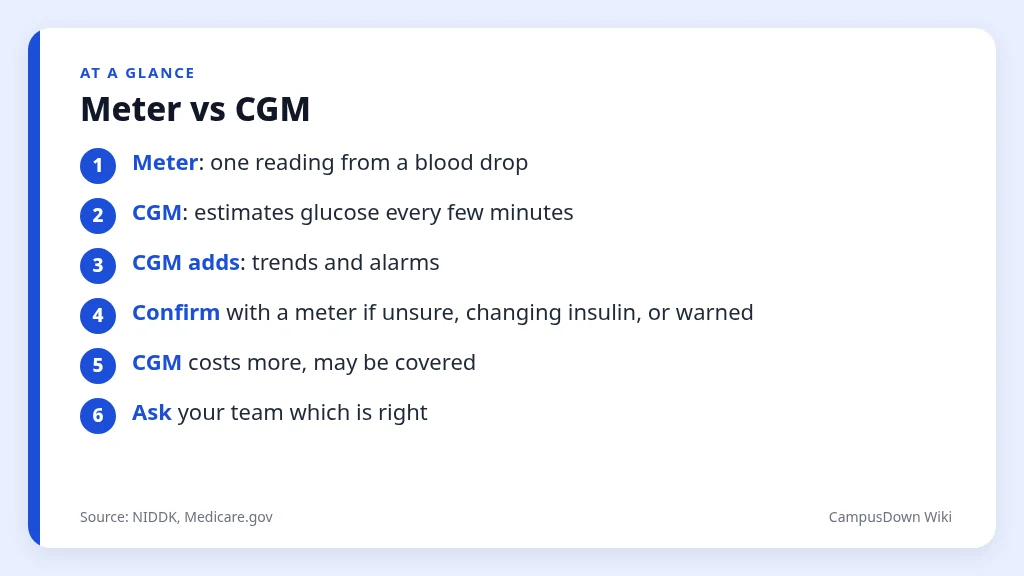
NIDDK says a CGM shows trends, such as whether glucose is rising or falling and how fast, and can sound alarms for high or low levels, and that compared with a standard meter it can help you manage glucose better, have fewer low blood glucose emergencies and need fewer finger sticks. Some can share information with a second person such as a caregiver. The benefit is greatest for people who use it every day or nearly every day. For low-sugar risks, see hypoglycemia in older adults.
Accuracy
All CGMs estimate glucose, and NIDDK says researchers are working to make them more accurate. It says you may sometimes need to compare CGM readings with a finger-stick if you doubt the accuracy, are changing your insulin dose, or the CGM gives a warning alert, and that some models require finger-stick calibration. Manufacturers publish accuracy figures (for example, Dexcom reports an overall MARD of 8.0% for the G7 15 Day in our Dexcom G7 guide); treat these as one company's data, not a promise about your own body. If your symptoms don't match the number, follow your care plan and check with a meter.
Practical issues
NIDDK lists: sensors must be replaced (every 7 to 14 days for disposable sensors, depending on model), transmitters may need replacing, devices sometimes need reconnecting, and skin redness or irritation from the patch can occur. See what to do when a CGM sensor falls off.
Cost and Medicare
NIDDK says a CGM costs more than a standard meter but may be covered by health insurance. Medicare Part B may cover a CGM with conditions on insulin use or low blood sugar history; see CGM Medicare coverage. Our Contour Next One guide notes Medicare Part B covers meters and strips when a clinician orders them.
Who might prefer which
Your clinician may suggest a CGM if you use insulin or have trouble with low blood sugar, or a meter if you test only occasionally. Many people use both: a CGM for trends and a meter to confirm or as a backup. For the wider picture, see diabetes in older adults.
Get help now if
If you have symptoms of a low, such as shakiness, sweating or confusion, don't wait for a CGM alarm; follow your care plan. Call 911 for fainting, seizure or inability to swallow.
Example scenario: the backup meter
- Who
- Julian, 75, a retired crane operator in Tacoma, Washington, started a CGM after his doctor worried about overnight lows. His wife, Ursula, 73, a retired hospital laundry supervisor, was tired of waking to check him.
- What happened
- One morning the phone said his sugar was fine, but he felt shaky and sweaty.
- How it felt
- Julian felt confused: the screen said one thing and his body another. Ursula felt her stomach drop.
- What they did
- Ursula remembered the diabetes educator's advice, pulled out the meter and checked a fingerstick, then followed the low-sugar plan they'd been given. They told his doctor, who reviewed the readings and sensor, and kept both tools.
- How it turned out
- Julian said the meter became his reality check. Ursula said the trend graph helped her sleep, and the meter helped her trust it.
This is an illustrative example, not a real patient or a review.
Julian's story is an illustrative example. Your care team decides how to use your devices.
Most-asked questions about meters and CGMs
What's the difference between a glucometer and a CGM?
A meter reads a drop of blood once; a CGM estimates glucose every few minutes from a sensor and shows trends and alarms.
Why people ask: "glucometer vs cgm" is #1 for "glucometer vs cgm" (US autocomplete, November 2026).
How do glucometer and CGM accuracy compare?
Both can be affected by technique or conditions; NIDDK advises confirming a CGM with a meter when in doubt.
Why people ask: "glucometer vs cgm accuracy" is #2 for "glucometer vs cgm" (US autocomplete, November 2026).
How does a glucose monitor compare with a CGM?
"Glucose monitor" can mean either; a CGM is the continuous type.
Why people ask: "glucose monitor vs cgm" is #5 for "glucometer vs cgm" (US autocomplete, November 2026).
Should I use a glucose meter or a CGM?
Ask your care team; many people use both.
Why people ask: "glucose meter or cgm" is #6 for "glucometer vs cgm" (US autocomplete, November 2026).
What's the difference between a CGM and a glucometer?
A CGM measures glucose in fluid between cells continuously; a meter measures blood at one moment.
Why people ask: "difference between cgm and glucometer" is #8 for "glucometer vs cgm" (US autocomplete, November 2026).
What is flash glucose monitoring vs CGM?
NIDDK describes intermittent-scan CGMs that need you to scan every few hours, vs real-time CGMs that send readings automatically.
Why people ask: "flash glucose monitoring vs cgm" is #6 for "glucose meter vs cgm" (US autocomplete, November 2026).
Is a CGM accurate?
It's an estimate; manufacturers publish accuracy data, and NIDDK advises checking with a meter when readings seem off.
Why people ask: "is cgm accurate" is #7 for "difference between cgm and glucometer" (US autocomplete, November 2026).
Related on CampusDown
You can learn more about the Dexcom G7 and check it for yourself with the Contour Next One guide.
Frequently asked questions
- Do I still need test strips with a CGM?
- NIDDK says CGM users need fewer finger sticks, but sometimes should confirm with one.
- Does Medicare cover CGMs?
- Under conditions; see our Medicare CGM guide.
- Does a CGM work while I sleep or exercise?
- NIDDK says worn CGMs are always on and recording, including while showering, working, exercising or sleeping.
- How long do sensors last?
- NIDDK says 7 to 14 days for disposable sensors, depending on the model.
A meter gives one precise moment, and a CGM gives the story between moments. Ask your team which fits your life, and keep a meter handy.
Browse more guides like this in the Home Medical Devices hub.
This article is for general education and does not replace advice from your own doctor, nurse or pharmacist.