
Should an 82-year-old with diabetes be pushed to the same A1C number as a 45-year-old? Many families are surprised to hear a doctor say "7.8% is fine for Dad," and they wonder whether that means the doctor has given up. It usually means the opposite: the plan is being tuned to protect him from the biggest everyday danger, low blood sugar.

This guide explains the American Diabetes Association's 2026 recommendations for older adults in plain language, plus NIDDK and NIA guidance on lows. If you help a parent manage diabetes, take a closer look at the medicine questions near the end.
Why goals change with age and health
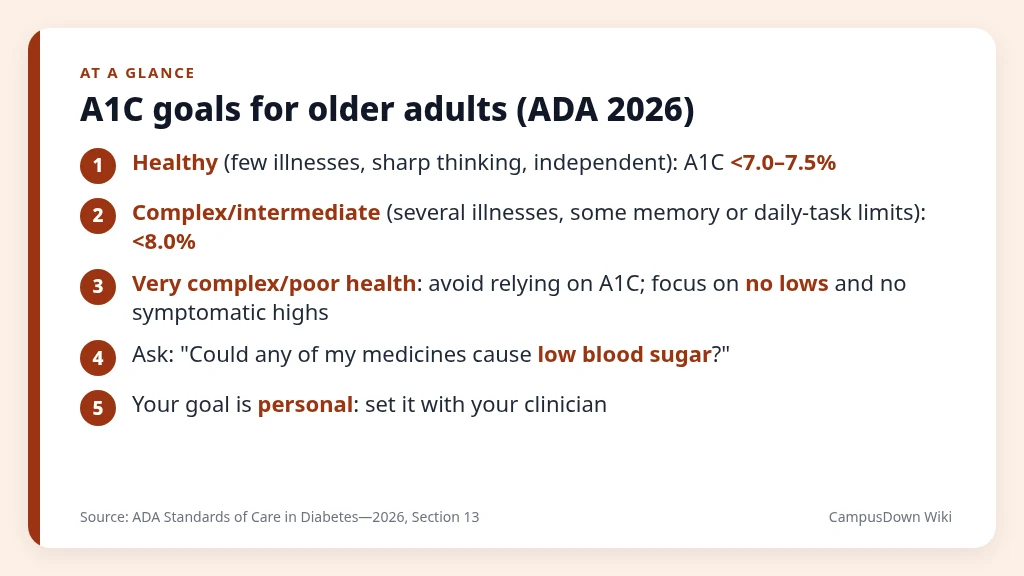
The ADA's Standards of Care in Diabetes—2026 (Section 13, Older Adults) group older adults by overall health rather than birthday:
- Healthy: few and stable chronic illnesses, intact thinking and daily function. A reasonable A1C goal is below 7.0–7.5%. If a CGM is used, the goal is time in range (70–180 mg/dL) of 70% or more and time below 70 mg/dL of 4% or less.
- Complex or intermediate: several chronic illnesses, limits in daily activities, or mild to moderate cognitive impairment. Goals are individualized and should prioritize avoiding hypoglycemia, such as an A1C below 8.0% and time in range of 50% or more with under 1% below 70 mg/dL.
- Very complex or poor health: for example, long-term care, end-stage chronic illness, or moderate to severe cognitive impairment. The ADA says these adults get minimal benefit from tight goals, so clinicians should avoid relying on A1C and focus on preventing lows and symptomatic highs.
The same table suggests a blood pressure goal under 130/80 mmHg for the first two groups and under 140/90 mmHg for the very complex group. See blood pressure targets for older adults.

Why lows matter so much after 65
The NIDDK lists being 65 or older, taking insulin or certain other diabetes medicines, and having kidney disease, heart disease or cognitive impairment as reasons someone is more likely to develop low blood glucose. In older adults a low can look like confusion, dizziness or irritability, and it can lead to a fall. Read low blood sugar in older adults in detail for symptoms and the 15-15 approach.
Numbers on a chart only go so far. The story below shows how a "good" A1C can hide a real problem.
Example scenario: the A1C that looked perfect
- Who
- Harold, 84, a retired mail carrier with type 2 diabetes and early memory problems, living with his daughter Maria.
- What happened
- His A1C came back at 6.2%, and he was proud of it. Over the same months, Maria found him confused and sweaty twice before lunch, and once he slipped getting out of the shower.
- How it felt
- Maria felt torn between relief at the "great" number and fear that something was being missed; Harold was embarrassed and insisted he was "just tired."
- What they did
- Maria wrote down the dates and times and brought every pill bottle to his next visit. The clinician recognized likely lows, noted his glyburide (a sulfonylurea), and discussed changing his plan.
- How it turned out
- Harold's plan was simplified, his A1C goal was set below 8.0%, and the morning episodes stopped. Maria now keeps a short log and glucose tablets in the kitchen, and Harold no longer dreads breakfast.
This is an illustrative example, not a real patient or a review.
Harold's story is an illustration, not a real patient. The ADA recommends deintensifying medicines that can cause lows when hypoglycemia risk is high, but that decision belongs with the care team.
Medicines and simplification
The ADA advises considering deintensification, meaning lowering or switching, of insulin, sulfonylureas or meglitinides when the risk of low blood sugar is high, and simplifying complex plans, especially insulin, to reduce burden. Metformin and several newer drug classes carry less risk of lows on their own; see metformin and Jardiance. The ADA also recommends CGM for older adults with type 1 diabetes or type 2 diabetes on insulin.
Get help now if
Never stop or cut a diabetes medicine on your own. Ask the prescriber or pharmacist to review the full list, including over-the-counter products, at least once a year. See polypharmacy and the Beers Criteria.
Most-asked questions about diabetes in older adults
What is a good A1C for a 70- or 80-year-old?
There is no single number by age. The ADA suggests under 7.0–7.5% for healthy older adults, under 8.0% for intermediate or complex health, and not relying on A1C in very poor health.
Why people ask: "a1c for 80 year old male" is #1 and "a1c for 80 year old woman" is #2 for "a1c for 80 year old"; "a1c goal for elderly ada" is #2 for "a1c goal for elderly" (US autocomplete, November 2026).
Why is my parent's A1C goal higher than mine?
Because the risks of tight control, mostly low blood sugar, falls and confusion, can outweigh the long-term benefits when someone has several illnesses, frailty or memory problems.
Why people ask: "a1c target for elderly" is #3 and "a1c guidelines for elderly" is #4 for "a1c goal for elderly" (US, November 2026).
What are the symptoms of diabetes in older adults?
The NIA lists tiredness, increased hunger or thirst, losing weight without trying, urinating often, numbness or tingling in the hands or feet, blurred vision, skin infections and slow healing. It adds that type 2 symptoms often develop slowly, some people have none, and older adults sometimes dismiss them as just getting old.
Why people ask: "diabetes in older adults symptoms" is #2 for "diabetes in older adults," and "diabetes in elderly symptoms" is #5 for "diabetes in elderly" (US, November 2026).
Can low blood sugar happen without diabetes in older people?
Yes, it can, from illness, some medicines, missed meals or alcohol, though it is less common. Unexplained lows need a medical evaluation.
Why people ask: "low blood sugar in elderly without diabetes" is #3 for "low blood sugar in elderly" (US, November 2026).
If you are a caregiver, check it for yourself before the next visit: list every medicine, note any confusion or sweating episodes with times, and ask what A1C goal fits this year.
Related on CampusDown
Learn more in Diabetes, HbA1c, what an A1C of 5.7 means, and the fall prevention checklist.
Frequently asked questions
- Does a higher A1C goal mean the doctor gave up?
- No. The ADA frames relaxed goals as a way to avoid harm, mainly low blood sugar, while still preventing symptomatic high blood sugar.
- Should older adults check blood sugar at home?
- It depends on the medicines. People on insulin or sulfonylureas usually need home checks or a CGM; ask the care team how often.
- What blood sugar is too low?
- For many people with diabetes, the NIDDK says below 70 mg/dL, but your number may differ.
- Is metformin safe for older adults?
- It is widely used, but kidney function must be checked, and B12 levels can drop over time. Ask the prescriber.
For older adults, a good diabetes plan protects today as well as the future. Learn more about your loved one's goals with the care team, and bring a medicine list and a symptom log to every visit.
Browse more guides like this in the Senior Health and Medicare hub.
This article is for general education and does not replace advice from your own doctor, nurse or pharmacist.