
Why does a medicine that so many people take every day make the first two weeks so miserable for some of them? If you just started metformin and your stomach is in revolt, you are dealing with the most common side effect on its label. The good news is that there are well-known ways to make it easier.

Metformin has been used for decades, is available as an inexpensive generic, and is often the first diabetes medicine people are prescribed. This guide uses the FDA label and MedlinePlus to explain how it works, the forms and strengths, and the warnings that matter. If you have kidney disease or are scheduled for a scan with contrast dye, take a closer look at the warnings section.
What metformin is used for
The label describes metformin as an addition to diet and exercise to improve blood sugar control in adults and children 10 years and older with type 2 diabetes. MedlinePlus notes that it is not used for type 1 diabetes.
Metformin belongs to a class called biguanides. It helps lower blood sugar mainly by reducing the amount of glucose the liver releases and by helping the body respond better to its own insulin. On its own, it is not one of the medicines MedlinePlus or the NIDDK list as a usual cause of low blood sugar, which is different from insulin or sulfonylureas such as glipizide.
In the NIH-funded Diabetes Prevention Program, metformin also lowered the chance of developing type 2 diabetes in people at high risk by 31%, less than the 58% seen with the lifestyle program. See what an A1C of 5.7 means for that story.

Forms and strengths
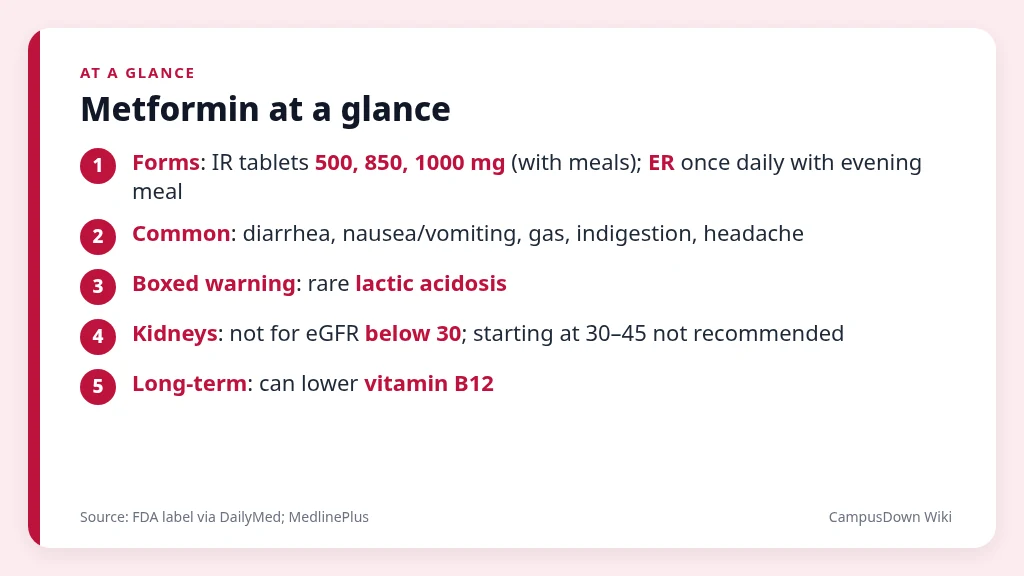
- Immediate-release (IR) tablets: 500 mg, 850 mg and 1000 mg. The label lists them as taken with meals, often twice a day, with doses increased slowly.
- Extended-release (ER) tablets: MedlinePlus says these are usually taken once daily with the evening meal.
- Oral solution: taken with meals 2 to 3 times a day, per MedlinePlus.
MedlinePlus marks several brand names, including Glucophage, as no longer available in the US; most people receive generic metformin. Your prescriber chooses the form and dose, so do not crush, split or change ER tablets unless your pharmacist says it is safe for your specific product.
Starting slowly is part of the plan, not a sign that something is wrong. The story below shows what those first weeks can feel like, and the warnings after it are worth reading in detail.
Example scenario: the first two weeks
- Who
- Denise, 58, a hospital billing clerk newly diagnosed with type 2 diabetes after an A1C of 7.4%.
- What happened
- She started metformin 500 mg twice a day. By day four she had cramping and loose stools, and she began timing her commute around restroom stops.
- How it felt
- She felt embarrassed at work and discouraged, convinced her body "could not handle" diabetes medicine. She quietly skipped her evening dose twice.
- What they did
- Instead of stopping completely, she called her pharmacist, who confirmed that stomach upset is the most common side effect, asked whether she was taking it with meals, and suggested she ask her prescriber about the extended-release form.
- How it turned out
- Her prescriber switched her to ER with dinner and kept the dose low for two weeks before increasing it. The cramps faded, she stopped skipping doses, and three months later her A1C had improved. She now tells friends to call the pharmacist before giving up.
This is an illustrative example, not a real patient or a review.
Denise's move, asking before stopping, is the one to copy. Stomach effects often settle, but the decision about your dose belongs with your care team.
Side effects and warnings
The label lists the most common side effects (more than 5%) as diarrhea, nausea or vomiting, gas, weakness, indigestion, abdominal discomfort and headache. The patient information notes these often go away over time and that taking the medicine with meals helps.
Get help now if
Metformin carries a boxed warning for lactic acidosis, a rare but life-threatening build-up of acid in the blood. Get emergency help for unusual muscle pain, trouble breathing, unusual sleepiness, severe stomach pain with vomiting, feeling cold, dizziness, or a slow or irregular heartbeat.
Other label warnings:
- Kidneys: do not use if eGFR is below 30. Starting metformin is not recommended when eGFR is 30–45. Your clinician checks kidney function before and during treatment. See Chronic Kidney Disease.
- Contrast dye: the label says to stop metformin at or before certain iodinated contrast imaging procedures in people with eGFR 30–60, liver disease, alcoholism or heart failure, and to recheck kidney function 48 hours later.
- Vitamin B12: in 29-week trials, about 7% of people had a drop to below-normal B12 levels. The label advises periodic blood checks. Read more in Vitamin B12 and metformin.
- Alcohol: excessive alcohol intake is listed as a risk factor for lactic acidosis.
- Surgery and serious illness: dehydration, severe infection, heart attack or stroke can raise risk; your team may pause metformin.
Most-asked questions about metformin
Metformin vs GLP-1 medicines like Ozempic: what is the difference?
Metformin is a tablet that mainly reduces glucose released by the liver. GLP-1 receptor agonists such as semaglutide (Ozempic) are a different class, given as weekly injections or, for Rybelsus, a daily tablet, and they affect appetite and insulin release. They are often used together, and your clinician weighs heart, kidney and weight goals. See semaglutide.
Why people ask: "metformin vs glp-1" is the #1 Google suggestion and "metformin vs ozempic" is #2 for "metformin vs" (US autocomplete, November 2026).
Metformin ER vs regular metformin: which is easier on the stomach?
Both contain metformin. ER releases it slowly and is usually taken once daily with the evening meal, while IR is taken with meals one to three times a day. Some people tolerate ER better, so ask your prescriber if stomach effects persist.
Why people ask: "metformin er vs metformin" is the #1 suggestion for "metformin er vs" (US, November 2026).
Can I drink alcohol on metformin?
The label lists excessive alcohol intake as a risk factor for lactic acidosis, and the NIDDK notes alcohol can also make low blood sugar harder to notice when combined with other diabetes medicines. Ask your clinician what is safe for you.
Why people ask: "metformin and alcohol" is the #1 suggestion for "metformin and" (US, November 2026).
Does metformin lower vitamin B12?
Yes, it can. The label reports below-normal B12 in about 7% of people in 29-week trials and recommends periodic checks.
Why people ask: "metformin and b12" is the #1 suggestion and "metformin and b12 deficiency" is #2 for "metformin and b12" (US, November 2026).
Will metformin make me lose weight?
Metformin is approved to treat type 2 diabetes, not obesity. Any weight change differs from person to person, so talk with your prescriber about weight goals.
Why people ask: "metformin weight loss" is the #1 suggestion for "metformin weight" (US, November 2026).
Before your next refill, check it for yourself: are you taking it with food, has your kidney function been checked this year, and do you know your last B12 level?
Related on CampusDown
Learn about diabetes and insulin resistance, and compare how other medicines raise the risk of lows in Hypoglycemia.
Frequently asked questions
- Should metformin be taken with food?
- Yes. The label directs taking IR tablets with meals, and MedlinePlus says ER tablets are usually taken with the evening meal.
- Does metformin cause low blood sugar?
- On its own it is not usually a cause, but lows can happen when it is combined with insulin or sulfonylureas, or with heavy alcohol use or skipped meals.
- Why do I need to stop metformin before a CT scan?
- Some iodinated contrast procedures can affect the kidneys. The label tells clinicians when to pause it and to recheck kidney function 48 hours later. Follow your imaging team's instructions.
- What if I miss a dose?
- MedlinePlus advises taking it when you remember unless it is almost time for the next dose; do not double up.
Metformin works best when you can stay on it, and that usually means taking it with food, starting slowly and asking questions early. Learn more about your kidney and B12 checks, and call your pharmacist before you skip a single dose.
Browse more guides like this in the Medicines hub.
This article is for general education and does not replace advice from your own doctor, nurse or pharmacist.