
Your mother takes glipizide in the morning, and one day she's sweaty, shaky and confused before lunch. Is that the medicine? It might be low blood sugar, which is the main risk of this drug class. Knowing the warning signs is the most useful thing a family can learn.
This guide is based on MedlinePlus, the FDA-approved Glucotrol (glipizide) label and the 2023 American Geriatrics Society (AGS) Beers Criteria. You can learn more about each source in the references. Talk with your doctor or pharmacist before changing anything. This isn't a dosing guide.
What glipizide is
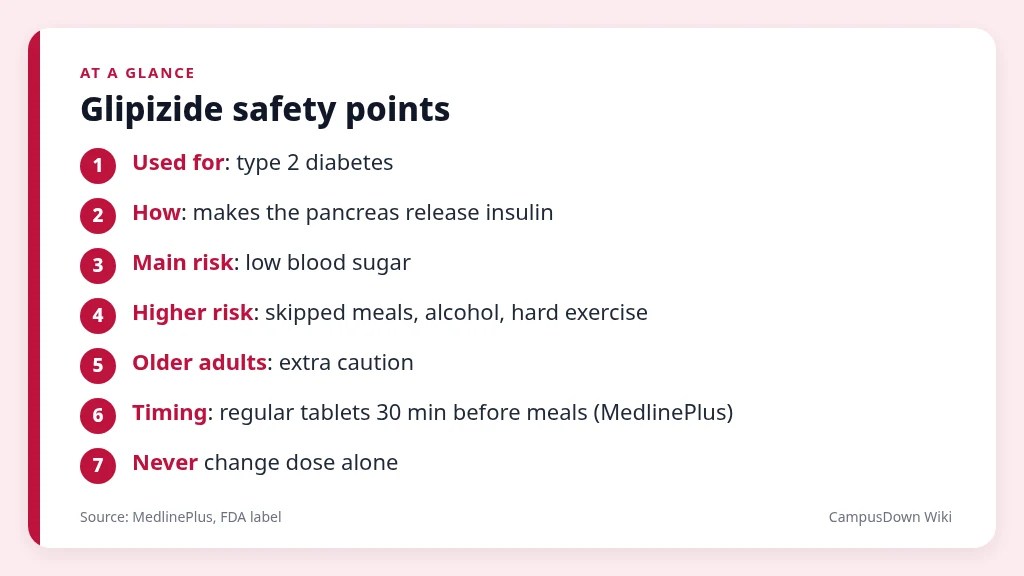
MedlinePlus says glipizide treats type 2 diabetes and belongs to the sulfonylurea class. It lowers blood sugar by causing the pancreas to produce insulin and helping the body use insulin efficiently. The label describes this as stimulating insulin release from pancreatic beta cells. Because it pushes insulin out whether or not you've just eaten, low blood sugar is the concern.

Low blood sugar: the main risk
The FDA label states that all sulfonylurea drugs are capable of producing severe hypoglycemia. It lists what raises the risk:
- Kidney or liver problems, which can raise blood levels of the drug
- Elderly, debilitated or malnourished patients
- Too little food, after severe or prolonged exercise, alcohol, or using more than one glucose-lowering drug
The label adds that hypoglycemia may be difficult to recognize in the elderly and in people taking beta-blockers. MedlinePlus lists warning signs as shakiness, nervousness, sweating, chills, irritability, confusion, fast heartbeat, lightheadedness, hunger, headache, nausea, blurred vision or weakness. For what to do and when to call 911, read hypoglycemia in older adults.
Older adults
The label says dose selection for an elderly patient should be cautious, usually starting at the low end of the dosing range, because kidney, liver or heart function may be lower and other drugs may be in use. The 2023 AGS Beers Criteria, a list of medicines to use with caution in people 65 and older, recommends avoiding sulfonylureas as first- or second-line monotherapy or add-on therapy unless safer options are substantially unavailable, and says that if one is used, short-acting agents such as glipizide are preferred over longer-acting ones. Learn more in polypharmacy and the Beers Criteria. This isn't an instruction to stop; if you take glipizide, talk with your doctor about whether it's still right for you. Kidney function matters too; see eGFR and kidney function.
Timing and missed doses
MedlinePlus says the regular tablet is taken one or more times a day, 30 minutes before breakfast or meals, while the extended-release tablet is taken once a day with breakfast, at the same time every day. If you miss a dose, MedlinePlus says to take it when you remember unless the next dose is near, and never take a double dose. Follow your own label and ask your pharmacist about your exact product.
Alcohol and other medicines
MedlinePlus says alcohol may make side effects worse and rarely may cause flushing, headache, nausea, vomiting, chest pain, confusion and other symptoms, so ask your doctor about alcohol. It also lists interactions with salicylate pain relievers, niacin, cimetidine, aspirin and NSAIDs such as ibuprofen and naproxen, and says not to start these without talking to your provider. Bring everything to a brown bag medication review.
Other side effects
MedlinePlus says to tell your doctor if diarrhea, gas, dizziness or skin rash, itching or hives are severe or don't go away, and to call right away for yellowing of the skin or eyes, dark urine, light stools, upper-right stomach pain or unusual bruising or bleeding. It also says glipizide may make skin sensitive to sunlight. Report any weight change or other new effect to your doctor.
Glipizide vs metformin
They work differently. Glipizide stimulates insulin release; metformin works differently. The metformin prescribing information notes an increased risk of hypoglycemia when it's combined with insulin or an insulin secretagogue such as a sulfonylurea, and says a lower dose of the other drug may be needed. Which is better depends on your health, kidneys and other medicines, which is why a doctor decides. For the bigger picture, see diabetes in older adults. If your A1C is in the prediabetes range, see A1C 5.7 and prediabetes.
Get help now if
Call 911 if someone on glipizide has severe confusion, can't swallow safely, has a seizure or passes out. Don't give food or drink to a person who is unconscious.
Example scenario: the missed lunch
- Who
- Sylvester, 79, a retired postal carrier in Dayton, Ohio, took his glipizide as usual before breakfast and then spent the late morning at the church volunteering, skipping lunch when the meeting ran over. His wife, Rowena, 77, a retired school secretary, noticed he was sweating.
- What happened
- He felt shaky and couldn't finish a sentence, and he waved her away at first, saying he was fine.
- How it felt
- Sylvester felt embarrassed and a little scared. Rowena felt her heart race, remembering the pharmacist's warning.
- What they did
- Rowena checked his meter, as they'd been taught, and followed the plan from his doctor's office. He recovered, and they called his doctor that afternoon. At the visit, the doctor reviewed the timing of his medicine and meals, checked his kidney function and discussed whether his plan should change. They also wrote a card for his wallet and the glovebox.
- How it turned out
- Sylvester said he'd never again assume a skipped lunch was harmless. Rowena said the card made her feel prepared.
This is an illustrative example, not a real patient or a review.
Sylvester's story is an illustrative example. Your doctor and pharmacist decide the right plan for you.
Most-asked questions about glipizide
What are the side effects of glipizide?
The main one is low blood sugar. MedlinePlus also lists diarrhea, gas, dizziness and skin reactions, and serious signs such as yellowing skin or unusual bleeding.
Why people ask: "glipizide side effects" is #1 for "glipizide side effects" (US autocomplete, November 2026).
What are glipizide side effects in the elderly?
The label says elderly patients are particularly susceptible to hypoglycemia, which can be hard to recognize. Talk with your doctor about your plan.
Why people ask: "glipizide side effects in elderly" is #2 for "glipizide side effects" (US autocomplete, November 2026).
Does glipizide cause weight gain?
The sources we reviewed don't give a figure. Tell your doctor about any weight change.
Why people ask: "glipizide side effects weight gain" is #6 for "glipizide side effects" (US autocomplete, November 2026).
Can glipizide cause low blood sugar?
Yes. The FDA label says all sulfonylureas can cause severe hypoglycemia.
Why people ask: "glipizide low blood sugar" is #1 for "glipizide low blood sugar" (US autocomplete, November 2026).
Glipizide vs metformin: which is better?
It depends on the person; they work differently and have different risks. Your doctor decides.
Why people ask: "glipizide vs metformin which is better" is #3 for "glipizide vs metformin" (US autocomplete, November 2026).
Glipizide vs metformin hypoglycemia risk?
The label warns of hypoglycemia with glipizide because it stimulates insulin release. Ask your doctor how each medicine affects your risk.
Why people ask: "glipizide vs metformin hypoglycemia" is #7 for "glipizide vs metformin" (US autocomplete, November 2026).
Related on CampusDown
You can take a closer look at hypoglycemia in older adults and check it for yourself in diabetes in older adults.
Frequently asked questions
- When should I take glipizide?
- MedlinePlus says regular tablets 30 minutes before meals and extended-release with breakfast; follow your label.
- Can I drink alcohol on glipizide?
- Ask your doctor; alcohol may worsen side effects and raise low-sugar risk.
- Can I stop it if I feel fine?
- Don't stop or change doses without your doctor's advice.
- Is glipizide safe for seniors?
- The Beers Criteria advise caution; talk with your doctor about whether it suits you.
Glipizide works, and low blood sugar is the cost of that strength. Know the warning signs, keep meals regular and review it with your doctor and pharmacist.
Browse more guides like this in the Medicines hub.
This article is for general education and does not replace advice from your own doctor, nurse or pharmacist.