
Is an A1C of 5.7 a big deal, or just a number that barely tipped over a line? If your portal just flagged 5.7% in red, you are not alone. "A1C 5.7 what should I do" is one of the top Google suggestions people see when they type that number.

The short answer: 5.7% is the first value in the prediabetes range. It is not diabetes, and it is not a reason to panic. It is an early signal that gives you time to act. This guide explains what the number means and what the research behind prevention showed, so you can take a closer look at your own result before your follow-up visit.
What an A1C of 5.7% means
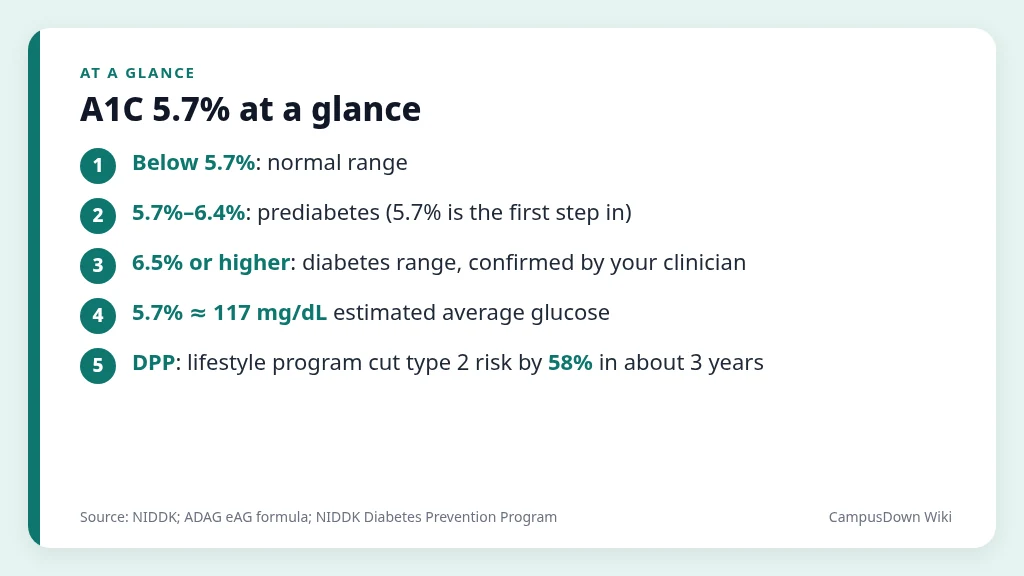
The A1C test measures how much glucose is attached to your red blood cells and reflects your average blood glucose over about the past three months. According to the NIDDK, the ranges are:
- Below 5.7%: normal
- 5.7% to 6.4%: prediabetes
- 6.5% or higher: diabetes range
A fasting plasma glucose of 100 to 125 mg/dL, or an oral glucose tolerance test result of 140 to 199 mg/dL, also falls in the prediabetes range. A diagnosis of diabetes is usually confirmed with a repeat test, so one number is a starting point, not a verdict.
Key point
An A1C of 5.7% means prediabetes, not diabetes. It is the earliest point in that range, which is the best time to make changes. Read more in our prediabetes overview and how the HbA1c test works.

5.7% as an average blood sugar
People often ask what 5.7% "equals" in everyday glucose numbers. The A1C-Derived Average Glucose (ADAG) study produced a formula that converts A1C into an estimated average glucose (eAG): eAG in mg/dL = 28.7 × A1C − 46.7. For 5.7%, that works out to about 117 mg/dL.
This is an average across day and night, before and after meals. A single fingerstick or CGM reading can be higher or lower and still fit this average. Some conditions that affect red blood cells, such as certain anemias, can make A1C less reliable, which is one reason your clinician may also check fasting glucose.
Who tends to land here? The NIDDK lists risk factors including overweight or a large waist, age 35 or older, a family history of diabetes, physical inactivity, a history of gestational diabetes, and conditions such as polycystic ovary syndrome or sleep apnea. If any of these fit you, the story below may sound familiar, and the steps after it are worth reading in detail.
Example scenario: the number that came back in red
- Who
- Daniel, 46, a warehouse supervisor with a desk-heavy schedule and a father who had type 2 diabetes.
- What happened
- His annual physical came back with an A1C of 5.7% and a fasting glucose of 104 mg/dL. The patient portal marked both in red before his doctor had called.
- How it felt
- He felt a jolt of fear and then shame. He spent the evening reading forums, convinced he would soon need insulin like his dad, and snapped at his kids at dinner.
- What they did
- At his follow-up, his doctor explained that 5.7% is the lowest prediabetes value and referred him to a CDC-recognized lifestyle change program. Daniel started walking at lunch, swapped soda for water, and kept a simple food log.
- How it turned out
- Six months later his weight was down about 6%, and his repeat A1C had moved back into the normal range. He still checks it yearly, but the fear turned into a routine he can live with.
This is an illustrative example, not a real patient or a review.
Daniel's results are an example, and results differ from person to person. What he did right was simple: he asked what the number meant, accepted a referral, and changed a few habits he could keep.
What the research says helps
The NIH-funded Diabetes Prevention Program (DPP) enrolled 3,234 adults at high risk for type 2 diabetes. Participants in the lifestyle group aimed to lose 7% of their body weight and exercise 150 minutes per week. According to the NIDDK:
- After about three years, the lifestyle program lowered the chance of developing type 2 diabetes by 58% compared with placebo.
- For participants aged 60 and older, the reduction was 71%.
- Metformin lowered the chance by 31%, a smaller effect than lifestyle change.
- Follow-up studies showed people could prevent or delay type 2 diabetes for at least 15 years with lifestyle changes or metformin.
The NIDDK also notes that losing 5% to 7% of starting weight helped reduce the chance of developing diabetes. The CDC's National Diabetes Prevention Program is based on the DPP, and Medicare has covered eligible people in it since 2018.
Most people do not need to overhaul their life overnight to benefit. Before your follow-up, it helps to know which questions come up most often, so you can check it for yourself against your own situation.
Most-asked questions about an A1C of 5.7
Is an A1C of 5.7 prediabetes?
Yes. The NIDDK defines prediabetes as an A1C of 5.7% to 6.4%, so 5.7% is the first value in that range. It is not diabetes.
Why people ask: "is a1c 5.7 prediabetes" is the #1 Google suggestion for "is a1c 5.7" (US autocomplete, November 2026).
What should I do after an A1C of 5.7?
Ask your clinician whether to repeat the test and when, review your risk factors, and ask about a CDC-recognized lifestyle change program. Small, steady changes in weight, activity and eating patterns are what the DPP tested.
Why people ask: "a1c 5.7 what should i do" is the #1 suggestion for "a1c 5.7 what" and #8 for "a1c 5.7" (US, November 2026).
What blood sugar does an A1C of 5.7 equal?
Using the ADAG formula, 5.7% corresponds to an estimated average glucose of about 117 mg/dL.
Why people ask: "a1c 5.7 average blood sugar" is #3 and "a1c 5.7 glucose 117" is #6 for "a1c 5.7" (US, November 2026).
Do I need metformin for an A1C of 5.7?
Not automatically. In the DPP, metformin lowered risk but less than lifestyle change, and the decision depends on your overall risk. This is a discussion for your clinician; see our metformin guide.
Why people ask: "a1c 5.7 do i need metformin" is the #2 suggestion for "a1c 5.7 can" (US, November 2026).
Questions to bring to your appointment
- Should we repeat the A1C or check fasting glucose to confirm?
- Do any of my health conditions make A1C less accurate for me?
- Am I eligible for a National Diabetes Prevention Program, and is it covered by my plan?
- How often should I be retested?
Related on CampusDown
Learn how insulin resistance fits into the picture in Insulin Resistance, and see the full picture of diabetes. If you are curious about glucose sensors sold without a prescription, read Dexcom Stelo, and for older relatives, see diabetes in older adults.
Frequently asked questions
- Is an A1C of 5.7 reversible?
- Many people bring their A1C back into the normal range with lifestyle changes, as the DPP showed for many participants. Results vary, so recheck with your clinician.
- How often should I recheck my A1C after 5.7?
- Your clinician will decide based on your overall risk. Many people with prediabetes are rechecked about once a year.
- Can stress or illness raise my A1C?
- A1C reflects average glucose over about three months, so a long stretch of illness or certain medicines can affect it. Conditions that change red blood cells can also make the result less accurate.
- Is 5.7 dangerous?
- Prediabetes is linked to higher risk of type 2 diabetes and some blood vessel changes, but 5.7% itself is not an emergency. It is a reason to plan, not to panic.
A 5.7% result is the most hopeful kind of warning: it arrives early. Write down your questions, ask about a lifestyle change program, and learn more about your own risk factors so your next A1C tells a better story.
Browse more guides like this in the U.S. Health Topics hub.
This article is for general education and does not replace advice from your own doctor, nurse or pharmacist.