
Can a sensor you buy online without a prescription tell you anything useful about your blood sugar? Since March 2024, Americans have been able to try exactly that with Stelo by Dexcom, and the questions have poured in: is it the same as a G7, is it accurate, and will insurance pay for it?
This guide sticks to what the FDA and Dexcom actually say about Stelo, who it is designed for, and where its limits are. If you have prediabetes or type 2 diabetes managed without insulin, take a closer look at the "not for" list before you buy.
What Stelo is
On March 5, 2024, the FDA cleared the Dexcom Stelo Glucose Biosensor System as the first over-the-counter (OTC) continuous glucose monitor. According to the FDA announcement:
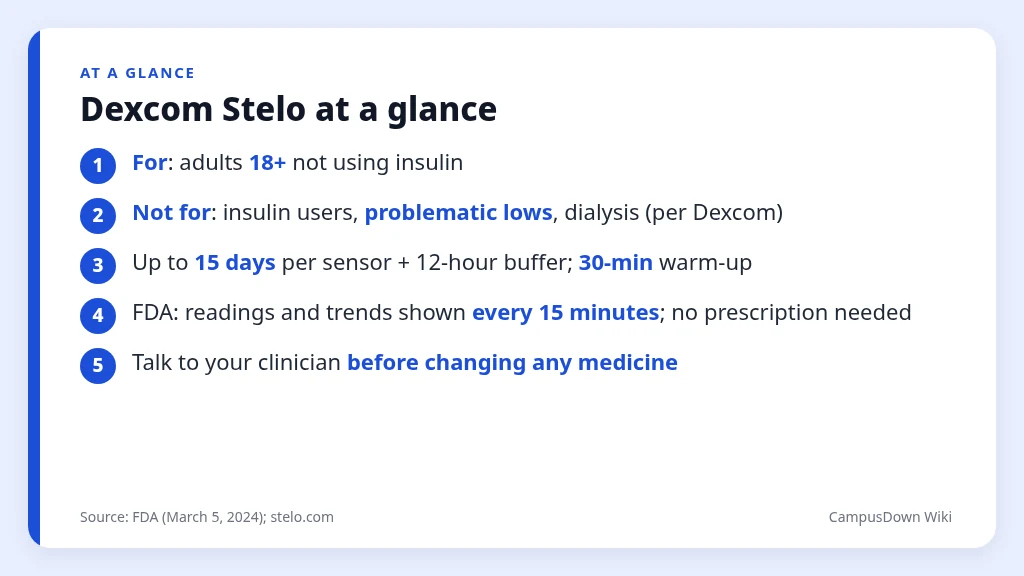
- It is intended for anyone 18 and older who does not use insulin, such as people with diabetes treated with oral medicines or people without diabetes who want to see how diet and exercise affect glucose.
- It is not for people with problematic hypoglycemia, because the system is not designed to alert users to that dangerous condition.
- Each sensor can be worn up to 15 days, and the app presents glucose measurements and trends every 15 minutes.
- Users should not make medical decisions based on the readings without talking to a health care provider.
- Adverse events in the study included local infection, skin irritation, and pain or discomfort.
Dexcom's product page adds a 30-minute warm-up, a 12-hour buffer after the session ends, and use on the back of the upper arm. It also says not to use Stelo if you are on dialysis or have a history of eating disorders, and that the sensor is unsafe in MRI, CT and diathermy settings.

What it costs and how it is sold
On stelo.com in November 2026, Dexcom listed a one-time 1-month supply of 2 biosensors for $99, a monthly subscription for $89, and a 3-month subscription of 6 biosensors for $252. Prices can change, and Dexcom states all sales are final.
Dexcom also discloses that in its sensor-life study, 77.9% of sensors lasted the full 15 days, and it says it will replace sensors with confirmed issues. Read that fine print in detail before choosing a subscription.
Knowing the rules is one thing; seeing how they play out is another. The story below shows a typical first month.
Example scenario: the oatmeal surprise
- Who
- Lorraine, 52, a school administrator recently told her A1C was 6.0%, not on any diabetes medicine.
- What happened
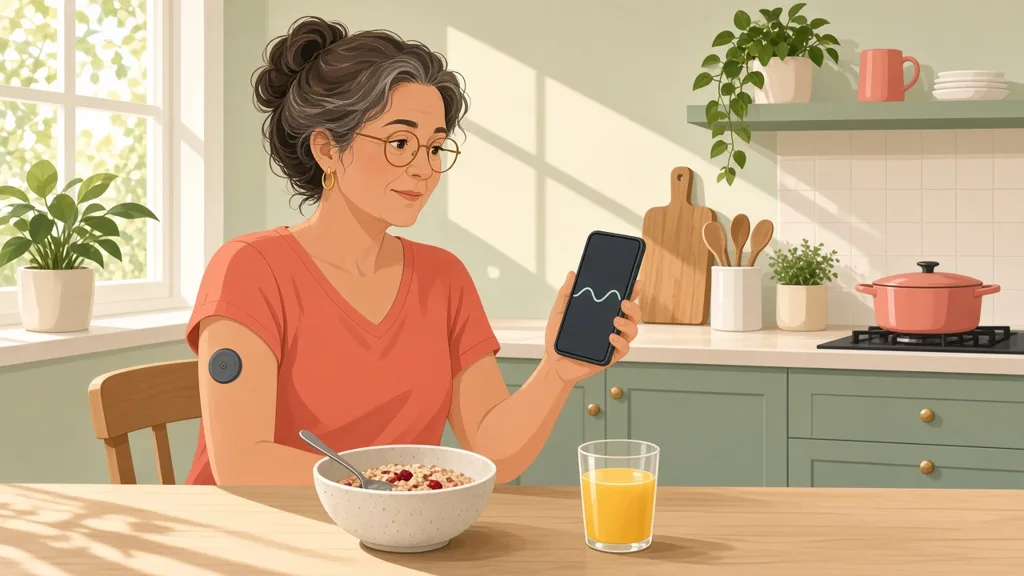
- She bought a Stelo to see what her "healthy" routine was doing. On day three, the app flagged a big rise after her usual breakfast of instant oatmeal with brown sugar and juice.
- How it felt
- She felt betrayed by the food she thought was virtuous, and then anxious, checking the app every few minutes and skipping lunch to make the line flatter.
- What they did
- Her primary care clinician reminded her that Stelo is for spotting patterns, not for medical decisions, and suggested she try small swaps rather than skipping meals. Lorraine tried steel-cut oats with nuts, kept the juice to weekends, and added a 15-minute walk after dinner.
- How it turned out
- By the second sensor the spikes were smaller and she was checking the app twice a day instead of thirty times. She brought her pattern notes to her next visit, and her clinician used them to plan her follow-up A1C.
This is an illustrative example, not a real patient or a review.
Lorraine's story is an illustration, and results differ from person to person. The useful lesson is how she used the data: as conversation material for her clinician, not as a scorecard.
Most-asked questions about Stelo
Dexcom Stelo vs G7: what is the difference?
The G7 is a prescription CGM with high, low and urgent-low alerts, cleared for ages 2 and older, including people on insulin. Stelo is sold without a prescription, is for adults not on insulin, is not for people with problematic lows, and the FDA described it as showing readings every 15 minutes. See our Dexcom G7 guide.
Why people ask: "dexcom stelo vs g7" is the #1 Google suggestion for "dexcom stelo vs," and "stelo vs g7" is #1 for "stelo vs g7" (US autocomplete, November 2026).
Stelo vs Abbott Lingo: which OTC sensor fits me?
Both are over-the-counter glucose biosensors for adults not using insulin. The FDA cleared Stelo for adults not on insulin, including people with type 2 diabetes on oral medicines, while Abbott positions Lingo as a wellness product. Compare details in Stelo vs Lingo and Abbott Lingo.
Why people ask: "stelo vs lingo" is the #1 suggestion for "stelo vs" (US, November 2026).
Does insurance or Medicare cover Stelo?
Stelo is sold directly to consumers. Medicare's CGM benefit, per Medicare.gov, is for people with diabetes who take insulin or have a history of low blood sugar problems, which are the groups Stelo is not intended for. Ask your own plan, HSA or FSA administrator before buying.
Why people ask: "stelo medicare coverage" is the #1 suggestion for "stelo medicare," and "stelo insurance coverage" is #1 for "stelo insurance" (US, November 2026).
Is Stelo accurate compared with a finger-prick meter?
The FDA said the device performed similarly to other integrated CGMs in the data it reviewed. Like all CGMs, it measures fluid under the skin, so it can lag and differ from a fingerstick when glucose changes quickly.
Why people ask: On a 557,000-view YouTube CGM comparison, the most-liked comment (122 likes) explains that sensors read interstitial fluid while a finger prick reads blood, so the numbers rarely match exactly (read November 2026). "stelo accuracy first 24 hours" is #2 for "stelo accuracy."
What if my Stelo stops working early?
Dexcom says about 20% of sensors may not last the full 15 days and that it will ship a replacement for confirmed issues. Contact Dexcom support with the dates and what happened.
Why people ask: "stelo stopped working" is #3 and "stelo stopped working early" is #4 for "stelo not working" (US, November 2026).
If you are on the fence, check it for yourself with one honest question: will you use the data to change habits with your clinician, or will it mostly make you anxious?
Who should choose a prescription CGM instead
- Anyone who uses insulin
- Anyone with a history of serious or frequent low blood sugar
- Anyone on dialysis
- Children and teens under 18
People taking sulfonylureas such as glipizide can also have lows, so ask your clinician whether an OTC sensor makes sense for you.
Related on CampusDown
If you just learned you have prediabetes, start with what an A1C of 5.7 means. Learn about insulin resistance, and if you take metformin, bring your Stelo patterns to your next medication review.
Frequently asked questions
- Do I need a prescription for Stelo?
- No. The FDA cleared it as an over-the-counter CGM for adults 18 and older not on insulin.
- Does Stelo have low glucose alarms?
- The FDA noted the system is not designed to alert users to problematic hypoglycemia, which is why it is not for people at risk of dangerous lows.
- How long does a Stelo sensor last?
- Up to 15 days, plus a 12-hour buffer, according to Dexcom.
- Can I swim with Stelo?
- Dexcom says the biosensor is waterproof and can be submerged up to 8 feet for 24 hours when properly applied.
Stelo can turn vague advice about "watching your sugar" into patterns you can see. Learn more about what your numbers mean with your clinician, and never change a medicine based on the app alone.
Browse more guides like this in the Home Medical Devices hub.
This article is for general education and does not replace advice from your own doctor, nurse or pharmacist.