
You want to see how your meals move your glucose, and two over-the-counter sensors keep showing up: Stelo and Lingo. Do they differ in ways that matter? A few, and they're easier to see side by side.
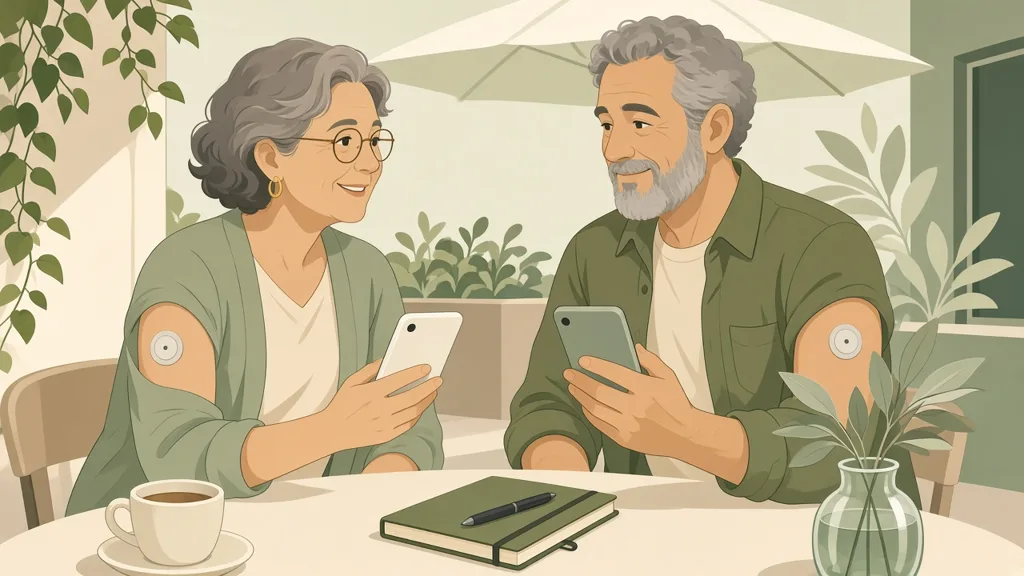
This guide uses FDA clearance summaries for each device (K234070 and K233655) and each company's plan page. It doesn't recommend one. If you take insulin or have diabetes, talk with your doctor first; these products aren't for everyone. For background, see the Abbott Lingo guide and the Stelo guide, and take a closer look at the table below.
What they have in common
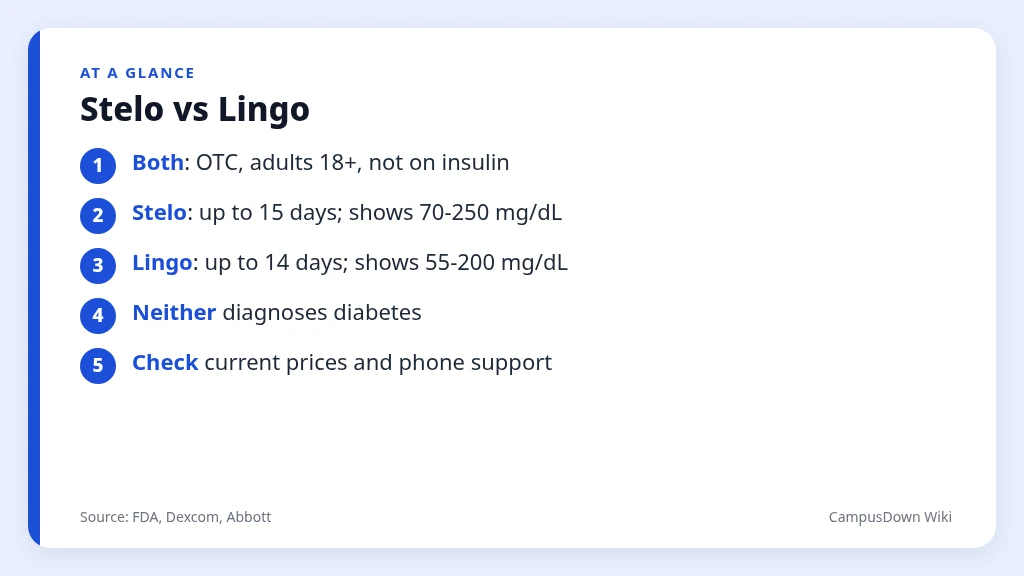
Both are over-the-counter integrated CGMs cleared by the FDA for people 18 and older not on insulin. Both say users shouldn't take medical action based on the output without consulting a qualified healthcare professional. Both are worn on the back of the upper arm, and both FDA summaries say not to use them on dialysis. Both are meant to help you understand how food, exercise and habits affect your glucose, not to diagnose diabetes. For how CGMs differ from fingerstick meters, see meter vs CGM.

Side by side
| Feature | Stelo by Dexcom | Abbott Lingo |
|---|---|---|
| FDA clearance | K234070, cleared March 5, 2024 | K233655, decision May 29, 2024 |
| Who | Adults 18+, not on insulin | Adults 18+, not on insulin |
| Wear | Up to 15 days (plus a 12-hour buffer on Dexcom's page) | Up to 14 days |
| Warm-up | 30 minutes (Dexcom's page) | Data appears in 60 minutes (Abbott's page) |
| Reportable range shown | 70 to 250 mg/dL | 55 to 200 mg/dL |
| App updates | Receives data every 5 minutes; shows readings every 15 minutes (FDA) | "Minute-by-minute" (Abbott's page) |
| Phones | iOS and Android | iOS and Android on listed devices |
| Don't use if | On insulin, dialysis, problematic hypoglycemia, history of eating disorders (Stelo's page) | On insulin, dialysis, critically ill (FDA) |
| Based on | Dexcom G7 technology (the FDA summary names the G7 as its predicate) | FreeStyle Libre 2 sensor (FDA summary) |
Sources: FDA K234070 and K233655 summaries; Dexcom's Stelo buy page; Abbott's Lingo plan page. Specs and prices change, so verify with each company.
What the ranges mean
The display range is the span of numbers the app will show. The FDA summary for Stelo says the sensor measures 40 to 400 mg/dL, but the app narrows the display to 70 to 250. Lingo reports 55 to 200 mg/dL and shows "< 55" or "> 200" outside it. Neither range is a diagnosis. If you often see numbers at the edges, talk to your doctor about proper testing. See what an A1C of 5.7 means.
Cost
Company plan pages (checked November 2026) show: Stelo at $99 for 2 biosensors one time, $89 per month on a monthly subscription, or $252 for 6 biosensors every 3 months; Lingo at $54 for one biosensor on its 2-week plan, $89 for two on its 4-week plan, or $249 for six every 12 weeks. Promotions and prices change, so don't rely on this page for current prices.
Reliability and replacement
Abbott says in its study 77.1% of Lingo biosensors lasted the full 14 days. Dexcom's page says that if there's an issue with a biosensor before its 15-day wear is complete, it will ship a new one. If a patch peels, see what to do when a CGM sensor falls off.
Which one fits you?
- Phone support: each app lists compatible phones; check yours before buying.
- Wear time and cost: compare per-sensor costs and how many days you want.
- Your health: if you have diabetes, take insulin or have problematic low blood sugar, neither OTC product is for you; see prescription CGM comparison and diabetes in older adults.
- Coverage: these are OTC; see CGM Medicare coverage for prescribed devices.
Get help now if
Neither sensor diagnoses diabetes. If you have symptoms such as extreme thirst, frequent urination, blurred vision or unexplained weight loss, contact your doctor. Call 911 for fainting, confusion or trouble breathing.
Example scenario: the trial month
- Who
- Rudolph, 58, a high school shop teacher in Spokane, Washington, had a borderline A1C result and a father with type 2 diabetes.
- What happened
- His wife had gifted him one sensor of each kind to try over two months.
- How it felt
- He felt curious but also anxious, and he found himself checking his phone every few minutes at work.
- What they did
- His doctor suggested reading the graph once or twice a day, writing down meals and sleep, and bringing the notes to his next visit. The doctor also ordered standard blood tests.
- How it turned out
- Rudolph said he was surprised how quickly the novelty wore off, and relieved his results turned into a plan instead of a worry.
This is an illustrative example, not a real patient or a review.
Rudolph's story is an illustrative example. Test results and next steps are decided with your doctor.
Most-asked questions about Stelo vs Lingo
What is the difference between Stelo and Lingo?
Both are OTC CGMs for adults not on insulin; they differ in wear time, warm-up, displayed range, app update rate and price.
Why people ask: "stelo vs lingo" is #1 for "stelo vs lingo" (US autocomplete, November 2026).
How do Stelo and Lingo compare as CGMs?
See the table above.
Why people ask: "stelo vs lingo cgm" is #2 for "stelo vs lingo" (US autocomplete, November 2026).
Is Stelo or Lingo a better glucose monitor?
Neither is better for everyone; fit, phone support, cost and your doctor's advice matter.
Why people ask: "stelo vs lingo glucose monitor" is #3 for "stelo vs lingo" (US autocomplete, November 2026).
How does the cost compare?
Check current plan pages; examples are listed above.
Why people ask: "stelo vs lingo cost" is #5 for "stelo vs lingo" (US autocomplete, November 2026).
Are Stelo and Lingo good for prediabetes?
They're meant to show how food and habits affect glucose, not to diagnose prediabetes; ask your doctor about testing.
Why people ask: "stelo vs lingo for prediabetes" is #7 for "stelo vs lingo" (US autocomplete, November 2026).
How do the sizes compare?
Dexcom lists Stelo's biosensor at about 24.14 mm by 27.4 mm by 4.72 mm; check Abbott for Lingo's size.
Why people ask: "stelo vs lingo size" is #8 for "stelo vs lingo" (US autocomplete, November 2026).
Which CGM is best?
It depends on your health, prescription status and coverage; ask your care team.
Why people ask: "which cgm is best" is #8 for "stelo vs lingo cgm" (US autocomplete, November 2026).
Related on CampusDown
You can learn more about Abbott Lingo and check it for yourself with the Dexcom Stelo guide.
Frequently asked questions
- Can I use Stelo or Lingo if I take insulin?
- No. Both are cleared for adults not on insulin.
- Do they replace a fingerstick meter?
- They aren't meant for treatment decisions; see our meter vs CGM guide.
- Which has more wear days?
- Stelo lists up to 15 days; Lingo lists up to 14.
- Are they covered by Medicare?
- Medicare coverage rules we cover are for prescribed CGMs; ask your plan about OTC devices.
Stelo and Lingo are two similar windows into your glucose, and neither is a diagnosis. Pick on fit and cost, and take the results to your doctor.
Browse more guides like this in the Home Medical Devices hub.
This article is for general education and does not replace advice from your own doctor, nurse or pharmacist.
References
- FDA: 510(k) Substantial Equivalence Determination Decision Summary K234070 (Stelo Glucose Biosensor System)
- FDA: 510(k) Substantial Equivalence Determination Decision Summary K233655 (Lingo Glucose System)
- Stelo by Dexcom: Stelo Glucose Biosensor product page
- Abbott Lingo: plans and important information