
Your doctor says "either one would work." So which CGM should you pick, the Dexcom G7 or the FreeStyle Libre 3 Plus? The honest answer is that the details matter more than the brand names.

This guide compares them using the American Diabetes Association (ADA) consumer guide, Dexcom and Abbott information. It doesn't recommend one product. Your care team and your insurance decide what you can use. If you want to take a closer look at one detail, start with the table.
At a glance
| Feature | Dexcom G7 (and G7 15 Day) | FreeStyle Libre 3 Plus |
|---|---|---|
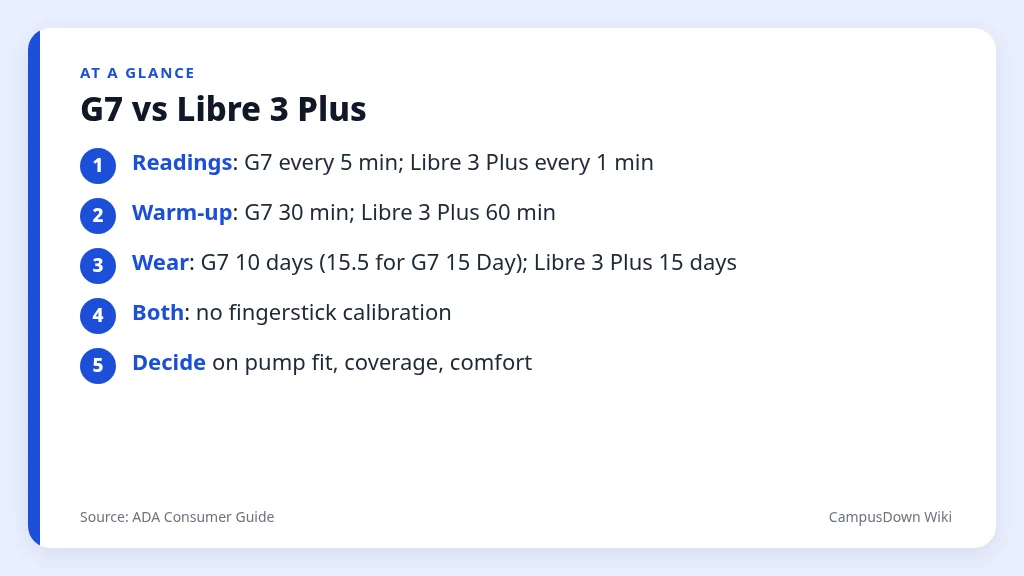
| Reading interval | Every 5 minutes | Every 1 minute |
| Warm-up | 30 minutes (G7); 60 minutes (G7 15 Day) | 60 minutes |
| Wear time | 10 days (G7), 15.5 days (G7 15 Day) | 15 days |
| Calibration | Not required | Not required |
| Ages | 2 and older (G7); 18 and older (G7 15 Day) | 2 and older |
| Water | Protected from submersion to 2.4 m (8 ft) for 24 hours | Can be immersed in 3 feet for up to 30 minutes |
| Range | 20 ft | 33 ft |
| Alerts | High, low and predictive urgent low | Optional low, high and signal-loss alarms |
| Pregnancy | Approved (ADA) | Approved (ADA) |
| Data sharing | Follow app; Clarity for clinicians | LibreLinkUp; LibreView for clinicians |
Source: ADA consumer guide listings for each device. Specifications change, so check the maker's current page. See our Dexcom G7 guide and FreeStyle Libre 3 Plus guide.

Accuracy numbers: read carefully
The ADA lists a MARD (average percent difference from a reference) of 8.7% for adults for the G7 and 8.9% for adults for the Libre 3 and 3 Plus listing, and separately 8.0% for the G7 15 Day. Lower is better, but these come from different studies, not a head-to-head comparison, so treat small gaps as uncertain. Neither number tells you how a sensor will behave on your arm. If readings and symptoms don't match, use a meter; see meter vs CGM.
Size and wear
ADA lists the G7 sensor/transmitter at about 0.94 × 1.07 × 0.47 inches and 0.42 oz, and the Libre 3 Plus sensor at about 0.11 inch high × 0.83 inch diameter and 0.04 oz. Size and shape affect comfort, clothing and how well a patch stays on. If a sensor comes off, see what to do when a CGM sensor falls off.
Pump compatibility
The ADA says the G7 works with the iLet, Omnipod 5, Tandem Mobi and Tandem t:slim X2, and that the G7 15 Day wasn't pump compatible at the time of its listing. Abbott says the Libre 3 Plus can be used with compatible insulin pumps; the ADA lists the Libre 3 with the iLet, t:slim X2 and twiist. Pump compatibility changes, so confirm with your pump maker and prescriber before switching. See also the iLet pump.
Cost and coverage
Prices vary by plan and pharmacy, so we don't quote them. Medicare Part B may cover a CGM if you meet its conditions; see CGM Medicare coverage. NIDDK notes a CGM costs more than a standard meter but may be covered by insurance. Ask your plan which sensor it prefers.
How to decide
- Ask your plan which sensor it covers and any prior-authorization steps.
2. Check your pump or planned pump. 3. Think about daily life: water, sleep position, patch adhesion, phone compatibility. 4. Try it with your care team's help, and keep a meter for backup. 5. Know the learning curve: alarms and numbers take weeks to trust.
Get help now if
If you have symptoms of a low or high that don't match your sensor, check with a meter and follow your care plan. Call 911 for fainting, seizure or inability to swallow.
Example scenario: two boxes on the table
- Who
- Quentin, 66, a retired railroad dispatcher in Omaha, Nebraska, was told his plan would cover either sensor. His wife, Yvette, 64, a part-time bookkeeper, had made a spreadsheet of features.
- What happened
- He wanted the one that stayed on his arm best and let him swim laps at the community pool.
- How it felt
- He felt overwhelmed by specs and nervous about picking wrong, and Yvette felt tired of arguing numbers that didn't show real life.
- What they did
- At his visit, the diabetes educator asked about swimming, sleep position and his phone model, and suggested the care team call the plan about which sensor it preferred. He picked one and agreed to review it after the first month.
- How it turned out
- Quentin said he stopped hunting for the perfect sensor and started paying attention to which one fit his days.
This is an illustrative example, not a real patient or a review.
Quentin's story is an illustrative example. Your choice depends on your situation and coverage.
Most-asked questions about G7 vs Libre 3 Plus
Dexcom G7 vs Libre 3 Plus: which is better?
Neither wins on every point; pump fit, coverage, comfort and your care team's advice usually decide.
Why people ask: "dexcom g7 vs libre 3 plus which is better" is #6 for "dexcom g7 vs libre 3 plus" (US autocomplete, November 2026).
How do their accuracy figures compare?
The ADA lists different MARD numbers from different studies, so don't treat small gaps as proof.
Why people ask: "dexcom g7 vs libre 3 plus accuracy" is #2 for "dexcom g7 vs libre 3 plus" (US autocomplete, November 2026).
How does the price compare?
Prices vary by plan and pharmacy; ask your insurer and pharmacy.
Why people ask: "dexcom g7 vs libre 3 plus price" is #3 for "dexcom g7 vs libre 3 plus" (US autocomplete, November 2026).
How do the sizes compare?
The ADA lists the Libre 3 Plus as a smaller, lighter round sensor than the G7's combined sensor and transmitter.
Why people ask: "dexcom g7 vs libre 3 plus size" is #5 for "dexcom g7 vs libre 3 plus" (US autocomplete, November 2026).
Should I choose the Dexcom G7 or the Libre 3 Plus?
Ask which your plan covers and which fits your pump and lifestyle.
Why people ask: "dexcom g7 or libre 3 plus" is #7 for "dexcom g7 vs libre 3 plus" (US autocomplete, November 2026).
How does the Dexcom G7 compare with the FreeStyle Libre 3 Plus?
See the table above.
Why people ask: "dexcom g7 vs freestyle libre 3 plus" is #9 for "dexcom g7 vs libre 3 plus" (US autocomplete, November 2026).
What is the difference between the Dexcom G7 and Libre 3?
The Libre 3 Plus adds 15-day wear, pump use and ages 2 and up, according to Abbott.
Why people ask: "dexcom g7 vs libre 3" is #2 for "dexcom g7 vs libre 3 price" (US autocomplete, November 2026).
Related on CampusDown
You can learn more about diabetes in older adults and check it for yourself with the FreeStyle Libre 2 Plus guide.
Frequently asked questions
- Do both need fingerstick calibration?
- No, the ADA lists calibration as not required for both.
- Which lasts longer?
- The Libre 3 Plus lists 15 days; the G7 lists 10 days, and the G7 15 Day lists 15.5.
- Can children use them?
- Both are approved for ages 2 and older (the G7 15 Day is for adults).
- Can I switch between them?
- Ask your care team and plan first, especially if you use an insulin pump.
A good CGM is the one you will wear, trust and be able to get covered. Compare the details, then decide with your care team.
Browse more guides like this in the Home Medical Devices hub.
This article is for general education and does not replace advice from your own doctor, nurse or pharmacist.