
You've been told you may get a FreeStyle Libre 2 Plus, or you already wear one and want to understand it better. How long does the sensor last, what do the alarms need, and do you need the reader or the phone app?
This guide uses the FDA 510(k) decision summary K233537 for the FreeStyle Libre 2 system, the American Diabetes Association (ADA) consumer guide and Abbott's product page. It describes the device; it doesn't tell you how to treat your diabetes. Your doctor or diabetes care team decides whether a CGM fits your plan and how to act on the readings. To learn more about how CGMs compare, see meter vs CGM, and take a closer look at the sections below.
What it is
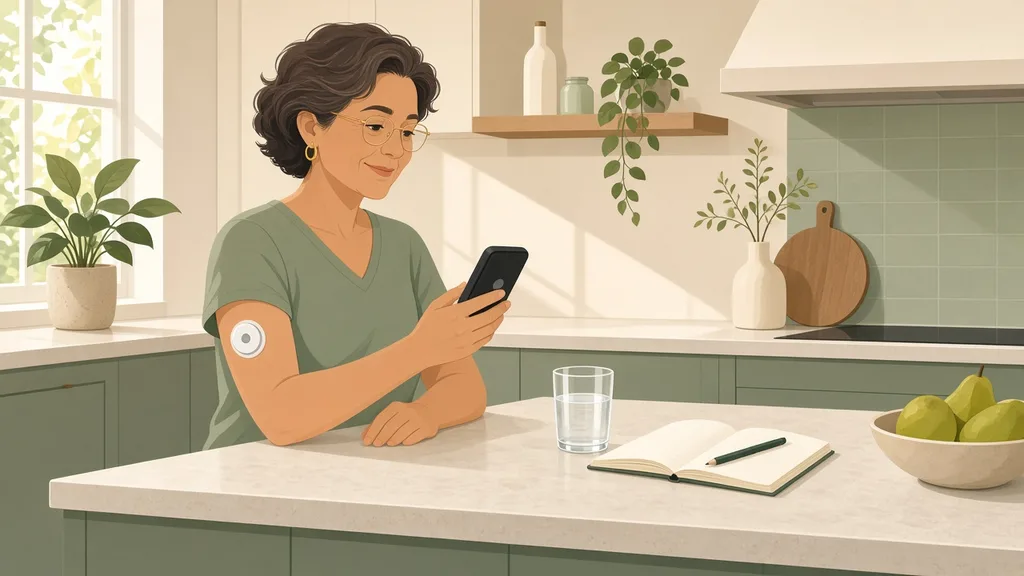
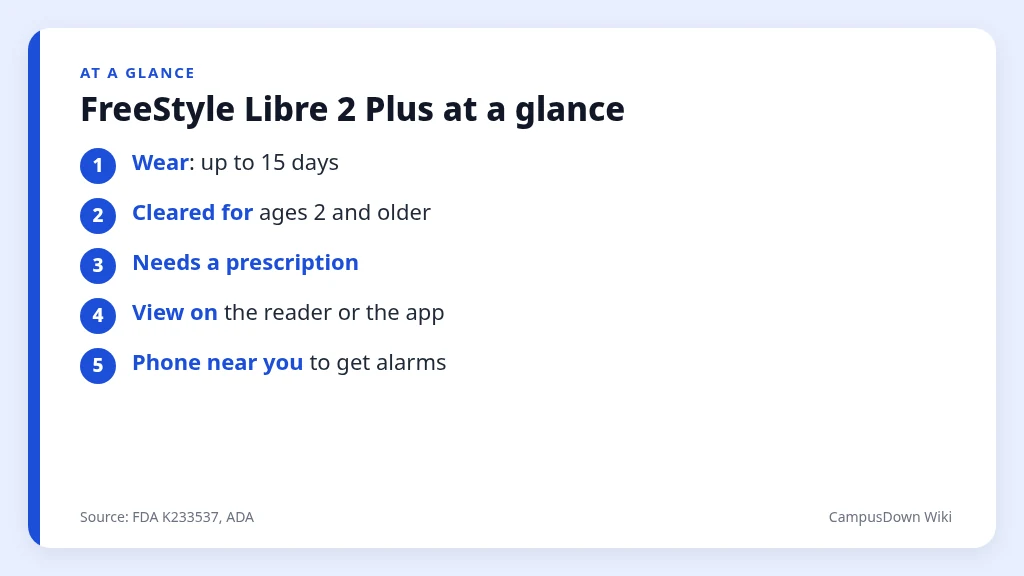
The FreeStyle Libre 2 Plus is a continuous glucose monitor (CGM) with real-time alarm capability. A small sensor, applied to the back of the upper arm, measures glucose in the fluid under the skin through a thin filament inserted with a needle that retracts into the applicator. The FDA summary describes the sensor as factory calibrated, with no fingerstick calibration required, and says it has an 8-hour memory. The measurement range is 40 to 400 mg/dL. The FDA summary also states that the Libre 2 and Libre 3 systems require a prescription and are intended for home use.

Libre 2 vs Libre 2 Plus
| Feature | FreeStyle Libre 2 | FreeStyle Libre 2 Plus |
|---|---|---|
| Wear time | Up to 14 days | Up to 15 days |
| Indicated for | Age 4 and older | Age 2 and older |
| Alarms | Real-time alarm capability | Real-time alarm capability |
| Can communicate with connected devices | Yes (ADA) | Yes, including automated insulin dosing systems per the ADA listing; confirm current compatibility with Abbott and your pump maker |
Sources: FDA K233537 decision summary; ADA consumer guide. Labeling changes, so check Abbott's current instructions and your prescriber.
The ADA guide lists a warm-up time of 60 minutes and a 20 foot range between sensor and display device. It also says the sensor can withstand immersion in about 3 feet of water for up to 30 minutes. It lists a mean absolute relative difference (MARD) of 8.2% for the Libre 2 Plus; MARD is a common accuracy measure where a smaller number means readings were closer to a reference method in testing, and it doesn't predict any single reading.
Reader or phone app
Per the FDA summary, the system's display device is either the FreeStyle Libre 2 reader or the FreeStyle Libre app on a compatible phone. The reader and the app do not interact with each other. The two work a little differently:
- App: uses NFC to start a sensor and Bluetooth to receive glucose data. You can view current glucose, trend, history and alarms. The list of compatible phones is in the app's Help feature or on Abbott's consumer site.
- Reader: a handheld device with a rechargeable battery that uses NFC to start and scan sensors. It uses Bluetooth to issue alarms telling you to scan the sensor when glucose passes a high or low threshold. It has a built-in strip port for FreeStyle Precision Neo blood glucose test strips.
Alarms: what they need
The FDA summary says the sensor itself doesn't sound alarms; the display device does. The system offers configurable alarms for low glucose, high glucose, urgent low and signal loss. A few practical points from the summary's special conditions:
- Keep your phone within 20 feet of you with no obstacles, or you may not get alarms.
- Don't force-close the app; it must run in the background to deliver alarms.
- On an iPhone using Screen Time, add the app to the always-allowed list; don't use Android's Digital Wellbeing with it.
- Check app and phone compatibility before updating your phone's operating system, and open the app afterward to confirm your settings.
- Don't share the app with another person.
Limits and cautions
The FDA summary says to use your blood glucose meter for treatment decisions when sensor readings don't match symptoms or expectations, when a reading has no number, or in the first 12 hours of wearing a sensor. It says not to use the system if you are on dialysis or critically ill, because it wasn't evaluated in these groups, and not to use it under the age in the indication. Store the sensor kit between 36 and 82 °F and don't freeze it. Remove all parts before diathermy treatment. For what a low or high reading means for you, see hypoglycemia and talk with your care team.
Sensor problems and coverage
If a patch peels early, read what to do when a CGM sensor falls off, and contact Abbott and your prescriber about a replacement. Because the Libre 2 Plus is a prescription device, coverage questions go to your plan; see CGM Medicare coverage and the comparison in Dexcom G7 vs Libre 3 Plus. If you're weighing the newer model, see FreeStyle Libre 3 Plus.
Get help now if
Don't ignore symptoms of low or high blood sugar because a sensor says you're fine. Check with your meter, and get medical help for confusion, fainting, seizure or trouble breathing; call 911 in an emergency.
Example scenario: the phone in the other room
- Who
- Cormac, 61, a high school band director in Madison, Wisconsin, had type 2 diabetes and had just been prescribed a Libre 2 Plus.
- What happened
- For the first week he left his phone charging in the kitchen while he slept in the bedroom.
- How it felt
- He felt a little embarrassed when he realized the alarms hadn't reached him, and worried he'd been risking his safety.
- What they did
- He read the instructions, moved the phone to his nightstand and asked his diabetes educator to go over the alarm settings with him.
- How it turned out
- Cormac said that learning the range rule felt like a small fix that made the device feel trustworthy.
This is an illustrative example, not a real patient or a review.
Cormac's story is an illustrative example. Device settings and diabetes care are decided with your care team.
Most-asked questions about the FreeStyle Libre 2 Plus
What is the FreeStyle Libre 2 Plus sensor?
A prescription CGM sensor worn on the back of the upper arm for up to 15 days, with real-time alarm capability.
Why people ask: "freestyle libre 2 plus sensor" is #2 for "freestyle libre 2 plus" (US autocomplete, November 2026).
How do I replace a Libre 2 Plus sensor?
Follow Abbott's instructions that come with the kit and ask your care team; if one fails early, contact Abbott about a replacement.
Why people ask: "freestyle libre 2 plus sensor replacement" is #3 for "freestyle libre 2 plus" (US autocomplete, November 2026).
How does the Libre 2 Plus app work?
It uses NFC to start a sensor and Bluetooth to get glucose data, alarms and trends, on a compatible phone.
Why people ask: "freestyle libre 2 plus app" is #4 for "freestyle libre 2 plus" (US autocomplete, November 2026).
Libre 2 Plus vs Libre 3 Plus: which is right?
Ask your care team; see our comparison guide for how they differ.
Why people ask: "freestyle libre 2 plus vs 3 plus" is #6 for "freestyle libre 2 plus" (US autocomplete, November 2026).
Is there a reader for the Libre 2 Plus?
Yes. The FDA summary lists the FreeStyle Libre 2 reader as one display device, with a built-in strip port.
Why people ask: "freestyle libre 2 plus reader" is #7 for "freestyle libre 2 plus" (US autocomplete, November 2026).
Related on CampusDown
You can learn more about the Libre 3 Plus and check it for yourself in when a meter or a CGM fits.
Frequently asked questions
- How long does a Libre 2 Plus sensor last?
- The FDA summary says up to 15 days; the older Libre 2 sensor lasts up to 14.
- Do I need a prescription?
- Yes. The FDA summary says the system requires a prescription.
- Can I use the reader and the app together?
- The FDA summary says they do not interact with each other. Ask Abbott or your care team how to set up your system.
- Why didn't my alarm go off?
- The sensor doesn't sound alarms; the phone or reader does. Keep your phone within 20 feet, don't force-close the app and check phone settings.
- Is it for children?
- The Libre 2 Plus is indicated for age 2 and older. A pediatric diabetes team can help decide.
The Libre 2 Plus is a prescription sensor with a phone-or-reader display and alarms that depend on your phone settings. Learn the setup, keep a meter handy and bring your questions to your care team.
Browse more guides like this in the Home Medical Devices hub.
This article is for general education and does not replace advice from your own doctor, nurse or pharmacist.