
Can Medicare pay for a continuous glucose monitor if you don't take insulin? Sometimes, yes. Medicare broadened its rules so people with dangerous low blood sugar can qualify too. Knowing exactly what your records need to show can be the difference between approval and denial.
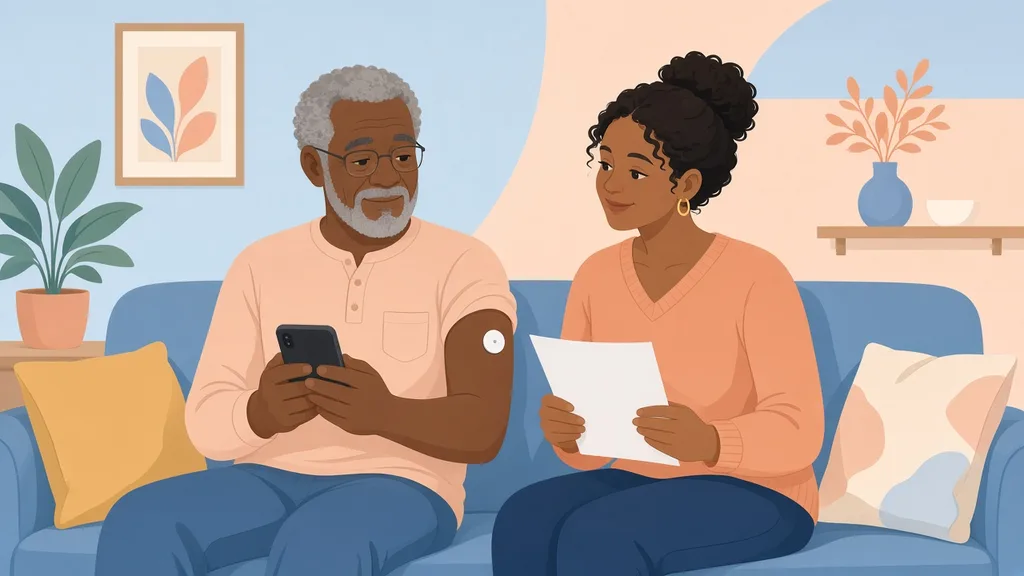
This guide is based on Medicare.gov's continuous glucose monitor page and the DME contractors' Glucose Monitors coverage policy (LCD L33822). It explains in detail who qualifies and what to bring to your doctor. Coverage decisions depend on your records; ask your provider and supplier.
Who qualifies
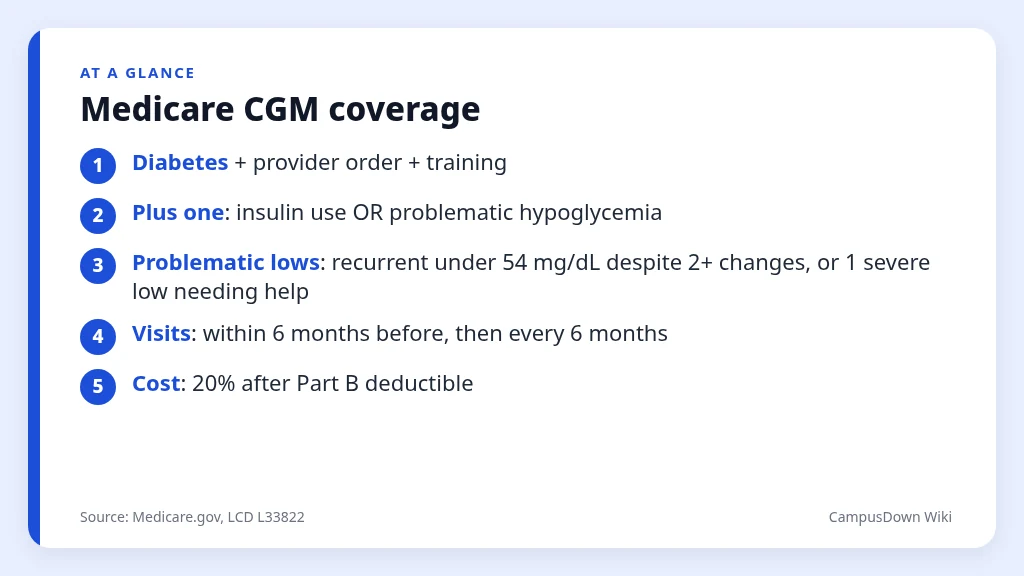
Medicare.gov says Part B may cover a CGM and supplies (like sensors) if you have diabetes, your provider orders it, and:
- You take insulin, or have a history of problems with low blood sugar, and
- You or your caregiver have had enough training to use it.
The coverage policy adds detail:
- Insulin: at least one daily administration of insulin.
- Problematic hypoglycemia: documented recurrent level 2 lows (glucose under 54 mg/dL) that persist despite 2 or more attempts to adjust medicines or the treatment plan, or a history of one level 3 event: a low with altered mental or physical state that needed someone else's help to treat.
- A visit (in person or Medicare-approved telehealth) within 6 months before the order, then every 6 months to document you're using it.
For more on dangerous lows, see hypoglycemia in older adults.

What doesn't qualify on its own
Type 2 diabetes without insulin and without documented problematic lows usually doesn't meet the policy. Over-the-counter CGMs like the Dexcom Stelo are sold without a prescription, outside this benefit.
What you pay
| Item | Your cost |
|---|---|
| CGM and supplies (Part B DME) | 20% of the Medicare-approved amount after the Part B deductible |
| Supplier that doesn't accept assignment | May charge more |
Source: Medicare.gov. Ask suppliers whether they participate in Medicare or accept assignment before ordering. Medicare Advantage plans cover CGMs too but may use specific suppliers.
Common devices
Prescription CGMs often used with Medicare include the Dexcom G7 and FreeStyle Libre 3 Plus. Compare them in Dexcom G7 and FreeStyle Libre 3 Plus. Your prescriber and supplier determine which model is covered for you.
Get help now if
Never treat a severe low based on a CGM alone if symptoms don't match; check with a fingerstick if possible and follow your care plan. Call 911 for confusion, seizures or unresponsiveness.
Building your case
Bring to your visit:
- Your insulin prescriptions, or
- A log of lows under 54 mg/dL and the medicine changes tried
- Any ER visit or paramedic report for a severe low
If you use insulin, see insulin types to describe your regimen accurately, and learn more about what your records show.
Example scenario: the low at church
- Who
- Archibald, 77, a retired letter carrier in Jackson, Mississippi, took glipizide and metformin for type 2 diabetes. His daughter, Josephine, 49, a dental hygienist, had found him sweaty and confused twice in two months.
- What happened
- The second time, at church, a nurse in the congregation gave him juice and his glucose read 41. His first request for a CGM had been denied because he didn't use insulin.
- How it felt
- Archibald felt ashamed and frightened; Josephine was scared of a nighttime low no one would see.
- What they did
- Josephine asked the doctor to document the event as a level 3 low needing help from another person. The doctor adjusted his medicines, recorded the event and ordered a CGM, and Josephine set up alerts on her phone.
- How it turned out
- Medicare approved the CGM. Two months later, an overnight alert woke Josephine before Archibald's sugar dropped too far. She said she finally slept through most nights again.
This is an illustrative example, not a real patient or a review.
Archibald's story is an illustrative example. Coverage depends on your documentation.
Most-asked questions about Medicare CGM coverage
What are the Medicare CGM coverage requirements?
Diabetes, a provider order, training, and either daily insulin use or documented problematic hypoglycemia, plus a visit within 6 months before ordering.
Why people ask: "medicare cgm coverage requirements" is #2 for "medicare cgm coverage" (US autocomplete, November 2026).
How does Medicare CGM coverage work for hypoglycemia?
You qualify with recurrent lows under 54 mg/dL despite 2+ treatment changes, or one severe low that needed another person's help.
Why people ask: "medicare cgm coverage hypoglycemia" is #3 for "medicare cgm coverage" (US, November 2026).
What is Medicare CGM coverage in 2026?
Part B covers CGMs as DME for eligible people; you pay 20% after the $283 Part B deductible in 2026.
Why people ask: "medicare cgm coverage 2026" is #4 for "medicare cgm coverage" (US, November 2026).
Does Medicare cover a CGM if not on insulin?
Yes, if you have documented problematic hypoglycemia; otherwise usually not.
Why people ask: "does medicare cover cgm if not on insulin" is #2 for "does medicare cover cgm" (US, November 2026).
Does Medicare cover a CGM for type 2 diabetes?
Yes, if you take insulin or have problematic hypoglycemia.
Why people ask: "does medicare cover cgm for type 2 diabetes" is #3 for "does medicare cover cgm" (US, November 2026).
Where do I find FreeStyle Libre Medicare suppliers?
Use Medicare-enrolled DME suppliers and ask whether they accept assignment; Medicare.gov's supplier finder can help.
Why people ask: "freestyle libre medicare suppliers" is #1 for "freestyle libre medicare" (US, November 2026).
Related on CampusDown
To take a closer look at device features, compare Dexcom G7 with FreeStyle Libre 3 Plus.
Frequently asked questions
- Do I need to see my doctor every 6 months?
- Yes, the policy requires a visit (in person or approved telehealth) every 6 months to document continued use.
- Does Medicare cover a CGM for prediabetes?
- No. The benefit requires diabetes.
- Is Dexcom covered by Medicare?
- Prescription Dexcom models can be covered if you meet the criteria. Check it for yourself with your supplier.
Medicare covers CGMs for people who use insulin or have documented dangerous lows. Keep records of your lows, see your provider every 6 months, and use a supplier that accepts assignment.
Browse more guides like this in the Home Medical Devices hub.
This article is for general education and does not replace advice from your own doctor, nurse or pharmacist.