
What if you could choose today where you'll get care at 90, and lock in much of the cost? That's the promise of a continuing care retirement community. It can also be one of the biggest checks you'll ever write.

This guide is based on the New York Department of Financial Services (DFS), the Washington Office of the Insurance Commissioner's 2022 CCRC study, the U.S. Government Accountability Office (GAO) report GAO-10-611 and Medicare.gov. It explains in detail how contracts and fees work. Have an elder law attorney and a financial advisor review any contract before you sign.
What a CCRC is
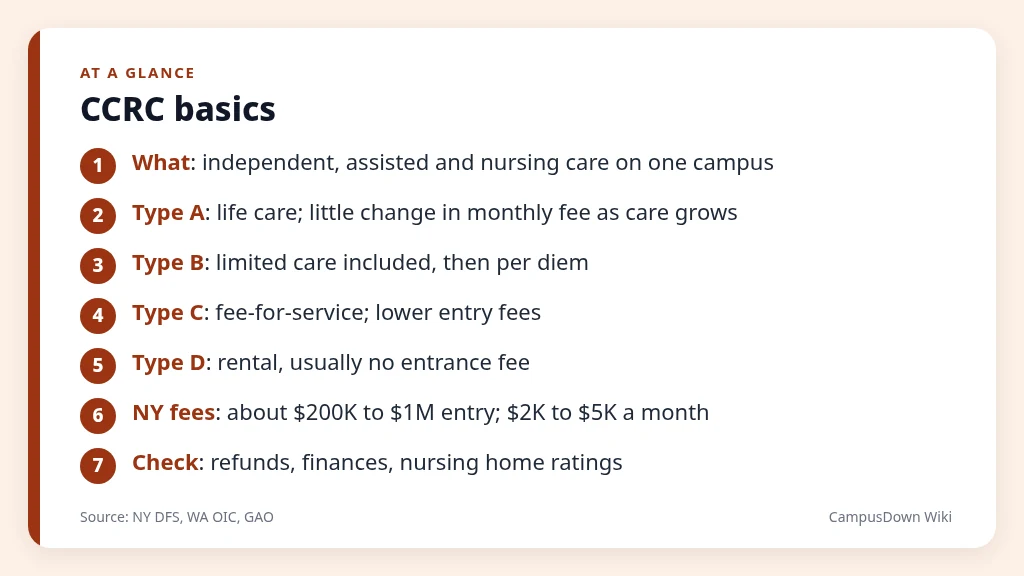
The Washington study describes CCRCs, also called life plan communities, as age-restricted campuses that combine independent living, assisted living and skilled nursing (or independent living and skilled nursing). Unlike stand-alone assisted living or nursing homes, they offer the full range of housing, health care and support services in one location. NY DFS says they also provide social events, dining, home care and access to physicians.
CCRC vs life plan community: they're generally the same thing. "Life plan community" is a newer industry name.

Contract types
NY DFS and the Washington study describe:
| Contract | What's included | Trade-off |
|---|---|---|
| Type A (life care, extensive) | Housing, services and unlimited specified health care, including long-term care | Highest entrance fees; monthly fee doesn't rise because you need more care (other than normal cost and inflation increases) |
| Type B (modified) | Housing, services and a limited amount of care, such as a set number of nursing days | After the limit, you pay a full or discounted daily rate |
| Type C (fee-for-service) | Housing and services; care paid as you use it | Lower fees upfront, but you carry the risk of care costs |
| Type D (rental) | Rental with access to the community's care | Usually no entrance fee; short-term terms |
What it costs
NY DFS says that in New York, entrance fees can range from about $200,000 to $1 million, depending on the size and type of home, plus monthly fees of about $2,000 to $5,000. DFS calls this option "very expensive" and practical mainly for people with higher than average incomes and significant assets. Fees in other states vary.
Remember that Medicare doesn't pay for long-term custodial care, according to Medicare.gov, so a CCRC contract, savings, long-term care insurance or Medicaid usually covers it. Compare options in our assisted living vs nursing home guide.
Refunds and taxes
The Washington study, quoting the IRS, describes common entrance fee refund types:
- Declining scale: the refundable share drops over time, for example 1% a month.
- Partially refundable: a set percentage, sometimes only within a time limit.
- Fully refundable: usually the most expensive option.
The study also notes the IRS may treat part of Type A and B fees as prepaid medical expenses, which may be deductible. Ask a tax professional about your situation.
The risks
Get help now if
The GAO found that CCRCs "can provide benefits, but not without some risk." The Washington study says few CCRCs closed in the 20 years before 2010, but some have closed or gone bankrupt since, in states including California, Texas and New York. Protections like required reserves and refund rules vary by state, and Washington's study found its state had limited financial requirements. A nonrefundable entrance fee can be hard to recover if you leave.
How to vet a CCRC
- Get the residency agreement and disclosure statement, and have them reviewed.
- Ask which contract type you're signing and exactly what care is included.
- Ask about refund terms, monthly fee increase history and financial statements.
- Ask who regulates CCRCs in your state, often the insurance department or an aging agency.
- Medicare.gov suggests checking the quality of the CCRC's nursing home and its inspection report. You can check it for yourself with our nursing home star ratings guide.
- Ask whether there's a memory care unit; see memory care units.
- Your local Area Agency on Aging can list CCRCs near you.
Example scenario: the cottage and the contract
- Who
- Cassius, 75, a retired civil engineer in Asheville, North Carolina, and his wife, Perpetua, 73, a former choir director, loved a CCRC near their church. Perpetua's mother had moved through three different facilities in her last years, and Perpetua never wanted that for their children.
- What happened
- The sales tour was beautiful, and the marketing director pushed a "founders' discount" if they signed that week.
- How it felt
- Cassius felt excited about the cottage and the woodshop. Perpetua felt pressure and a knot in her stomach about handing over most of their savings.
- What they did
- They asked for the residency agreement and financial disclosures, took them home, and paid an elder law attorney to review them. They compared a Type A contract with a Type C one, asked about the refund schedule, and looked up the CCRC's nursing home rating and inspection results. They chose a Type A contract with a partially refundable fee, weeks after the discount expired.
- How it turned out
- Perpetua said she finally felt the decision was theirs, not the salesperson's. Cassius said reading the contract line by line was "the most boring, most important afternoon of retirement."
This is an illustrative example, not a real patient or a review.
Cassius and Perpetua's story is an illustrative example. Contracts, fees and protections vary widely.
Most-asked questions about CCRCs and life plan communities
What does CCRC mean?
Continuing care retirement community: a campus with independent living, assisted living and skilled nursing, tied together by a residency contract.
Why people ask: "ccrc meaning" is #2 for "ccrc" (US autocomplete, November 2026).
What is CCRC senior living?
Senior living where you can move from independent living to assisted living and nursing care on the same campus as your needs change.
Why people ask: "ccrc senior living" is #8 for "ccrc" (US autocomplete, November 2026).
What is the definition of a continuing care retirement community?
A community that provides continuing care under a residency agreement, with the full range of housing and care in one location.
Why people ask: "continuing care retirement community definition" is #4 for "continuing care retirement community" (US autocomplete, November 2026).
Life plan community vs CCRC: what's the difference?
They're generally the same; life plan community is a newer name for a CCRC.
Why people ask: "life plan community vs ccrc" is #3 for "life plan community" (US autocomplete, November 2026).
What are life plan community contract types?
Type A (life care), Type B (modified), Type C (fee-for-service) and Type D (rental).
Why people ask: "life plan community contract types" is #5 for "life plan community" (US autocomplete, November 2026).
How much does a life plan community cost?
NY DFS says New York entrance fees run about $200,000 to $1 million, plus about $2,000 to $5,000 a month; other states vary.
Why people ask: "life plan community cost" is #6 for "life plan community" (US autocomplete, November 2026).
Related on CampusDown
Weighing your options? You can learn more about Medicaid's look-back rules and in-home care costs.
Frequently asked questions
- Does Medicare pay for a CCRC?
- Medicare doesn't pay for long-term custodial care. It may cover some medical services, like a qualifying skilled nursing stay, under its usual rules.
- Is a CCRC entrance fee refundable?
- It depends on the contract: declining scale, partially refundable, fully refundable or nonrefundable.
- What's the safest CCRC contract?
- No contract fits everyone. Type A limits care cost increases but costs more upfront; Type C costs less upfront but you carry the care cost risk.
- Who regulates CCRCs?
- It varies by state, often the insurance department or an aging agency. Ask before you sign.
A CCRC can give you one home for every stage of aging, but the contract matters as much as the campus. Read it closely, check the finances and nursing care quality, and get independent advice before you pay.
Browse more guides like this in the Senior Health and Medicare hub.
This article is for general education and does not replace advice from your own doctor, nurse or pharmacist.