
Can Mom stay at home if someone comes in to help? It's one of the first questions families ask, and the answer depends on what kind of help she needs. Medicare pays for one type of in-home care and not the other, and mixing them up can lead to surprise bills.

This guide is based on Medicare.gov's home health coverage page and the National Institute on Aging (NIA). It explains in detail what's covered. Rules for Medicare Advantage plans and state Medicaid programs vary, so confirm with your plan.
Two kinds of in-home care
| Home health care | Home care (non-medical) | |
|---|---|---|
| What it is | Skilled nursing, physical, occupational or speech therapy | Help with bathing, dressing, meals, housekeeping, companionship |
| Who orders it | A doctor or provider, after an in-person visit | You arrange it |
| Who provides it | Medicare-certified home health agency | Home care agency or private aide |
| Medicare pays? | Yes, if eligible | No, when it's the only care needed |

What Medicare home health covers
Medicare.gov lists, for eligible people:
- Part-time or intermittent skilled nursing, like wound care, injections, IV or nutrition therapy, and patient and caregiver education
- Physical, occupational and speech therapy
- Medical social services
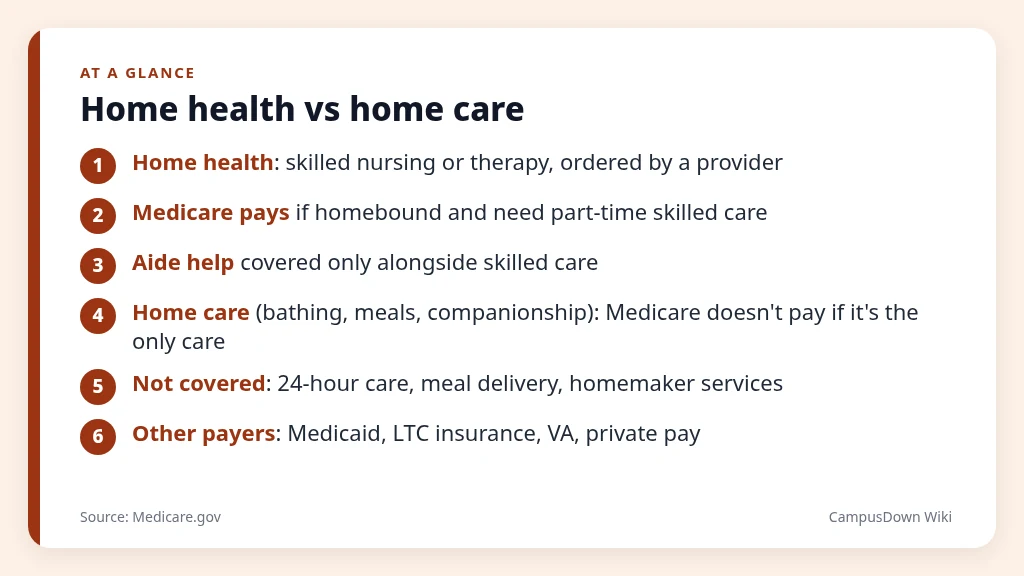
- Home health aide help with walking, bathing, grooming or feeding, only while you're also getting skilled care
- Durable medical equipment and medical supplies
You pay nothing for covered home health services; for equipment, you pay 20% after the Part B deductible. Learn more in Medicare home health.
Who qualifies
You must need part-time or intermittent skilled services and be homebound: leaving home isn't recommended or takes a lot of effort and help, like a walker, wheelchair or another person. Short trips for medical care, religious services or adult day care are allowed. "Part-time" usually means up to 8 hours a day combined, maximum 28 hours a week, with short-term exceptions up to 35 hours.
What Medicare doesn't pay for
- 24-hour care at home
- Home meal delivery
- Homemaker services like shopping and cleaning unrelated to the care plan
- Custodial or personal care (bathing, dressing, toileting) when it's the only care you need
Get help now if
If an agency says something isn't covered, it should give you an Advance Beneficiary Notice (ABN) in writing before providing it. Read it before you sign, and ask how much you'll owe.
Paying for non-medical home care
- Private pay: most families pay hourly. Rates vary by state, city and agency, so get written quotes, including minimum shift lengths.
- Medicaid: many states have home and community-based services programs for eligible people.
- Long-term care insurance: may cover home care; see long-term care insurance.
- Veterans: ask the VA about home care benefits.
- Area Agency on Aging: may offer or point to local help. Call the Eldercare Locator, 800-677-1116.
Questions to ask a home care agency
- Are aides screened, trained and supervised? Any dementia training?
- What happens if an aide is sick or doesn't show up?
- What's the hourly rate, the minimum shift, and are nights or weekends extra?
- Who creates and updates the care plan?
- Is the agency licensed in your state?
Paid help can also give the family caregiver a break; see respite care and caregiver burnout. When needs outgrow home, compare memory care and assisted living.
Example scenario: the hip, then the hard question
- Who
- Matthias, 55, an insurance adjuster in Tulsa, brought his mother, Philomena, 84, home after a hip fracture. She lived alone and had early memory problems.
- What happened
- The hospital arranged Medicare home health: a nurse and physical therapist twice a week, plus an aide for baths. After six weeks, therapy ended, and so did the aide.
- How it felt
- Matthias panicked. He couldn't leave work every morning, and his mother couldn't safely shower or cook alone. He felt torn between his job and his promise to keep her home.
- What they did
- He learned the difference between home health and home care, called the Eldercare Locator, checked her long-term care insurance policy and interviewed three agencies about dementia training and minimum shifts.
- How it turned out
- The policy covered part of a four-hour morning aide on weekdays, and a church neighbor handled Saturday lunch. Philomena stayed home, and Matthias said reading the coverage rules in detail kept him from paying for things Medicare would have covered.
This is an illustrative example, not a real patient or a review.
Matthias's story is an illustrative example. Check your own coverage before arranging care.
Most-asked questions about in-home care
Does Medicare pay for in-home care for the elderly?
Medicare pays for home health (skilled nursing and therapy) if you're homebound. It doesn't pay for non-medical home care when that's the only care needed.
Why people ask: "in home care for elderly medicare" is #5 for "in home care for elderly" (US autocomplete, November 2026).
How much does in-home care for the elderly cost?
Medicare-covered home health costs nothing. Private home care is usually billed by the hour and varies by location and agency, so get written quotes.
Why people ask: "in home care for elderly cost" is #4 for "in home care for elderly" (US, November 2026).
What are in-home care costs per hour?
Hourly rates vary widely by state, city and agency. Ask about minimum shifts and extra charges for nights or weekends.
Why people ask: "in home care costs per hour" is #5 for "in home care cost" (US, November 2026).
What are the Medicare requirements for home health care?
You must be homebound, need part-time or intermittent skilled care, have a provider see you in person and order care, and use a Medicare-certified agency.
Why people ask: "home health care medicare requirements" is #4 for "home health care medicare" (US, November 2026).
Can someone with dementia get in-home care?
Yes. Ask agencies about dementia training, consistent aides and supervision, and plan for needs to grow over time.
Why people ask: "in home care for elderly with dementia" is #6 for "in home care for elderly" (US, November 2026).
Related on CampusDown
To take a closer look at the Medicare side, read Medicare home health.
Frequently asked questions
- Will Medicare pay a family member to be a caregiver?
- Original Medicare doesn't. Some state Medicaid programs and VA programs may; ask your state Medicaid office or the VA.
- Can I get home health and go to adult day care?
- Yes. Medicare.gov says you can still get home health care if you attend adult day care.
- How many hours of home health does Medicare cover?
- Usually up to 8 hours a day combined and 28 hours a week, with short-term exceptions up to 35.
Know which kind of help you need. Medicare covers skilled home health if you're homebound; daily help with living usually falls to private pay, Medicaid or insurance. Ask questions, get quotes in writing, and plan before a crisis.
Browse more guides like this in the Senior Health and Medicare hub.
This article is for general education and does not replace advice from your own doctor, nurse or pharmacist.