
Your patient was chatty this morning and is now a little sleepy and slow to answer. The vital signs look "okay." Is that nothing, or could it be the first sign of rising pressure inside the skull?
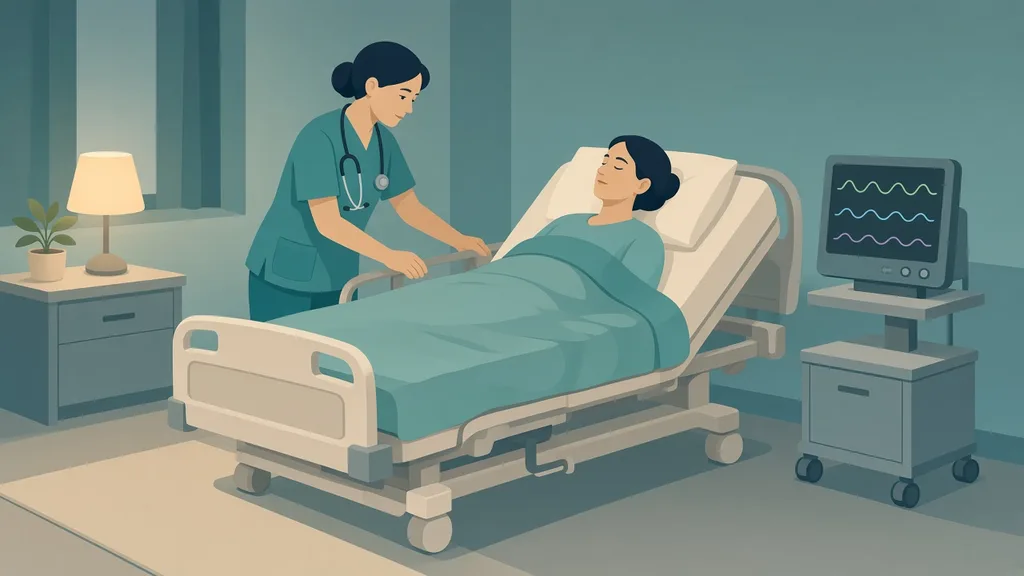
This guide uses OpenStax Medical-Surgical Nursing (sections 17.1, Intracranial Pressure Changes, and 35.4, Neurological Concerns). It is for education only. Follow your instructor, facility policy and the provider's orders. If you want to learn more about scoring consciousness, take a closer look at the Glasgow Coma Scale.
The idea behind it
OpenStax explains the Monro-Kellie doctrine: the skull is a closed, rigid space holding brain, blood and CSF, so if one volume increases, the others must compensate. ICP is measured in mm Hg; OpenStax says normal is between 7 and 15 mm Hg lying down, and not more than 15 upright, and that pressures greater than 20 mm Hg require treatment. Section 35.4 gives the normal range more broadly (between 1 and 20), so use your facility's numbers.
Common causes: head trauma, brain tumors, bleeding in the brain, vascular problems such as aneurysms, and infections that cause swelling.

Signs to watch for
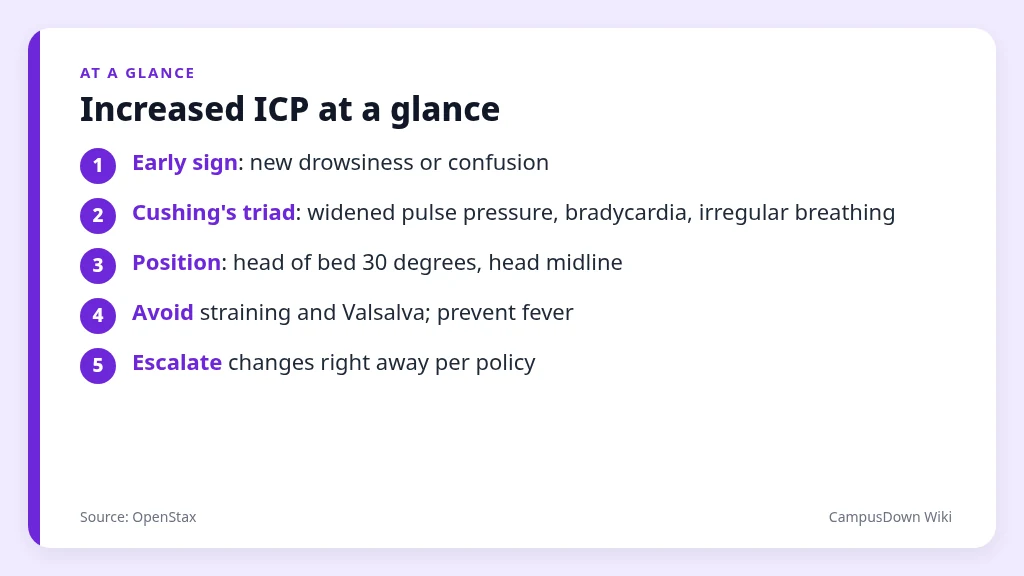
- A change in level of consciousness is the first sign and easy to miss: more drowsy than usual or slightly confused, per OpenStax 35.4
- Headache, nausea and vomiting (projectile vomiting, often without nausea)
- Seizures and speech changes
- Visual disturbances: pupillary changes, impaired eye movement, blurred vision and swelling of the optic disks (papilledema)
- Abnormal posturing: decerebrate (limbs extended) or decorticate (limbs flexed across the chest)
- In infants: bulging fontanels, suture separation, increased head circumference and a high-pitched cry
OpenStax adds that sudden confusion in older adults is never a good sign and is cause for further investigation, and that confusion can be harder to judge in someone with dementia.
Cushing's triad
OpenStax defines Cushing's triad as widened pulse pressure (a larger gap between systolic and diastolic), bradycardia (a slow pulse) and irregular breathing patterns. It notes that vital signs are controlled in the brain stem, so worsening changes can signal herniation. Treat the triad as an urgent finding rather than a sign to wait for. Check your own assessment skills in head-to-toe assessment.
Get help now if
New drowsiness, confusion, unequal or sluggish pupils, a worsening headache with vomiting, a seizure or a slowing pulse with rising blood pressure needs immediate escalation. Call the provider or rapid response team per your facility's policy.
Nursing interventions (OpenStax Table 17.1)
- Focused neurological assessments (LOC, pupils, motor function, speech) and vital signs
- Head of bed elevated 30 degrees to help venous drainage, with the body in alignment
- Avoid Valsalva maneuvers; use stool softeners or laxatives to prevent straining (see docusate and senna)
- Maintain fluid and electrolyte balance
- Prevent fever
- Give pain relief and use comfort measures, since pain and stress can raise ICP
- Support oxygenation and ventilation
- Monitor ICP if a monitor is in place
- Implement seizure precautions
Section 35.4 adds keeping the head midline, avoiding hip flexion and a low-stimulus environment (limit visitors and procedures, keep the room dim and quiet).
MAP and cerebral perfusion
OpenStax says the nurse may titrate medicines or fluids to keep mean arterial pressure (MAP) between 70 and 90 mm Hg so cerebral perfusion pressure (CPP) stays adequate. These are provider-ordered targets, so follow the order. Review shock types for related pressure concepts.
Medicines and procedures (ICU context)
- Mannitol, an osmotic diuretic, pulls water out of the brain; give it only when ICP can be closely monitored and frequent neuro assessments are possible. OpenStax warns too fast an infusion can worsen neurologic dysfunction, and side effects include dehydration, electrolyte imbalance, hypotension and rebound cerebral edema.
- Corticosteroids such as dexamethasone or methylprednisolone may be used for swelling.
- Levetiracetam may be used for seizures; watch for muscle weakness and mood changes.
- Targeted temperature management, sedation and surgical options such as craniectomy, ventriculostomy or shunt may be used per protocol.
Diagnostics
OpenStax lists CT or MRI, cerebral angiography and CSF analysis, and monitoring devices such as intraventricular catheters and parenchymal monitors.
Questions to ask your instructor or preceptor
- Which neuro check schedule and tool do we use?
- At what point do I call a rapid response?
- What are this unit's ICP, MAP and CPP targets?
- How do we position and handle a patient with a drain or monitor?
- How do I teach family about a quiet environment?
Example scenario: the sleepy morning
- Who
- Hildegard, 26, a new graduate nurse in Milwaukee, Wisconsin, was caring for a patient after a head injury whose answers had become slower and whose eyes opened only when she spoke.
- What happened
- The vital signs were within the patient's usual range and she wondered whether she was overreacting.
- How it felt
- She felt uneasy and a little embarrassed to call.
- What they did
- She did a focused neuro check, compared it with the earlier chart, and called the provider using SBAR; the patient's head of bed was already at 30 degrees and she kept the room quiet while waiting. Hildegard documented the times and findings.
- How it turned out
- Hildegard said trusting the change from baseline was the right instinct.
This is an illustrative example, not a real patient or a review.
Hildegard's story is an illustrative example. Always follow your facility's policy and the provider's orders.
Most-asked questions about increased intracranial pressure
What are nursing interventions for increased intracranial pressure?
Focused neuro checks, head of bed 30 degrees with alignment, avoiding Valsalva, preventing fever, supporting oxygenation, seizure precautions and monitoring ICP.
Why people ask: "increased intracranial pressure nursing interventions" is #1 for "increased intracranial pressure nursing" (US autocomplete, November 2026).
What is a nursing diagnosis for increased intracranial pressure?
Your instructor or care-plan resource sets the wording; the OpenStax cues (confusion, headache, vomiting, vision changes) feed your assessment.
Why people ask: "increased intracranial pressure nursing diagnosis" is #3 for "increased intracranial pressure nursing" (US autocomplete, November 2026).
What does nursing care for increased intracranial pressure include?
Assessment, positioning, avoiding straining, fluid and electrolyte balance, fever prevention, pain relief and oxygenation.
Why people ask: "increased intracranial pressure nursing care" is #4 for "increased intracranial pressure nursing" (US autocomplete, November 2026).
How is increased intracranial pressure managed in nursing?
By assessment, positioning, a calm environment and provider-ordered treatments such as mannitol or surgical options.
Why people ask: "increased intracranial pressure nursing management" is #5 for "increased intracranial pressure nursing" (US autocomplete, November 2026).
What goes in a care plan for increased intracranial pressure?
Use the Table 17.1 interventions and rationales and your school's care-plan format.
Why people ask: "increased intracranial pressure nursing care plan" is #6 for "increased intracranial pressure nursing" (US autocomplete, November 2026).
What are the signs of Cushing's triad?
Widened pulse pressure, bradycardia and irregular breathing.
Why people ask: "cushing's triad signs" is #2 for "cushing's triad" (US autocomplete, November 2026).
What is the treatment for Cushing's triad?
The sources here describe treating the underlying increased ICP with provider orders; escalate immediately.
Why people ask: "cushing's triad treatment" is #3 for "cushing's triad" (US autocomplete, November 2026).
What are the symptoms of Cushing's triad?
The three findings are widened pulse pressure, a slow pulse and irregular breathing, along with ICP signs like drowsiness and vomiting.
Why people ask: "cushing's triad symptoms" is #4 for "cushing's triad" (US autocomplete, November 2026).
How is Cushing's triad related to ICP?
OpenStax lists it as a vital sign pattern that can occur with increased ICP and signal herniation.
Why people ask: "cushing's triad icp" is #5 for "cushing's triad" (US autocomplete, November 2026).
How does Cushing's triad compare with Beck's triad?
The sources used here don't cover Beck's triad; ask your instructor or use your fundamentals text.
Why people ask: "cushing's triad vs beck's triad" is #6 for "cushing's triad" (US autocomplete, November 2026).
What is widening pulse pressure in Cushing's triad?
A larger distance between the systolic and diastolic numbers, per OpenStax.
Why people ask: "cushing's triad widening pulse pressure" is #7 for "cushing's triad" (US autocomplete, November 2026).
What causes Cushing's triad?
Increased ICP from head trauma, tumors, bleeding, aneurysms or infections, per OpenStax.
Why people ask: "cushing's triad causes" is #8 for "cushing's triad" (US autocomplete, November 2026).
What are the nursing interventions for Cushing's triad?
Escalate right away, keep the head of bed at 30 degrees with alignment, monitor neuro status and vitals closely, and follow orders.
Why people ask: "cushing's triad nursing interventions" is #9 for "cushing's triad" (US autocomplete, November 2026).
Related on CampusDown
You can learn more about the nursing student hub and check it for yourself in the Glasgow Coma Scale guide. For mental status changes in detail, see delirium in the hospital, and for a common cause of brain emergencies see stroke.
Frequently asked questions
- What is normal ICP?
- OpenStax says 7 to 15 mm Hg lying down and not more than 15 upright; above 20 needs treatment.
- What is the earliest sign?
- A drop in level of consciousness, such as new drowsiness or confusion.
- Why head of bed 30 degrees?
- It helps venous drainage and lowers ICP, per OpenStax.
- Why avoid straining?
- Straining and Valsalva can raise ICP; stool softeners help.
- What does mannitol do?
- It pulls water out of the brain; it needs close monitoring and frequent neuro checks.
Rising intracranial pressure often starts quietly with a change in alertness. Know the normal range, the signs, Cushing's triad, the basic interventions, the MAP target and the medicines' cautions, and escalate early.
Browse more guides like this in the Nursing Student and NCLEX hub.
This article is for general education and does not replace advice from your own doctor, nurse or pharmacist.