
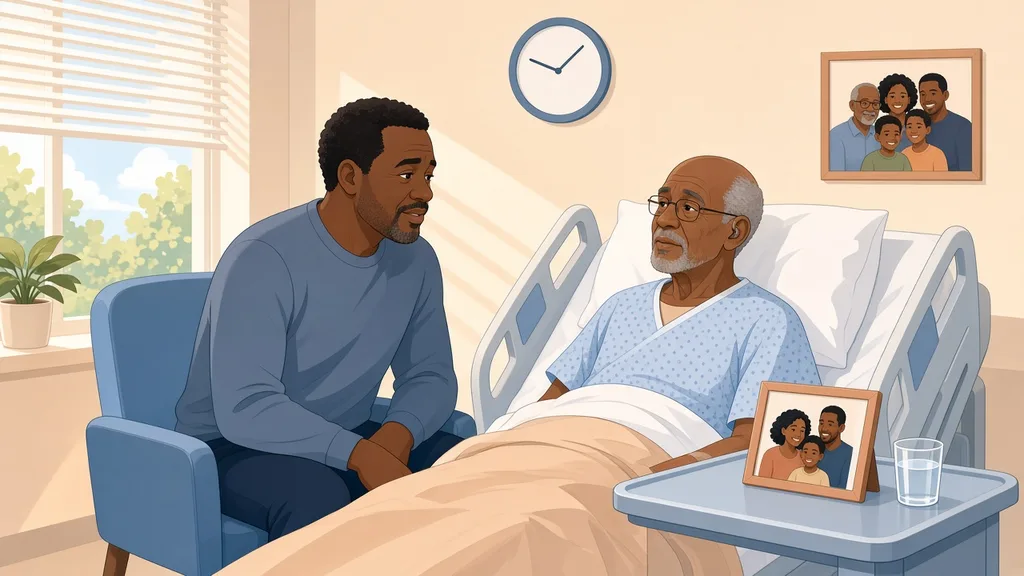
Was your dad sharp before his hip surgery, but suddenly confused, convinced it was 1985, or simply too sleepy to follow a conversation? Families often fear it's sudden dementia. Often it's delirium, a common and serious hospital problem that can sometimes be prevented and needs prompt attention.
This guide uses a National Institute on Aging (NIA) research feature and a 2018 meta-analysis of the Hospital Elder Life Program (HELP). It explains in detail what they say. Always tell the care team right away about new confusion.
What delirium looks like
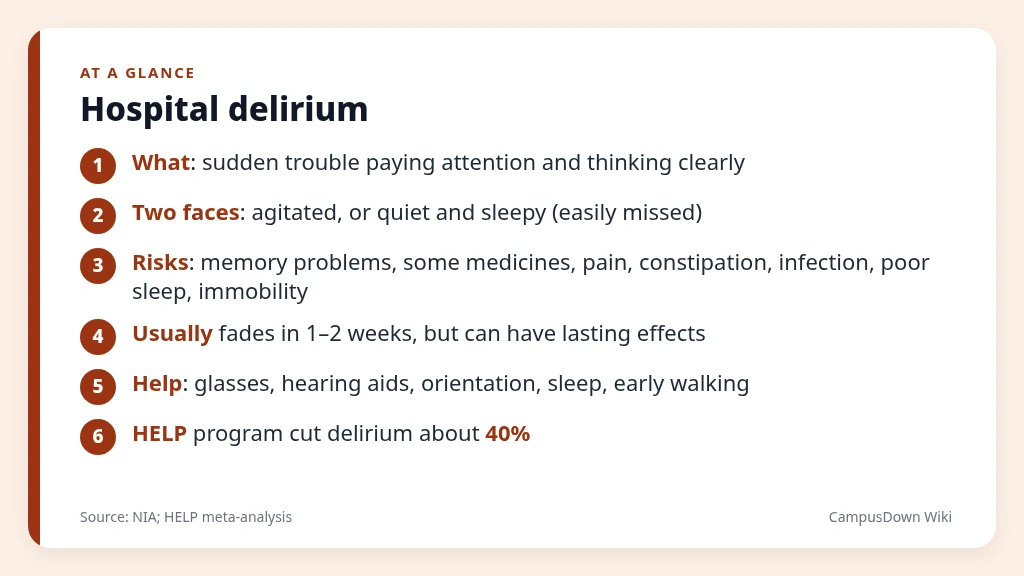
NIA describes hospital delirium as appearing within a few days of surgery or serious illness, with disorientation and trouble thinking clearly or paying attention.
- Some people are agitated, aggressive or have hallucinations.
- Others are quiet and sleepy, which is harder to spot.
- Symptoms wax and wane, so a patient may seem fine during rounds and confused at night.
NIA notes staff can miss delirium, which is why families who know the person's normal self are so important.

Delirium vs dementia
| Delirium | Dementia | |
|---|---|---|
| Onset | Sudden, hours to days | Gradual, months to years |
| Attention | Strongly affected | Often preserved early |
| Course | Fluctuates; often improves | Slowly progresses |
| Cause | Illness, surgery, medicines and more | Brain diseases such as Alzheimer's |
They can overlap: NIA quotes experts that delirium is more likely in people with dementia and can worsen their decline. Learn more in dementia.
Who's at risk
NIA lists risk factors for delirium after surgery in older adults, including:
- Existing memory or thinking problems
- Certain medicines; see anticholinergic drugs and memory
- Poorly controlled pain, constipation, fever or infection
- Depression and alcohol use
- Sleep deprivation, low blood oxygen and not being able to move
- Long surgeries, such as heart operations and hip fracture repair
NIA quotes an expert that, without other risk factors, delirium is unlikely to be caused by anesthesia alone.
How long it lasts and why it matters
NIA says the fluctuating symptoms usually disappear within a week or two. But delirium is linked to readmission, emergency visits, discharge to long-term care, falls and higher risk of death, and it can affect thinking for months or even years in some people.
What helps prevent it
HELP, developed by Dr. Sharon Inouye, has been shown to lower delirium by about 40% in hospitalized older adults, according to NIA. A meta-analysis of 14 studies found significantly fewer delirium cases and a 42% lower rate of falls in three studies. Its approach targets several risks at once:
- Someone present to orient and talk with the patient
- Glasses and hearing aids in place; see hearing and the brain
- Uninterrupted sleep at night
- Getting up and moving as soon as it's safe
- Help with food and fluids
NIA also says care teams try to avoid certain medicines that raise delirium risk, such as benzodiazepines and antipsychotics. In one ICU study, the antipsychotics haloperidol and ziprasidone didn't shorten delirium compared with placebo.
Get help now if
Tell the nurse or doctor immediately about new or sudden confusion, unusual sleepiness, hallucinations or agitation. Delirium can be a sign of infection, low oxygen, a medicine problem or another medical issue that needs treatment.
What families can do
- Bring glasses, hearing aids and dentures, and make sure they're used.
- Bring a familiar photo; talk about the date, the place and family news.
- Ask: "Does this hospital have a delirium prevention program like AGS CoCare: HELP?"
- Share the person's normal baseline: how they think, walk and sleep at home.
- Ask for a medicine review and check it for yourself on the medication list, especially sleep aids and new sedating drugs.
- After discharge, watch for lingering confusion and tell the doctor.
Example scenario: "That's not my dad"
- Who
- Deshawn, 45, a city bus mechanic in Milwaukee, visited his father, Augustus, 81, the evening after hip fracture surgery.
- What happened
- His father, usually quick with jokes, didn't recognize the room, pulled at his IV and insisted he was at the plant where he'd worked for 30 years. By morning he was quiet and drowsy, and a nurse said he was "just tired."
- How it felt
- Deshawn felt panicked and helpless, sure his father had suddenly developed dementia, and guilty that he'd gone home to sleep.
- What they did
- He told the nurse this wasn't his father's baseline and asked about delirium. The team checked for infection and pain, reviewed a new sleep medicine and stopped it, and got him up to a chair. Deshawn brought his father's glasses and hearing aids, opened the blinds by day and played his favorite gospel station.
- How it turned out
- Over the next week, his father became clearer. He went to rehab with a follow-up plan. Deshawn said speaking up early was the most useful thing he did.
This is an illustrative example, not a real patient or a review.
Deshawn's story is an illustrative example. The care team can explain what's happening in your situation.
Most-asked questions about hospital delirium
What is hospital delirium in the elderly?
A sudden change in attention and thinking that often starts within days of surgery or serious illness. It may look agitated or quiet and sleepy.
Why people ask: "hospital delirium in elderly" is #3 for "hospital delirium" (US autocomplete, November 2026).
How long does hospital delirium last?
NIA says symptoms usually disappear within a week or two, but some people have thinking effects for months or longer.
Why people ask: "hospital delirium how long does it last" is #10 for "hospital delirium" (US, November 2026).
What does hospital delirium recovery look like?
Many people improve as the cause is treated, but delirium is linked to falls, readmission and lasting thinking problems, so follow-up matters.
Why people ask: "hospital delirium recovery" is #5 for "hospital delirium" (US, November 2026).
Hospital delirium vs dementia: how can you tell?
Delirium starts suddenly and fluctuates, with poor attention; dementia develops gradually. People with dementia are more likely to get delirium.
Why people ask: "hospital delirium vs dementia" is #9 for "hospital delirium" (US, November 2026).
What is the treatment for delirium in the elderly?
Finding and treating causes such as infection, pain or medicines, plus support like orientation, sleep, glasses, hearing aids and mobility. NIA notes antipsychotics didn't shorten ICU delirium in one study.
Why people ask: "delirium elderly treatment" is #3 for "delirium elderly" (US, November 2026).
Related on CampusDown
To take a closer look at late-day confusion at home, read sundowning and mild cognitive impairment.
Frequently asked questions
- Is delirium the same as sundowning?
- No. Sundowning is late-day agitation in someone with dementia; delirium is a sudden medical change that needs evaluation.
- Can anesthesia cause delirium?
- NIA quotes experts that, without other risk factors, delirium is unlikely to be caused by anesthesia alone.
- Can family prevent delirium?
- Family can help a lot by bringing glasses and hearing aids, orienting the person, supporting sleep and speaking up about changes.
Sudden confusion in the hospital isn't "just old age." Know the signs, keep the person oriented and moving, ask about delirium prevention, and talk to the care team right away when something changes.
Browse more guides like this in the Senior Health and Medicare hub.
This article is for general education and does not replace advice from your own doctor, nurse or pharmacist.