
Do you find yourself nodding along at dinner because you can't quite follow the conversation? Hearing loss is easy to ignore, but researchers now list it as one of the biggest modifiable risk factors for dementia. The evidence is real and also more nuanced than headlines suggest.

This guide uses the 2024 Lancet Commission report on dementia and the National Institute on Aging (NIA) summary of the ACHIEVE trial. It explains in detail what they found. It isn't a diagnosis; talk to your doctor about memory concerns.
Why hearing loss is on the list
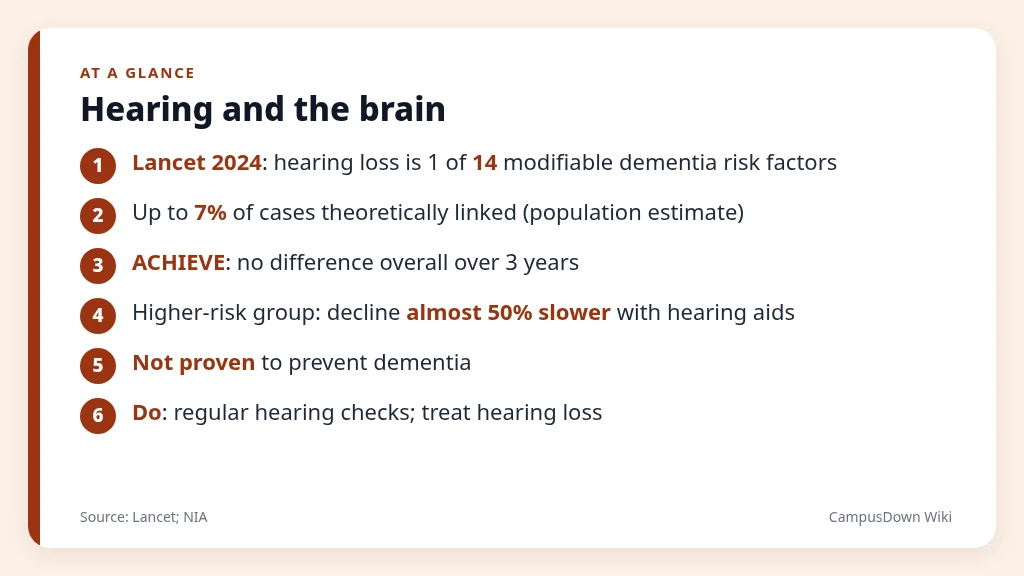
The 2024 Lancet Commission named 14 modifiable risk factors for dementia, including hearing loss, high LDL cholesterol, untreated vision loss, physical inactivity, smoking and social isolation. It estimated that up to about 7% of dementia cases worldwide could theoretically be linked to hearing loss. That's a population estimate, assuming the link is causal. It doesn't tell you your own risk.
Why might hearing matter? Researchers have proposed several reasons, such as the brain working harder to decode sound, and people withdrawing from conversation and social life. These are still being studied.

What the ACHIEVE trial found
ACHIEVE was a randomized trial funded by NIA and others, led by Dr. Frank Lin at Johns Hopkins, and published in The Lancet in 2023. Older adults aged 70 to 84 with untreated hearing loss were randomly assigned to:
- Hearing intervention: hearing aids plus instruction from audiologists, or
- Health education on healthy aging.
Participants took thinking tests at the start and yearly for three years. NIA's summary:
- Overall, there was no difference in the rate of cognitive decline between the two groups.
- In participants from a heart-health study who were older and had more dementia risk factors, the hearing aid group had an almost 50% reduction in the rate of cognitive decline compared with health education.
So hearing aids weren't proven to prevent dementia, and the benefit appeared only in a higher-risk subgroup. Researchers are still following participants.
What this means for you
Dr. Lin's advice, quoted by NIA, is simple: older adults should have their hearing checked regularly and any hearing problems properly addressed. Even without a dementia benefit, better hearing can improve conversation, safety and connection.
Practical steps:
- Ask your doctor for a hearing check, or see an audiologist.
- For mild to moderate hearing loss in adults, OTC hearing aids are an option; see OTC vs prescription hearing aids.
- Wear them consistently. Adjustment takes time.
- Learn the common signs in age-related hearing loss.
Get help now if
Sudden hearing loss in one or both ears needs prompt care. See a doctor right away. Also report new or worsening memory problems to your doctor; hearing loss can make memory tests harder, so tell them about your hearing too.
Example scenario: back in the conversation
- Who
- Fergus, 76, a retired railroad dispatcher in Omaha, had struggled to hear for years. He'd started skipping his Thursday card game and letting his wife answer the phone.
- What happened
- His daughter noticed he seemed "foggy" and quieter at family dinners, and she worried it was the start of dementia like his mother's.
- How it felt
- Fergus felt embarrassed and defensive. He insisted his hearing was fine and that people mumbled, but privately he was scared about his memory.
- What they did
- His doctor checked his hearing first and referred him to an audiologist, who fitted hearing aids and coached him through the first weeks. His doctor also did a brief memory screen and planned to recheck it.
- How it turned out
- Within two months, Fergus was back at cards and joking at dinner. His daughter said he seemed like himself again. He said the hardest part was admitting he couldn't hear.
This is an illustrative example, not a real patient or a review.
Fergus is an illustrative example. Hearing aids aren't a proven way to prevent dementia; talk to your doctor about memory concerns.
Most-asked questions about hearing loss and dementia
What is the link between hearing loss and dementia?
Studies find that hearing loss is associated with higher dementia risk, and the 2024 Lancet Commission lists it among 14 modifiable risk factors. Whether treating it prevents dementia isn't proven.
Why people ask: "hearing loss dementia link" is #2 for "hearing loss dementia" (US autocomplete, November 2026).
How much does hearing loss raise dementia risk?
The Lancet Commission estimates up to about 7% of dementia cases worldwide could theoretically be linked to hearing loss. That's a population estimate, not an individual risk.
Why people ask: "hearing loss dementia risk" is #3 for "hearing loss dementia" (US, November 2026).
Can hearing aids prevent dementia?
Not proven. In ACHIEVE, hearing aids didn't slow decline overall over three years, but they slowed it by almost 50% in older adults at higher risk.
Why people ask: "hearing aids dementia prevention" is #2 for "hearing aids dementia" (US, November 2026).
What did the hearing aids dementia study show?
The ACHIEVE trial found no overall difference, with a benefit in a higher-risk subgroup. Researchers continue to follow participants.
Why people ask: "hearing aids dementia study" is #3 for "hearing aids dementia" (US, November 2026).
What was the ACHIEVE trial on hearing?
A US randomized trial in adults aged 70 to 84 with hearing loss comparing hearing aids plus audiology support with health education over three years.
Why people ask: "achieve trial hearing" is #4 for "achieve trial" (US, November 2026).
Related on CampusDown
To take a closer look at memory, read dementia and mild cognitive impairment. If ringing is part of the picture, check it for yourself in tinnitus.
Frequently asked questions
- Does Medicare pay for hearing aids?
- Original Medicare doesn't cover hearing aids or routine hearing exams for fitting them; some Medicare Advantage plans offer hearing benefits.
- Will hearing aids improve my memory?
- They can make conversations easier, but they aren't proven to improve memory or prevent dementia.
- Should I get a memory test if I have hearing loss?
- Talk to your doctor. Tell them about your hearing so they can account for it during testing.
Hearing loss is one of the few dementia risk factors you can act on, even though hearing aids aren't proven to prevent dementia. Get your hearing checked, wear aids if you need them, stay connected, and talk to your doctor about any memory concerns.
Browse more guides like this in the Senior Health and Medicare hub.
This article is for general education and does not replace advice from your own doctor, nurse or pharmacist.
References
- NIA: Hearing aids slow cognitive decline in people at high risk
- Livingston G, et al. Dementia prevention, intervention, and care: 2024 report of the Lancet standing Commission
- Lin FR, et al. Hearing intervention versus health education control to reduce cognitive decline (ACHIEVE), Lancet 2023, PMC
- Medicare.gov: Hearing aids