
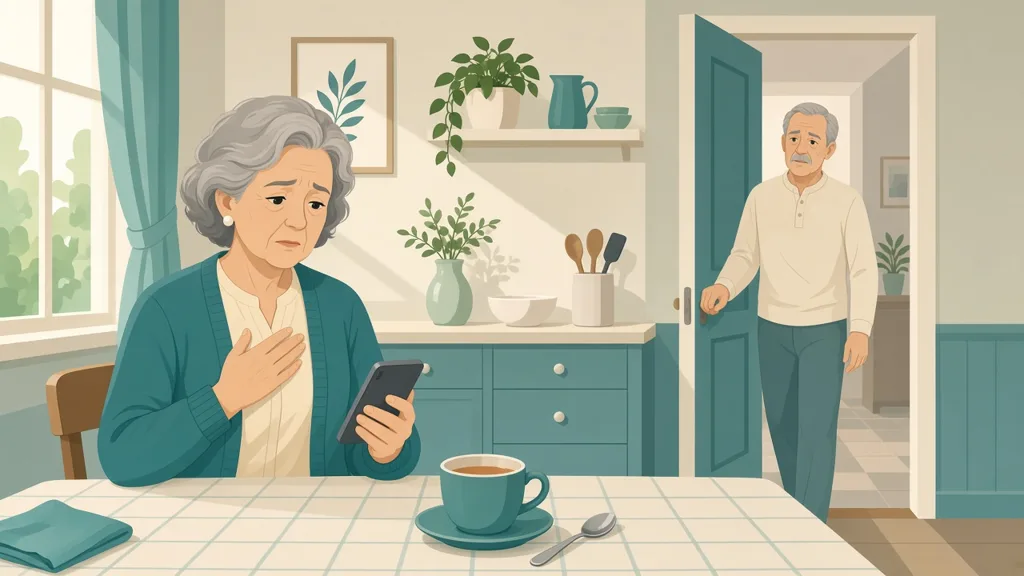
You feel strangely tired, a little sick to your stomach, and there's an ache between your shoulder blades. Is that a heart attack, or just a rough day? Many women ask themselves exactly that, and many wait. The signs can be quiet, and knowing them in advance is the best defense.
This guide is based on the American Heart Association (AHA), the National Heart, Lung, and Blood Institute (NHLBI) and MedlinePlus. You can learn more about each in the references. If you think you may be having a heart attack, call 911 now. This guide is not a substitute for emergency care or your doctor.
The signs everyone should know
The AHA lists these warning signs, and says to call 911 if you have any of them:
- Chest discomfort in the center of the chest, lasting more than a few minutes or going away and returning, which can feel like pressure, squeezing, fullness or pain
- Discomfort in other areas of the upper body: one or both arms, back, neck, jaw or stomach
- Shortness of breath, with or without chest discomfort
- Other signs: cold sweat, nausea, rapid or irregular heartbeat, feeling unusually tired, lightheadedness
MedlinePlus adds that chest discomfort can feel like heartburn or indigestion, and that symptoms vary from mild to severe.

What women are more likely to have
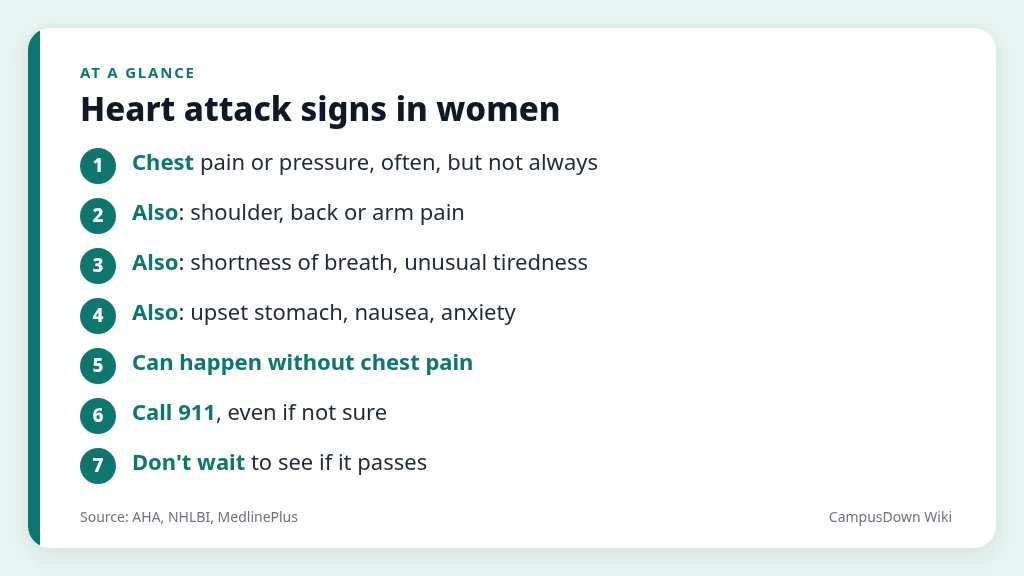
The AHA says women's most common symptom is chest pain or discomfort, as with men. But women may also have symptoms that are less associated with heart attack: anxiety, shortness of breath, nausea, vomiting, upset stomach, pain in the shoulder, back or arm, and unusual tiredness and weakness. NHLBI gives a similar list and says these can happen together with chest pain or without any chest pain. MedlinePlus notes women are more likely to feel tired for no reason.
Why signs get missed
NHLBI explains that women may delay care by downplaying symptoms, or because the usual initial hospital screening tests may not detect an early or atypical heart attack. It also says women are more likely than men to have heart attacks that are not caused by coronary artery disease, which can make diagnosis harder, and that women have more health problems after a heart attack than men. NHLBI adds that women may get heart attacks at older ages than men, and that smoking, high blood pressure, high cholesterol, high blood sugar, obesity and stress raise risk more in women than in men. Talk with your doctor about your own risks; see blood pressure of 130/80 and diabetes in older adults.
Women over 60
The signs are the same lists above. Because age and other conditions can make tiredness or breathlessness seem "normal," it helps to notice what's new or different for you. If something feels wrong in a new way, treat it as worth a call. An irregular or racing heartbeat can have other causes too, such as AFib; see AFib symptoms in women.
What to do
- Call 911. The AHA says it's almost always the fastest way to get lifesaving treatment, because emergency medical staff can begin treatment when they arrive, and people who arrive by ambulance may be treated faster at the hospital.
- Even if you're not sure. MedlinePlus and the AHA both say to call even if you're unsure it's a heart attack.
- Don't wait to see whether it passes.
- Ask the 911 dispatcher what to do while you wait. Daily aspirin for prevention is a different topic; see low-dose aspirin.
Get help now if
Call 911 right away for chest discomfort, shortness of breath, pain spreading to the arm, back, neck, jaw or stomach, cold sweat, nausea or unusual sudden tiredness. Don't wait, and don't rely on a watch or app reading to decide.
Between emergencies
Ask your doctor about your heart risk, your blood pressure and your cholesterol, and bring a list of your medicines. Devices that record heart rhythm, like the KardiaMobile 6L or Apple Watch ECG, look for rhythm problems and can't rule out a heart attack. If you have heart failure, see daily weights for heart failure.
Example scenario: the tired afternoon
- Who
- Benedetta, 68, a retired elementary school music teacher in Providence, Rhode Island, felt oddly exhausted while folding laundry, with an ache between her shoulder blades and a queasy stomach. Her husband, Nikolai, 70, a retired piano tuner, found her sitting on the edge of the bed.
- What happened
- She said it was probably the flu shot she'd had two days earlier and told Nikolai not to fuss.
- How it felt
- Benedetta felt embarrassed about making a scene and afraid of being wrong. Nikolai felt his own pulse climbing, remembering a poster in the clinic waiting room.
- What they did
- Nikolai called 911 anyway, and the dispatcher stayed on the line. At the hospital, the team ran tests and explained what they found. Benedetta later said the ride in the ambulance was the moment she stopped arguing with herself. Her doctor reviewed her risk factors and medicines at a follow-up visit.
- How it turned out
- Benedetta said she'd never again "wait and see" with those signs. Nikolai said the dispatcher's calm voice was what held him together.
This is an illustrative example, not a real patient or a review.
Benedetta's story is an illustrative example. Call 911 for symptoms and let clinicians decide what's happening.
Most-asked questions about heart attack symptoms in women
What are heart attack symptoms in women?
Chest discomfort is most common, but women are more likely to also have shoulder, back or arm pain, shortness of breath, unusual tiredness, nausea and upset stomach, per the AHA and NHLBI.
Why people ask: "heart attack symptoms in women" is #1 for "heart attack symptoms in women" (US autocomplete, November 2026).
What are heart attack symptoms in women over 60?
The same signs apply; notice what's new for you and call 911 if you suspect a heart attack.
Why people ask: "heart attack symptoms in women over 60" is #2 for "heart attack symptoms in women" (US autocomplete, November 2026).
What are heart attack symptoms in women over 50?
The same warning signs; NHLBI says women may have heart attacks at older ages than men.
Why people ask: "heart attack symptoms in women over 50" is #3 for "heart attack symptoms in women" (US autocomplete, November 2026).
How do women's heart attack symptoms differ from men's?
Both often have chest pain; women may also have anxiety, nausea, upset stomach, unusual tiredness and shoulder, back or arm pain, with or without chest pain.
Why people ask: "heart attack symptoms in women vs men" is #4 for "heart attack symptoms in women" (US autocomplete, November 2026).
Can a woman have arm pain in a heart attack?
Yes; the AHA lists arm pain or discomfort, and women may have pain in the shoulder, back or arm.
Why people ask: "heart attack symptoms in women arm" is #8 for "heart attack symptoms in women" (US autocomplete, November 2026).
What are heart attack symptoms for women over 60?
See the lists above; call 911 for any of the warning signs.
Why people ask: "heart attack symptoms women over 60" is #1 for "heart attack symptoms women over 60" (US autocomplete, November 2026).
What are silent heart attack symptoms in women?
The AHA says some heart attacks start slowly with mild pain or discomfort, and NHLBI says women may downplay symptoms. Ask your doctor about your risk.
Why people ask: "silent heart attack symptoms in women" is #3 for "silent heart attack" (US autocomplete, November 2026).
Related on CampusDown
You can learn more about AFib symptoms in women and take a closer look at blood pressure goals.
Frequently asked questions
- Should I call 911 even if I'm not sure?
- Yes. The AHA and MedlinePlus say to call even if you're unsure.
- Can a heart attack happen without chest pain?
- NHLBI says women's symptoms can occur with or without chest pain.
- Should I drive myself?
- The AHA says calling 911 is almost always the fastest way to get treatment, since EMS can start care when they arrive.
- Can my smartwatch tell me it's a heart attack?
- No; call 911 if you have symptoms and talk with your doctor about devices. Check it for yourself with them.
If the signs are there, call 911 first and explain later. A false alarm costs little; waiting can cost a lot.
Browse more guides like this in the U.S. Health Topics hub.
This article is for general education and does not replace advice from your own doctor, nurse or pharmacist.