
Have you been told your exhaustion is "just stress," "just menopause" or "just getting older"? Sometimes it is. But for some women, the real cause is an irregular heart rhythm called atrial fibrillation, and it can go unnoticed for months.
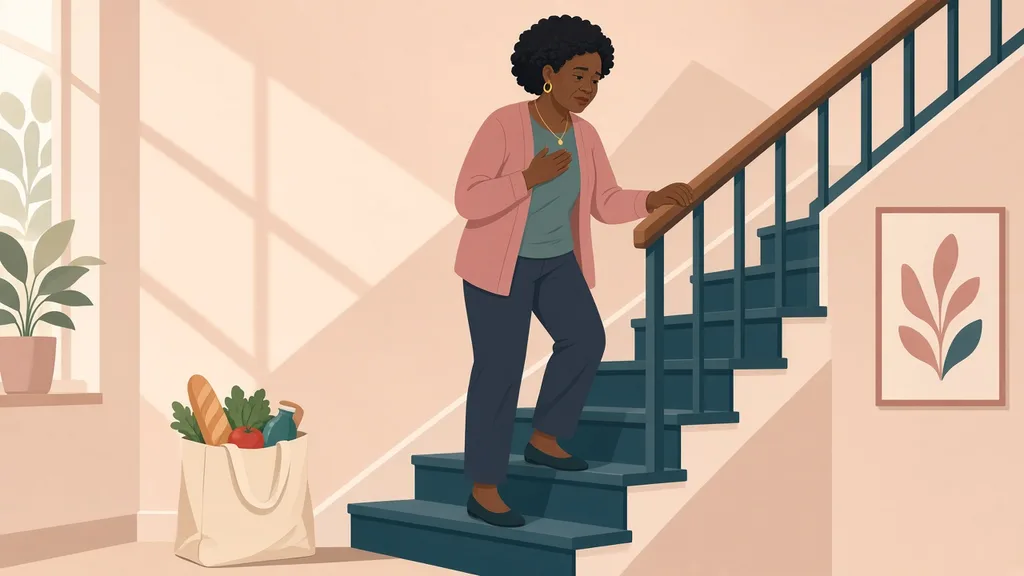
This guide uses the NHLBI symptom page and two research reviews on AFib in women: one in Nature Reviews Cardiology (2016) and one in npj Women's Health (2026). It explains the symptoms, why women may experience them differently, and when to go to the ER. If you have been feeling "off" without an answer, take a closer look at the tracking tips below.
What AFib is
In atrial fibrillation, the upper chambers of the heart beat out of sync with the lower chambers. The heart can race, flutter or beat irregularly. Apple's health pages, citing the CDC, note that about 2% of people younger than 65 and 9% of people 65 and older have AFib.

The symptoms
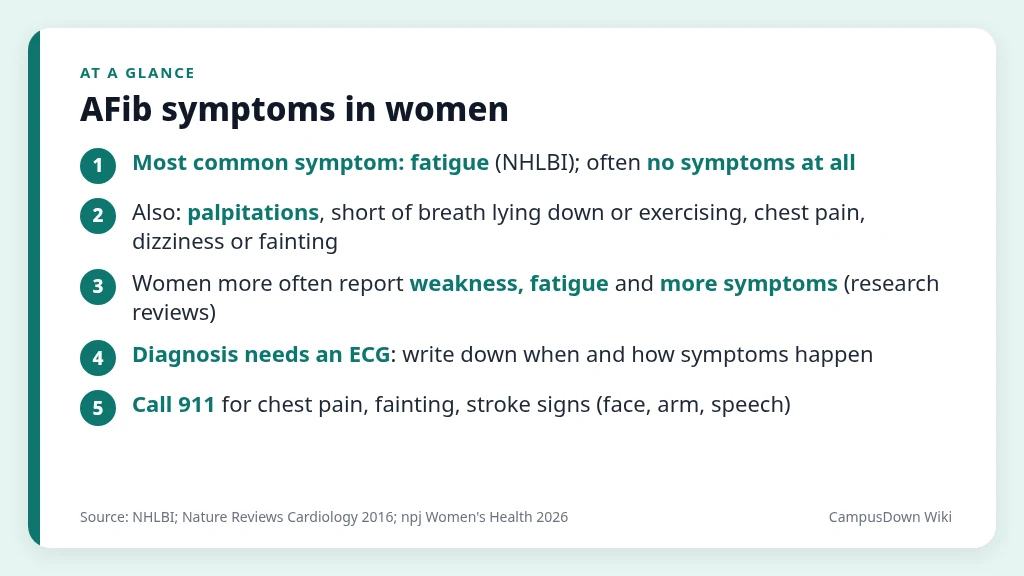
NHLBI says AFib often occurs with no symptoms. When it does cause symptoms, the most common is fatigue, or extreme tiredness. Others include:
- heart palpitations: a feeling that your heart is skipping, fluttering, pounding, or beating too hard or too fast
- difficulty breathing, especially when lying down or exercising
- chest pain
- dizziness or fainting
- low blood pressure
Symptoms may come and go, or be frequent and serious. NHLBI notes you are more likely to notice symptoms if you have heart disease.
How AFib can look different in women
The symptom list is the same for everyone, but research suggests women often experience it differently:
- A 2016 review in Nature Reviews Cardiology reported that women are more likely to present with atypical symptoms such as weakness and fatigue, have longer duration of symptoms, and report worse quality of life and more frequent depression than men.
- A 2026 review in npj Women's Health described registry data in which women had higher symptom scores and reported palpitations, breathlessness with effort, lightheadedness and fatigue more often. It also noted women coming to the emergency department are more likely to present with weakness and fatigue.
- The same reviews describe female sex as a risk factor for AFib-related stroke, which is why stroke risk scores have included a sex category.
Because fatigue and weakness are so common for other reasons, AFib in women can be mistaken for anxiety, thyroid problems, menopause or poor sleep. That does not mean those causes are wrong, only that a heart rhythm check is worth asking about.
Example scenario: "I thought it was menopause"
- Who
- Monique, 57, a middle school principal in North Carolina, had high blood pressure and assumed her new exhaustion was menopause and a hard school year.
- What happened
- For three months she needed to stop halfway up the stairs at school, woke up some nights feeling her heart "flip," and canceled weekend plans because she was too tired. Her sister finally pushed her to see her doctor after Monique nearly fainted at a grocery store.
- How it felt
- She felt dismissed by her own mind: she had told herself every symptom was normal. She was also scared, because her mother had had a stroke at 70.
- What they did
- At the visit she brought a written list of when the symptoms happened. Her doctor ordered an ECG, which was normal that day, then a wearable heart monitor for two weeks, which recorded episodes of AFib.
- How it turned out
- With a diagnosis, Monique and her doctor discussed her stroke risk, a blood thinner and rate control, and how to manage her blood pressure. She says getting a name for the exhaustion was the first relief she had felt in months.
This is an illustrative example, not a real patient or a review.
Monique is an illustrative example, not a real patient. Your own testing and treatment depend on your doctor's evaluation.
When to go to the ER
Get help now if
Call 911 for chest pain or pressure, fainting, severe shortness of breath, or signs of stroke: face drooping, arm or leg weakness, trouble speaking, sudden vision loss or confusion. Women often have heart attack symptoms that are not classic chest pain; see heart attack symptoms in women. Do not drive yourself.
Call your doctor soon (same week) for new palpitations, unexplained fatigue that limits normal activities, or getting winded with tasks that used to be easy.
How AFib is diagnosed
AFib is confirmed with an ECG (electrocardiogram). Because episodes can come and go, a normal ECG in the office does not rule it out. Doctors may use a wearable monitor for days or weeks. Consumer devices can help you capture an episode to show your doctor:
These devices do not replace a medical evaluation, and they cannot detect a heart attack.
Track your symptoms
NHLBI suggests keeping track of when and how often symptoms occur, what you feel, and whether they change over time. A simple log helps:
- date, time and what you were doing
- what it felt like (fluttering, pounding, tired, dizzy)
- how long it lasted
- caffeine, alcohol, poor sleep or illness that day
Most-asked questions about AFib in women
What are the symptoms of AFib in women?
The same as in men: fatigue (the most common), palpitations, shortness of breath, chest pain, dizziness or fainting. Reviews report women more often describe weakness and fatigue and report more symptoms overall.
Why people ask: "afib symptoms in women" is the #2 Google suggestion for "afib symptoms," right after the general term (US autocomplete, November 2026).
When should I go to the ER for AFib symptoms?
Go now, by calling 911, for chest pain, fainting, severe shortness of breath or stroke signs. Call your doctor promptly for new or worsening palpitations or fatigue.
Why people ask: "afib symptoms when to go to er" is #10 for "afib symptoms" (US, November 2026).
What causes AFib in women?
Common risk factors include older age, high blood pressure, heart valve disease, heart failure, obesity, diabetes, sleep apnea, thyroid problems and alcohol. The 2016 review notes women with AFib more often have high blood pressure and valve disease than men.
Why people ask: "afib symptoms in women causes" is #3 for "afib symptoms in women" (US, November 2026).
What do AFib symptoms look like in elderly women?
Often subtle: tiredness, less ability to exercise, dizziness, or no symptoms at all. Because stroke risk rises with age, older women should ask about a rhythm check if they notice new fatigue or palpitations.
Why people ask: "afib symptoms in elderly women" is #6 for "afib symptoms in women," and "afib in elderly women" is #7 for "afib elderly" (US, November 2026).
You can check it for yourself this week: start a symptom log on paper or in your phone, and bring it to your next appointment.
Related on CampusDown
You can learn more about skipped heartbeats (PVCs), blood thinners for AFib and stroke.
Frequently asked questions
- Can anxiety feel like AFib?
- Yes, both can cause a racing heart, but only an ECG can tell them apart.
- Can AFib come and go?
- Yes. Episodes can start and stop on their own, which is why longer monitors are sometimes used.
- Is AFib dangerous if I feel fine?
- It can be; NHLBI says untreated AFib can lead to stroke and heart failure even without symptoms.
- Does menopause cause AFib?
- Symptoms can overlap, so ask your doctor to check your heart rhythm if you are unsure.
Tiredness is easy to explain away, and many women do exactly that. Learn more from a simple ECG, track what you feel, and talk to your doctor if something has changed.
Browse more guides like this in the U.S. Health Topics hub.
This article is for general education and does not replace advice from your own doctor, nurse or pharmacist.
References
- NHLBI: Atrial Fibrillation Symptoms
- Ko D, et al. Atrial fibrillation in women: epidemiology, pathophysiology, presentation, and prognosis. Nature Reviews Cardiology, 2016
- McAlister AB, et al. Atrial fibrillation and thromboembolic stroke risk in women. npj Women's Health, 2026
- MedlinePlus: Atrial Fibrillation