
Your phone says "Z-Pak," the pharmacy label says "azithromycin," and the leaflet mentions your heartbeat. Are they the same thing, and why does a short antibiotic carry a heart warning?

This guide uses MedlinePlus's drug information on azithromycin (revised May 2026) to explain the basics. It is general information, not a prescription; your prescriber and pharmacist decide whether this medicine is right for you. If you want to learn more about another common antibiotic, take a closer look at amoxicillin.
What the names mean
MedlinePlus lists the brand name Zithromax and describes azithromycin as a macrolide antibiotic that works by stopping the growth of bacteria. "Z-Pak" is the popular name for a pre-packaged short course; MedlinePlus doesn't define it, so your prescription label and pharmacist tell you exactly how many days and tablets apply to you.

What it treats
MedlinePlus says azithromycin is used to treat infections caused by bacteria, and to treat and prevent disseminated Mycobacterium avium complex (MAC) infection, a type of lung infection in people with suppressed immune systems. It is also sometimes used for conditions such as H. pylori infection, travelers' diarrhea, Legionnaires' disease, whooping cough, Lyme disease and babesiosis.
MedlinePlus doesn't list specific illnesses like sinus infections or strep throat on this page. Whether an antibiotic is needed for those, and which one, is a clinician's decision after evaluating you.
Get help now if
Antibiotics such as azithromycin will not work for colds, flu or other viral infections, and using them when they aren't needed increases your risk of a later infection that resists antibiotics (MedlinePlus). Don't save leftovers or share them.
How it is taken
- Tablet or liquid suspension.
- Once a day, with or without food, at the same time each day, for as long as your doctor tells you. (For MAC prevention the tablets are taken once weekly.)
- Take it exactly as directed; don't take more, less or more often.
- Shake the liquid well, and measure with a dosing spoon, oral syringe or measuring cup; rinse the device afterward.
- If you get the single-dose 1-gram packet, MedlinePlus says to mix it with 1/4 cup (60 mL) of water, drink all of it right away, then add another 1/4 cup of water to the glass, mix and drink that too.
- If you vomit within an hour after a dose, call your doctor right away; don't take another dose unless told to.
- You should begin to feel better in the first few days. If not, or if you get worse, call your doctor.
- Finish the prescription even if you feel better, unless you have severe side effects. Stopping early or skipping doses may leave the infection incompletely treated and the bacteria resistant.
- Discard leftover liquid after taking all doses.
Antacids and other medicines
MedlinePlus says if you take antacids containing aluminum hydroxide or magnesium hydroxide, you need to allow some time between those antacids and azithromycin tablets or liquid; ask your doctor or pharmacist how many hours. Tell them about every prescription, over-the-counter drug, vitamin, supplement and herbal product, because doses or monitoring may change. See the brown bag medication review and polypharmacy and the Beers criteria.
The heart rhythm warning
MedlinePlus says to tell your doctor if you or a family member has had a prolonged QT interval (a rare heart problem that may cause irregular heartbeat, fainting or sudden death), a fast, slow or irregular heartbeat, low potassium or magnesium, heart failure or other heart problems, kidney or liver disease, cystic fibrosis, myasthenia gravis or a blood infection. A fast, pounding or irregular heartbeat while taking it is on the list of symptoms to stop taking azithromycin and call your doctor immediately or get emergency care. If you notice unexplained heart flutters at night, see palpitations at night and mention the antibiotic.
Side effects
Tell your doctor if these are severe or don't go away (MedlinePlus): nausea, vomiting, diarrhea, stomach pain, headache.
Stop taking it and call your doctor immediately or get emergency care for:
- Fast, pounding or irregular heartbeat
- Rash with or without fever, blisters or peeling, or fever with pus-filled sores and swelling of the skin
- Hives, itching, wheezing, trouble breathing or swallowing, hoarseness, or swelling of the face, throat, tongue, lips, eyes, hands, feet, ankles or lower legs
- Severe watery or bloody diarrhea, with or without fever and cramps, which may occur up to 2 months or more after treatment
- Yellowing of the skin or eyes, unusual bleeding or bruising, pain in the upper right stomach, dark urine or loss of appetite (possible liver problems)
- Extreme tiredness, lack of energy, flu-like symptoms, unusual muscle weakness or trouble controlling muscles, or pink and swollen eyes
- In infants under 6 weeks old, vomiting or irritability while feeding
The late diarrhea warning links to C. diff after antibiotics; for prevention at home, see hand hygiene and C. diff.
Missed doses and storage
Take a missed dose when you remember, but skip it if it's almost time for the next one, and don't double up. Store at room temperature away from heat and moisture (not in the bathroom), and use a take-back program for unneeded medicine rather than flushing it.
Common questions
- Sinus infection or strep: see "What it treats" above; MedlinePlus doesn't name them, so ask your prescriber why an antibiotic was chosen.
- Yeast infections, sweating or how long side effects last: MedlinePlus doesn't address these; call your clinician or pharmacist about symptoms that bother you.
- Antibiotic resistance: see the antibiotic resistance guide for why finishing as directed and avoiding unnecessary antibiotics matter.
Questions for your pharmacist
- How many days and tablets are in my course?
- Should I take it with food, and at what time?
- How many hours apart from my antacid?
- Does my heart history or other medicine matter?
- Which symptoms mean I should stop it and call?
Example scenario: the heartbeat she noticed
- Who
- Ramona, 58, a pharmacy technician in Sacramento, California, started a short antibiotic course for a cough and felt her heart racing on day three.
- What happened
- She worried about "bothering" the clinic over something that might pass.
- How it felt
- She felt nervous and a little silly.
- What they did
- She remembered the leaflet's heartbeat warning, called the clinic, who asked her to describe it and told her what to do next, and she took her own list of medicines to the visit. Ramona wrote the symptom and the time in her notes.
- How it turned out
- Ramona said the leaflet turned a vague worry into a clear reason to call.
This is an illustrative example, not a real patient or a review.
Ramona's story is an illustrative example. Call your prescriber or 911 for a fast, pounding or irregular heartbeat, fainting or trouble breathing.
Most-asked questions about Z-Pak
What is a Z-Pak?
A common name for a short pre-packaged azithromycin course; MedlinePlus lists the brand Zithromax and says your doctor sets how long you take it.
Why people ask: "z pack medicine" is #2 for "z pack" (US autocomplete, November 2026).
What is the Z-Pak dosage?
Your prescription label sets it; MedlinePlus says azithromycin is taken once a day with or without food for as long as your doctor directs.
Why people ask: "z pack dosage" is #3 for "z pack" (US autocomplete, November 2026).
What are the side effects of a Z-Pak?
Nausea, vomiting, diarrhea, stomach pain and headache are listed; heart rhythm changes, rash, severe diarrhea and yellow skin or eyes need prompt help.
Why people ask: "z pack side effects" is #4 for "z pack" (US autocomplete, November 2026).
Is a Z-Pak used for a sinus infection?
MedlinePlus doesn't name sinus infections; many are viral and antibiotics don't work on viruses, so ask your clinician.
Why people ask: "z pack for sinus infection" is #5 for "z pack" (US autocomplete, November 2026).
Is a Z-Pak an antibiotic?
Yes; azithromycin is a macrolide antibiotic.
Why people ask: "z pack antibiotic" is #6 for "z pack" (US autocomplete, November 2026).
How is a Z-Pak dosed?
As prescribed, once a day, for the number of days on your label; don't take more or less than directed.
Why people ask: "z pack dosing" is #7 for "z pack" (US autocomplete, November 2026).
Is a Z-Pak used for strep throat?
MedlinePlus doesn't name strep; whether it's right for any throat infection is up to your clinician.
Why people ask: "z pack for strep" is #8 for "z pack" (US autocomplete, November 2026).
What are the Z-Pak instructions?
Take it once a day with or without food, finish the course, space it from aluminum or magnesium antacids and call for vomiting within an hour of a dose.
Why people ask: "z pack instructions" is #9 for "z pack" (US autocomplete, November 2026).
What is a Z-Pak used for?
Bacterial infections chosen by your clinician; it does not work on colds, flu or other viruses.
Why people ask: "z pack used for" is #10 for "z pack" (US autocomplete, November 2026).
Can a Z-Pak affect the heart?
MedlinePlus says to tell your doctor about QT prolongation or irregular heartbeat, and to stop it and call for a fast, pounding or irregular heartbeat.
Why people ask: "z pack side effects heart" is #9 for "z pack side effects" (US autocomplete, November 2026).
Related on CampusDown
You can learn more about the medicines hub and check it for yourself in the C. diff after antibiotics guide. For plain amoxicillin in detail, see amoxicillin.
Frequently asked questions
- Can I take it with food?
- Yes; MedlinePlus says with or without food.
- Should I take antacids with it?
- Allow time between aluminum or magnesium antacids and azithromycin; ask how many hours.
- What if I vomit after a dose?
- If within an hour, call your doctor; don't take another dose unless told.
- Can it cause diarrhea after I finish?
- Severe watery or bloody diarrhea can occur up to 2 months or more later and needs a call.
- Does it treat the flu?
- No; antibiotics don't work on viral infections.
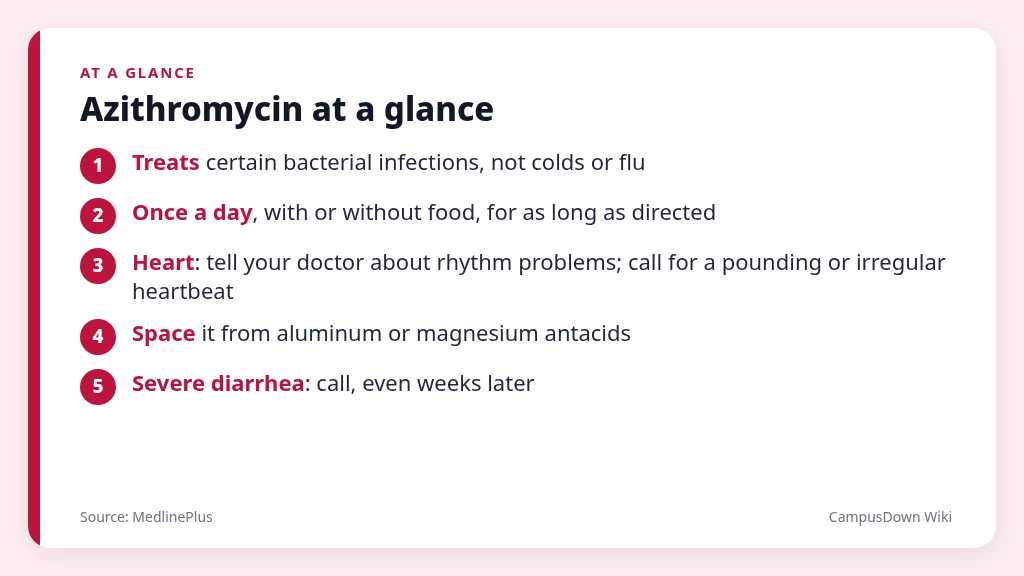
Azithromycin is a once-a-day macrolide antibiotic for bacterial infections. Take it as directed, tell your prescriber about heart rhythm history, space antacids, and call promptly for a pounding heartbeat, severe diarrhea, rash or yellow skin or eyes.
Browse more guides like this in the Medicines hub.
This article is for general education and does not replace advice from your own doctor, nurse or pharmacist.