
Your father is telling a story at dinner and suddenly his words slur and one corner of his mouth droops. He says he is fine. What do you do in the next minute?
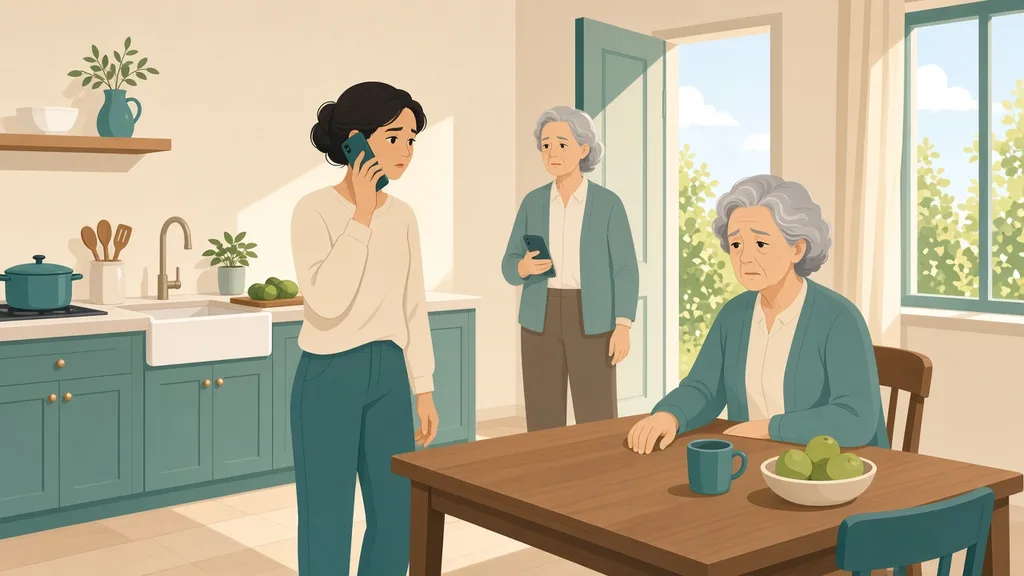
This guide uses the CDC page on stroke signs and symptoms (updated May 19, 2026) and the MedlinePlus encyclopedia article on stroke (reviewed April 16, 2025). It is general information, not a substitute for emergency care. If you want to learn more about a common rhythm problem that raises stroke risk, take a closer look at atrial fibrillation and blood thinners in older adults.
Get help now if
If you see any stroke sign, call 911 right away. Do not wait to see if it passes, and do not drive yourself or let someone else drive you to the hospital.
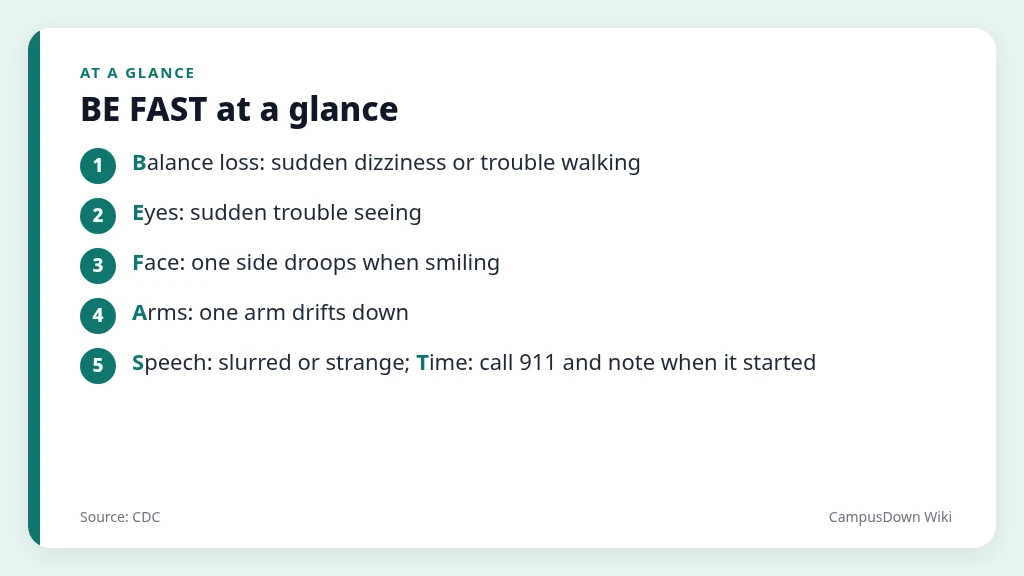
What BE FAST stands for
CDC says "during a stroke, every minute counts," and fast treatment can lessen the brain damage a stroke can cause. Its B.E. F.A.S.T. test:
- B, Balance loss: ask the person if they feel off-balance or dizzy.
- E, Eye (vision) changes: ask if they have trouble seeing normally.
- F, Face: ask them to smile; does one side of the face droop?
- A, Arms: ask them to raise both arms; does one arm drift downward?
- S, Speech: ask them to repeat a simple phrase; is the speech slurred or strange?
- T, Time: if you see any of these signs, call 911 right away and note the time symptoms first appeared, which helps providers decide on treatment.
The older FAST version leaves out balance and eye changes; the BE FAST version adds them.

Other sudden warning signs
CDC lists sudden trouble walking, dizziness, loss of balance or lack of coordination; sudden trouble seeing; sudden numbness or weakness in the face, arm or leg, especially on one side; sudden confusion, trouble speaking or difficulty understanding speech; and a sudden severe headache with no known cause. MedlinePlus adds that symptoms usually develop suddenly but may come and go for the first day or two, and can include changes in alertness, hearing or taste, trouble swallowing, trouble reading or writing, vision loss or double vision, loss of bladder or bowel control, numbness or tingling on one side and personality or mood changes. MedlinePlus says a stroke caused by bleeding in the brain can cause a sudden, severe headache that may be worse when lying flat, wake you from sleep or worsen with bending, straining or coughing. A fast heartbeat by itself isn't on these lists, so call 911 for the signs above; see Apple Watch ECG and atrial fibrillation.
Why call 911 instead of driving
CDC says do not drive to the hospital or let someone else drive you; call 911 so medical personnel can begin life-saving treatment on the way. The best treatments are available only if the stroke is recognized and diagnosed in time: CDC's page says within 3 hours of the first symptoms, while MedlinePlus says clot-busting medicine must be started within 4 1/2 hours, and the sooner the better. The two pages give different windows, so the safe message is the same: call 911 immediately and note the time symptoms started.
What a mini-stroke means
CDC says if stroke symptoms go away after a few minutes, you may have had a transient ischemic attack (TIA), or "mini-stroke," and that although brief, a TIA is a sign of a serious condition that will not go away without medical help. Because TIAs clear up, many people ignore them; if you think you or someone you know had one, tell a health care team about the symptoms right away.
Two types of stroke
MedlinePlus says a stroke occurs when blood flow to part of the brain stops, and brain cells can die. Ischemic stroke is caused by a blood clot or plaque blocking a vessel that supplies the brain. Hemorrhagic stroke occurs when a weak blood vessel bursts and bleeds into the brain. Hemorrhagic strokes may also occur with blood thinners (such as apixaban, rivaroxaban, dabigatran, edoxaban and warfarin), bleeding disorders or very high blood pressure. Imaging such as CT or MRI helps find the type. See apixaban (Eliquis).
Risk factors
MedlinePlus says high blood pressure is the main risk factor, and other major ones include atrial fibrillation, diabetes, smoking, a family history of stroke, being male, high cholesterol, increasing age (especially after 55), obesity and a history of stroke or TIA. Birth control pills in women who smoke and are over 35, pregnancy, hormone therapy, sleep apnea and excessive alcohol or recreational drug use raise risk too. Learn about blood pressure of 130/80 and ask about low-dose aspirin before starting it on your own.
After a stroke
Treatment in the hospital depends on the cause and can include clot-busting medicine, a thrombectomy and blood thinners, and therapy (physical, occupational, speech and swallowing) begins in the hospital. The goal is to help you recover as much function as possible and prevent future strokes. For older adults, see the senior health hub.
Questions for your clinician
- What are my own stroke risk factors, and how can we lower them?
- Do I have an irregular heartbeat or high blood pressure that needs treatment?
- What should my family do if they see warning signs?
- Is a blood thinner or aspirin right for me?
- Where is the nearest stroke-ready hospital?
Example scenario: the dinner table
- Who
- Maximilian, 58, a retired shop teacher in Rochester, New York, noticed his father's speech slur at dinner and one side of his face droop.
- What happened
- His father waved it off and wanted to lie down.
- How it felt
- Maximilian felt panicky but remembered the face, arm and speech check.
- What they did
- He asked his father to smile and raise both arms, saw one arm drift down, called 911, wrote down the time and unlocked the front door for the paramedics. Maximilian stayed with him and told the crew his father's medicines.
- How it turned out
- Maximilian said he was grateful for the check.
This is an illustrative example, not a real patient or a review.
Maximilian's story is an illustrative example. If you see stroke signs, call 911 immediately.
Most-asked questions about BE FAST
What are the stroke warning signs in BE FAST?
Balance loss, eye changes, face drooping, arm drift, speech trouble and time to call 911.
Why people ask: "stroke warning signs be fast" is #2 for "stroke signs be fast" (US autocomplete, November 2026).
What does the FAST acronym stand for in stroke signs?
CDC's version is B.E. F.A.S.T.: Balance, Eyes, Face, Arms, Speech, Time.
Why people ask: "stroke signs fast acronym" is #3 for "stroke signs be fast" (US autocomplete, November 2026).
What are the stroke signs and symptoms in BE FAST?
The five checks plus sudden confusion, numbness or weakness on one side and a severe headache with no known cause.
Why people ask: "stroke signs and symptoms be fast" is #4 for "stroke signs be fast" (US autocomplete, November 2026).
What are the stroke symptoms in the FAST acronym?
Face droop, arm weakness and speech trouble, with balance and eye changes added in BE FAST, and time to call 911.
Why people ask: "stroke symptoms fast acronym" is #5 for "stroke signs be fast" (US autocomplete, November 2026).
How do I do the stroke symptoms FAST test?
Ask the person to smile, raise both arms and repeat a simple phrase, and ask about balance and vision; call 911 for any problem.
Why people ask: "stroke symptoms fast test" is #6 for "stroke signs be fast" (US autocomplete, November 2026).
What are stroke symptoms in the faster version?
The sources describe BE FAST rather than a "faster" version; the balance and eye checks are the additions to FAST.
Why people ask: "stroke symptoms faster" is #7 for "stroke signs be fast" (US autocomplete, November 2026).
Does a fast heart rate mean stroke symptoms?
The CDC and MedlinePlus symptom lists don't include a fast heart rate; atrial fibrillation is a stroke risk factor, so ask a clinician about palpitations.
Why people ask: "stroke symptoms fast heart rate" is #8 for "stroke signs be fast" (US autocomplete, November 2026).
What are F.A.S.T. stroke symptoms?
Face drooping, Arm weakness, Speech difficulty and Time to call 911; CDC's B.E. F.A.S.T. adds Balance and Eyes.
Why people ask: "stroke f.a.s.t. symptoms" is #9 for "stroke signs be fast" (US autocomplete, November 2026).
What are fast stroke symptoms?
Symptoms of stroke usually come on suddenly; if you notice them, call 911 right away.
Why people ask: "fast stroke symptoms" is #10 for "stroke signs be fast" (US autocomplete, November 2026).
Why should I act fast with stroke symptoms?
CDC says every minute counts and that the best treatments are available only if the stroke is recognized and treated in time.
Why people ask: "stroke symptoms act fast" is #7 for "stroke symptoms be fast" (US autocomplete, November 2026).
Related on CampusDown
You can learn more about the health topics hub and check it for yourself in atrial fibrillation and blood thinners in older adults. For blood pressure in detail, see blood pressure of 130/80, and for another emergency see heart attack symptoms in women.
Frequently asked questions
- What does BE FAST mean?
- Balance, Eyes, Face, Arms, Speech, Time.
- What should I do if I see signs of a stroke?
- Call 911 right away, note when symptoms started and don't drive to the hospital.
- If the symptoms go away, can I wait?
- No; a mini-stroke (TIA) is a serious warning, so tell a health care team right away.
- What is the main stroke risk factor?
- High blood pressure.
- How are the two stroke types different?
- Ischemic stroke is a blocked vessel; hemorrhagic stroke is a vessel that bursts and bleeds.
Use B.E. F.A.S.T. to spot a stroke: balance, eyes, face, arms, speech and time. Call 911 immediately for any sign, note when it began, don't drive yourself and treat a mini-stroke as a serious warning, then ask your clinician how to lower your risk.
Browse more guides like this in the U.S. Health Topics hub.
This article is for general education and does not replace advice from your own doctor, nurse or pharmacist.