
Have you ever looked at the little pink pill in your organizer and wondered what would happen if you just skipped it? With Eliquis, that question matters more than most. It is one of the most prescribed blood thinners in the United States, and the label puts a boxed warning right at the top about stopping it too early.
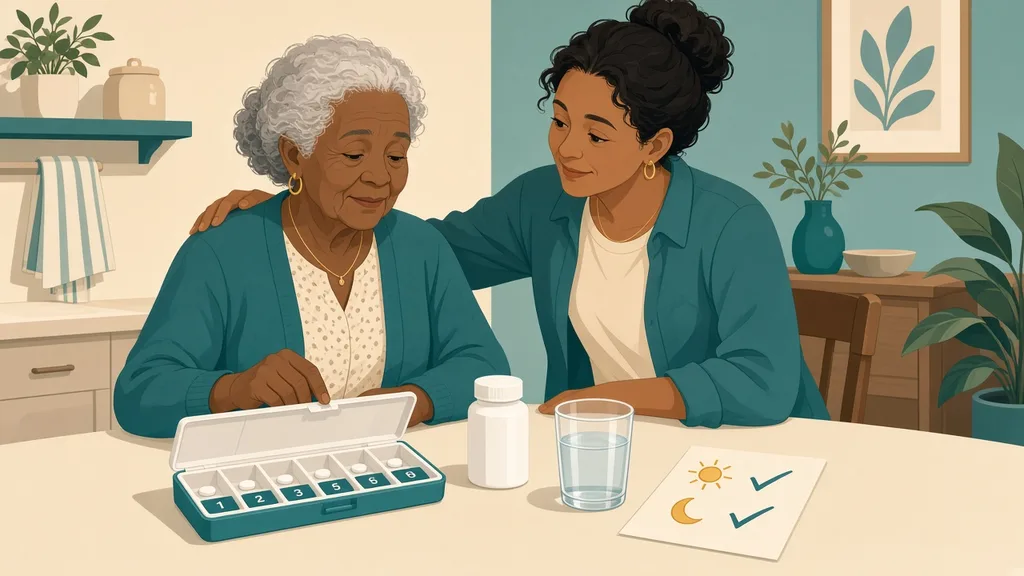
This guide is built from the Bristol-Myers Squibb label on DailyMed, plus pricing from CMS. It covers what Eliquis treats, how the two doses work, the side effects people search for most, and what to do before a dental visit or surgery. If you or a parent just started it, take a closer look at the missed-dose and warning-sign sections.
What Eliquis is used for
Eliquis (apixaban) is a factor Xa inhibitor, one of the newer pills often called direct oral anticoagulants or DOACs. It was first approved in 2012. Per the label, it is used in adults to:
- reduce the risk of stroke and systemic embolism in nonvalvular atrial fibrillation (AFib not caused by certain valve problems)
- prevent deep vein thrombosis (DVT) after hip or knee replacement surgery
- treat DVT and pulmonary embolism (PE) and lower the risk they come back after initial treatment
The label also covers treating blood clots in children from birth, after at least 5 days of initial anticoagulant treatment. If you are new to AFib, start with what atrial fibrillation is and why it can lead to stroke.

Doses: 5 mg, 2.5 mg and the "2 of 3" rule
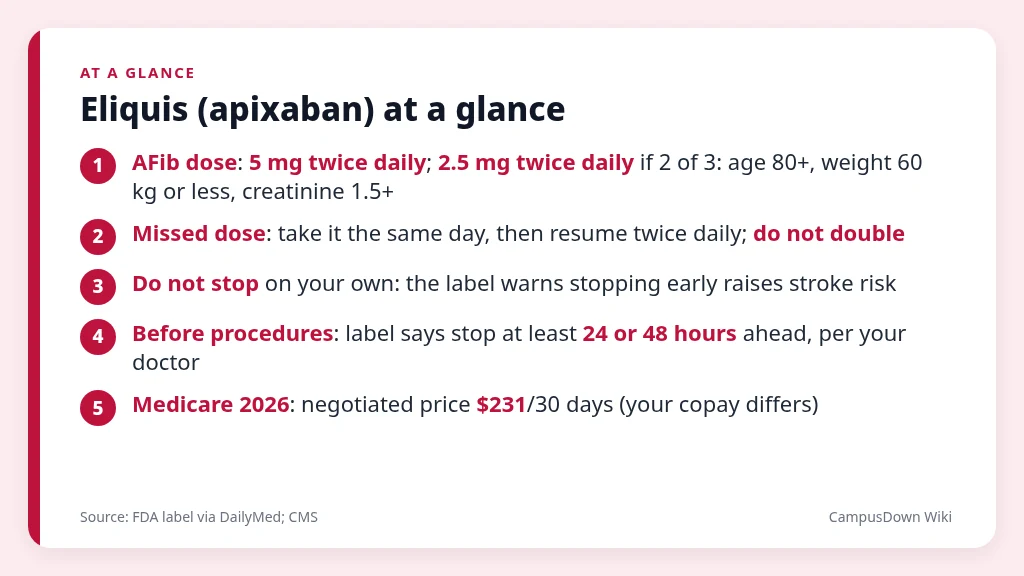
Eliquis comes as a 2.5 mg yellow tablet and a 5 mg pink tablet. For AFib, the label lists 5 mg twice daily. The dose is 2.5 mg twice daily when a person has at least two of these three features:
- age 80 or older
- body weight 60 kg (about 132 lb) or less
- serum creatinine 1.5 mg/dL or higher
This is why two people of the same age can be on different doses. For DVT or PE treatment, the label lists 10 mg twice daily for 7 days, then 5 mg twice daily; after at least 6 months, 2.5 mg twice daily may be used to lower the risk of a repeat clot. After hip replacement the label lists 2.5 mg twice daily for 35 days, and after knee replacement for 12 days.
Your prescriber picks the dose. Never cut or change it yourself. If swallowing is hard, the label says tablets may be crushed and mixed with water, apple juice or applesauce and taken right away; ask your pharmacist first.
Example scenario: the pill she almost stopped
- Who
- Constance, 78, a retired school librarian in Georgia with AFib, started Eliquis 5 mg twice daily after a short hospital stay.
- What happened
- Two weeks later she bumped her shin on the car door and woke up to a dark bruise the size of her palm. Her neighbor told her that blood thinners "eat your blood" and she should quit.
- How it felt
- She was scared of bleeding to death in her sleep, and just as scared of having a stroke like her older sister. That night she left the evening tablet in the organizer and lay awake feeling guilty.
- What they did
- In the morning her daughter called the pharmacist, who asked about nosebleeds, black stools and headaches, explained which bruises are expected and which are urgent, and reminded her that the label warns against stopping on her own. The pharmacist also checked her other medicines and found an over-the-counter pain reliever she took for her knee.
- How it turned out
- Constance restarted her normal schedule that day after her doctor's office agreed, switched to a pain reliever her doctor approved, and taped a list of warning signs inside her kitchen cabinet. She says the list made her feel in control instead of afraid.
This is an illustrative example, not a real patient or a review.
Constance is an illustrative example, not a real patient. The point is simple: a bruise alone is common on blood thinners, but you should never stop Eliquis without calling your prescriber.
Missed doses and stopping
The label says if you miss a dose, take it as soon as possible on the same day and then go back to twice daily. Do not take two doses at once to make up for it.
The first boxed warning says stopping Eliquis early, without another blood thinner in place, increases the risk of clots and stroke. The second warns about spinal or epidural blood clots (hematomas) in people who have spinal anesthesia or a spinal puncture, which can cause long-term paralysis.
Before surgery, dental work or procedures
The label says to stop Eliquis at least 48 hours before procedures with a moderate or high risk of bleeding, and at least 24 hours before procedures with a low risk where bleeding would be minor. It says "bridging" with another blood thinner is generally not needed. Your surgeon, dentist and prescriber decide together; ask them before you hold any dose.
Side effects and warning signs
In adults, the label says the most common adverse reactions are related to bleeding. Easy bruising and gums that bleed a bit when brushing can happen.
Get help now if
Call 911 or get emergency care for signs of serious bleeding: red, pink or brown urine; red or black, tar-like stools; coughing up blood or vomiting blood or material that looks like coffee grounds; a severe headache, dizziness or weakness; or bleeding that will not stop. Also get emergency help after a hard fall or any hit to the head, even if you feel fine.
Medicines that raise bleeding risk with Eliquis, per the label, include aspirin, NSAIDs such as ibuprofen and naproxen, other antiplatelet drugs, and some antidepressants. Strong drugs that change apixaban levels, such as rifampin, carbamazepine, phenytoin and St. John's wort, can make it less effective. Show your pharmacist every pill and supplement; our low-dose aspirin guide explains why aspirin plus a blood thinner needs a clear reason.
Most-asked questions about Eliquis
What are the side effects of Eliquis in older adults?
The label's most common adult side effects are bleeding-related, and the risk of bleeding rises with age, kidney problems and other medicines like NSAIDs. Older adults may notice more bruising. Report any unusual bleeding, dizziness or falls to your doctor.
Why people ask: "eliquis side effects" is the #2 Google suggestion for "eliquis," and "eliquis side effects in elderly woman" is #2 for "eliquis side effects" (US autocomplete, November 2026).
When will generic Eliquis be available?
Bristol Myers Squibb and Pfizer have said generic apixaban is not expected to launch in the U.S. before April 1, 2028, subject to legal challenges. Some generic labels already appear on DailyMed, but a label listing is not the same as a product on pharmacy shelves. Ask your pharmacist what is actually stocked.
Why people ask: "eliquis generic" is #4 for "eliquis," and "eliquis generic release date" is #3 for "eliquis generic" (US, November 2026).
How much does Eliquis cost with Medicare?
CMS negotiated a maximum fair price of $231 for a 30-day supply, effective January 1, 2026, compared with a 2023 list price of $521. Your real cost depends on your Part D plan, and the yearly out-of-pocket cap still applies; see the Part D cap guide.
Why people ask: "eliquis cost" is #8 and "eliquis coupon" is #3 for "eliquis" (US, November 2026).
Is apixaban the same as Eliquis?
Yes. Apixaban is the generic (active ingredient) name and Eliquis is the brand name.
Why people ask: "apixaban brand name" is #2 and "apixaban eliquis" is #6 for "apixaban" (US, November 2026).
Eliquis vs Xarelto: which is better?
Both are factor Xa inhibitors with AFib and DVT/PE uses. Eliquis is twice daily; Xarelto for AFib is once daily with the evening meal. Which fits you depends on kidney function, other medicines, cost and your doctor's judgment. See our Xarelto guide.
Why people ask: "xarelto vs eliquis" is #5 for "xarelto," with "which is better" at #7 for "xarelto vs eliquis" (US, November 2026).
Before your next refill, check it for yourself: is your dose 5 mg or 2.5 mg, and do you know which of the "2 of 3" features apply to you?
Related on CampusDown
You can learn more about warfarin (Jantoven), how doctors choose blood thinners for AFib in older adults, and the lab tests in INR and PTT explained.
Frequently asked questions
- What color is Eliquis 5 mg?
- The label describes the 5 mg tablet as pink and the 2.5 mg tablet as yellow.
- Does Eliquis need INR blood tests?
- No routine INR monitoring is needed, but your doctor checks kidney function and blood counts from time to time.
- Can I drink alcohol on Eliquis?
- Ask your doctor; alcohol can raise bleeding and fall risk.
- How long does Eliquis stay in your system?
- The label says its effect can last at least 24 hours after the last dose, which is why procedures need a planned hold.
Eliquis works best when it is boring: same two times every day, no surprise stops, and a pharmacist who knows every other pill you take. Learn more about your own plan with your doctor or pharmacist, and never stop a blood thinner on your own.
Browse more guides like this in the Medicines hub.
This article is for general education and does not replace advice from your own doctor, nurse or pharmacist.