
Have you been told to "stay away from salad" because you take warfarin? That advice scares a lot of people, and it is not quite what the label says. Warfarin is an older blood thinner, but it is still prescribed every day in the U.S., and it rewards people who understand how it works.
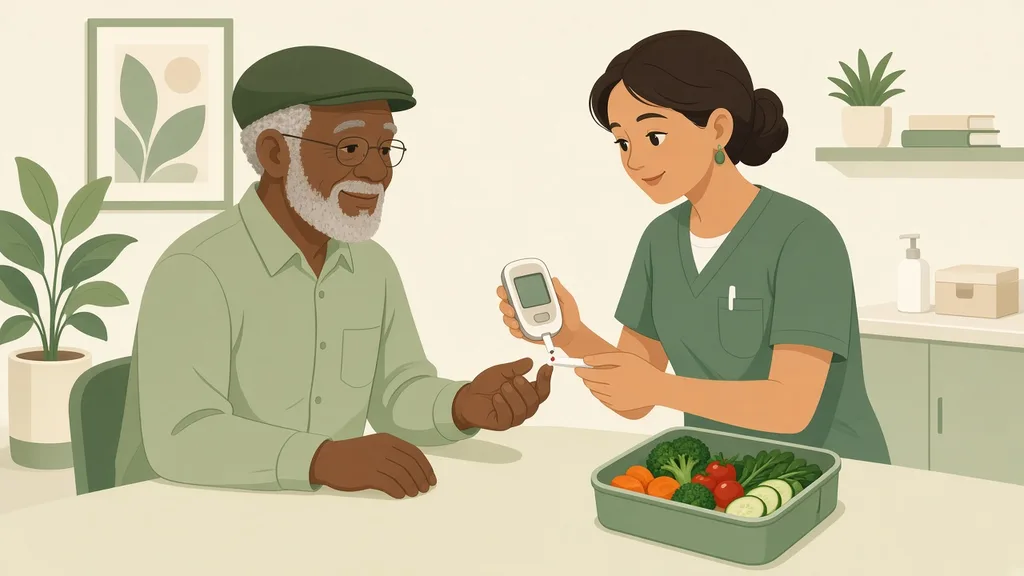
This guide uses the Jantoven (warfarin sodium) label on DailyMed and the MedlinePlus warfarin page. It covers the INR range, vitamin K foods, missed doses, tablet colors and how warfarin compares with newer pills. If you care for a parent on warfarin, take a closer look at the interactions section.
What warfarin does
Warfarin is a vitamin K antagonist. It lowers the liver's ability to make several vitamin K-dependent clotting factors, so blood takes longer to clot. Per the label, it is used to:
- prevent and treat venous thrombosis and pulmonary embolism
- prevent and treat clot complications of atrial fibrillation and heart valve replacement
- lower the risk of death, repeat heart attack and stroke after a heart attack
The label notes warfarin has no direct effect on a clot that has already formed. It stops new clots from forming or growing. See atrial fibrillation and stroke for background.

The INR: your warfarin number
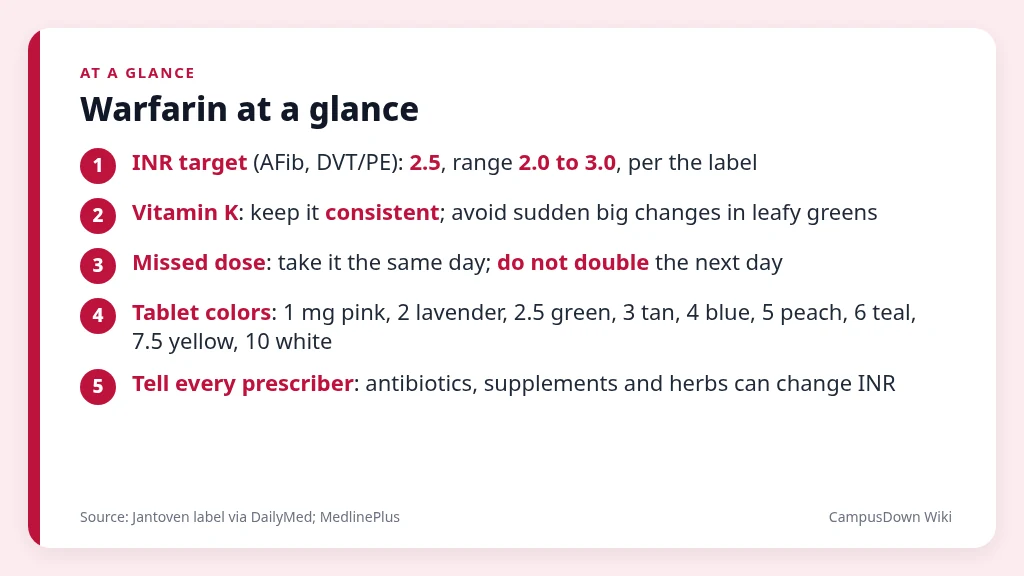
Warfarin doses are adjusted using the INR (international normalized ratio), part of the PT/INR blood test. For AFib and DVT/PE, the label lists a target INR of 2.5, with a range of 2.0 to 3.0. Some mechanical heart valves need a higher range, 2.5 to 3.5. The label adds that an INR above 4.0 appears to give no extra benefit in most people and raises bleeding risk.
MedlinePlus explains it simply: an INR that is too low means clots are still a risk, and one that is too high means bleeding is a risk. Our INR and PTT guide walks through the test.
Doses vary widely between people. The label says age, body weight, other medicines, illness and genetics (CYP2C9 and VKORC1) all affect the dose. That is why one person takes 2 mg and another takes 7.5 mg, and why you should never borrow or share tablets.
Example scenario: Thanksgiving and the INR spike
- Who
- Odell, 81, a retired postal carrier in Ohio, had taken warfarin for AFib for six years and kept a steady INR at his anticoagulation clinic.
- What happened
- In late November he finished a course of an antibiotic for a chest cold, skipped his usual spinach salads during a busy holiday week, and had two nosebleeds in two days.
- How it felt
- He felt foolish for "messing it up" after so many good years and was frightened when his grandson saw blood on his handkerchief. He worried the clinic would scold him.
- What they did
- His grandson called the anticoagulation clinic. The nurse asked about new medicines, diet changes and alcohol, and arranged a same-day fingerstick INR. The result was above his range, and the clinic adjusted his dose and scheduled a recheck.
- How it turned out
- Within a week his INR was back in range. The nurse gave him a one-page list of what to report: new antibiotics, supplements, big diet changes and sick days. Odell now calls the clinic before starting anything new, and he says the list made him feel like a partner, not a problem.
This is an illustrative example, not a real patient or a review.
Odell is an illustrative example, not a real patient. The details of any dose change belong to your own care team.
Vitamin K and food
The label says to eat a normal, balanced diet with a consistent amount of vitamin K, and to avoid drastic changes, such as suddenly eating large amounts of green leafy vegetables. MedlinePlus adds that some vegetable oils are high in vitamin K, and asks you to talk to your doctor about grapefruit. Our vitamin K guide lists common sources.
So the goal is not zero greens. It is the same amount week to week, and telling your clinic if your diet changes, for example during an illness, a new diet plan, or a trip.
Interactions that change the INR
Warfarin interacts with many medicines and supplements. The label names botanicals such as St. John's wort, ginseng, coenzyme Q10, ginkgo, garlic, echinacea and goldenseal, and grapefruit juice. Many antibiotics, antifungals and heart medicines can also change the INR. Aspirin and NSAIDs add bleeding risk.
Get help now if
Get emergency care for signs of serious bleeding: red or black stools, pink, red or dark brown urine, vomiting blood or coffee-ground material, coughing up blood, a sudden severe headache, dizziness or weakness, or bleeding that will not stop. After a fall or a hit to the head, get checked right away even if you feel fine.
Missed doses, procedures and pregnancy
The label says if you miss a dose, take it as soon as possible on the same day, and do not double the dose the next day. Before dental or surgical procedures, the label says the INR should be checked right before, and any change in dosing is a decision for your prescriber. A single dose of warfarin works for 2 to 5 days, so stopping takes days to wear off.
Warfarin is contraindicated in pregnancy except in pregnant women with mechanical heart valves at high risk of clots, because it can cause birth defects. If you could become pregnant, talk with your doctor about birth control and planning.
Coumadin, Jantoven and generic warfarin
Bristol Myers Squibb announced in April 2020 that it would stop selling brand Coumadin in the U.S. because of a manufacturing issue, not a safety finding. Warfarin is still available as Jantoven and as generic warfarin sodium. Tablets are color-coded by strength: 1 mg pink, 2 mg lavender, 2.5 mg green, 3 mg tan, 4 mg blue, 5 mg peach, 6 mg teal, 7.5 mg yellow and 10 mg white. If your tablet color changes at a refill, ask your pharmacist before taking it.
Most-asked questions about warfarin
What are the side effects of warfarin?
Bleeding is the main risk and is the subject of the label's boxed warning. The label also lists rare problems such as tissue death (necrosis) of the skin and calciphylaxis. Report unusual bruising, bleeding gums or dark urine to your doctor.
Why people ask: "warfarin side effects" is the #2 Google suggestion for "warfarin" (US autocomplete, November 2026).
What is the antidote for warfarin?
The label says warfarin's effect can be reversed by stopping it and, if needed, giving vitamin K1 by mouth or injection. In emergencies, hospitals may also use clotting factor products. This is decided by your medical team.
Why people ask: "warfarin antidote" is #3 and "warfarin reversal" is #9 for "warfarin" (US, November 2026).
What foods should I avoid on warfarin?
The label does not ban foods; it asks for a consistent amount of vitamin K and no drastic changes such as suddenly eating large amounts of leafy greens. Ask about grapefruit, alcohol and supplements.
Why people ask: "warfarin diet" is #2 and "warfarin diet restrictions" is #3 for "warfarin diet" (US, November 2026).
Warfarin vs Eliquis: what is the difference?
Warfarin needs regular INR checks and steady vitamin K intake; Eliquis does not need routine INR checks but must be taken twice daily. Warfarin is still used in situations such as mechanical heart valves. Your doctor weighs kidney function, cost and other conditions. See our Eliquis guide.
Why people ask: "warfarin vs eliquis" leads its own suggestion list, with "warfarin vs eliquis for afib" at #3 and "warfarin vs eliquis cost" at #4, and "warfarin vs heparin" is #10 for "warfarin" (US, November 2026).
What is the brand name of warfarin?
Coumadin was the best-known brand but was discontinued in the U.S. in 2020. Jantoven is a current brand, and generic warfarin sodium is widely used.
Why people ask: "warfarin brand name" is #6 and "warfarin generic name" is #5 for "warfarin" (US, November 2026).
Before your next INR check, check it for yourself: can you name every new medicine or supplement you started since the last test?
Related on CampusDown
You can learn more about heparin vs warfarin, choosing a blood thinner in older adults and Xarelto.
Frequently asked questions
- Can I drink alcohol on warfarin?
- MedlinePlus notes that alcohol can affect PT/INR results; ask your doctor how much, if any, is safe for you.
- How often is INR checked?
- Often at first, then less often once stable; your clinic sets the schedule.
- Can I check INR at home?
- Home INR meters exist and are used by some patients with a prescription; ask your clinic whether you qualify.
- Why did my tablet color change?
- Strengths have different colors; a change can mean a new dose or an error, so ask your pharmacist.
Warfarin is old, inexpensive and still useful, and it works best with steady habits and a clinic that hears from you early. Learn more about your own INR goal from your doctor or pharmacist, and never change your dose on your own.
Browse more guides like this in the Medicines hub.
This article is for general education and does not replace advice from your own doctor, nurse or pharmacist.